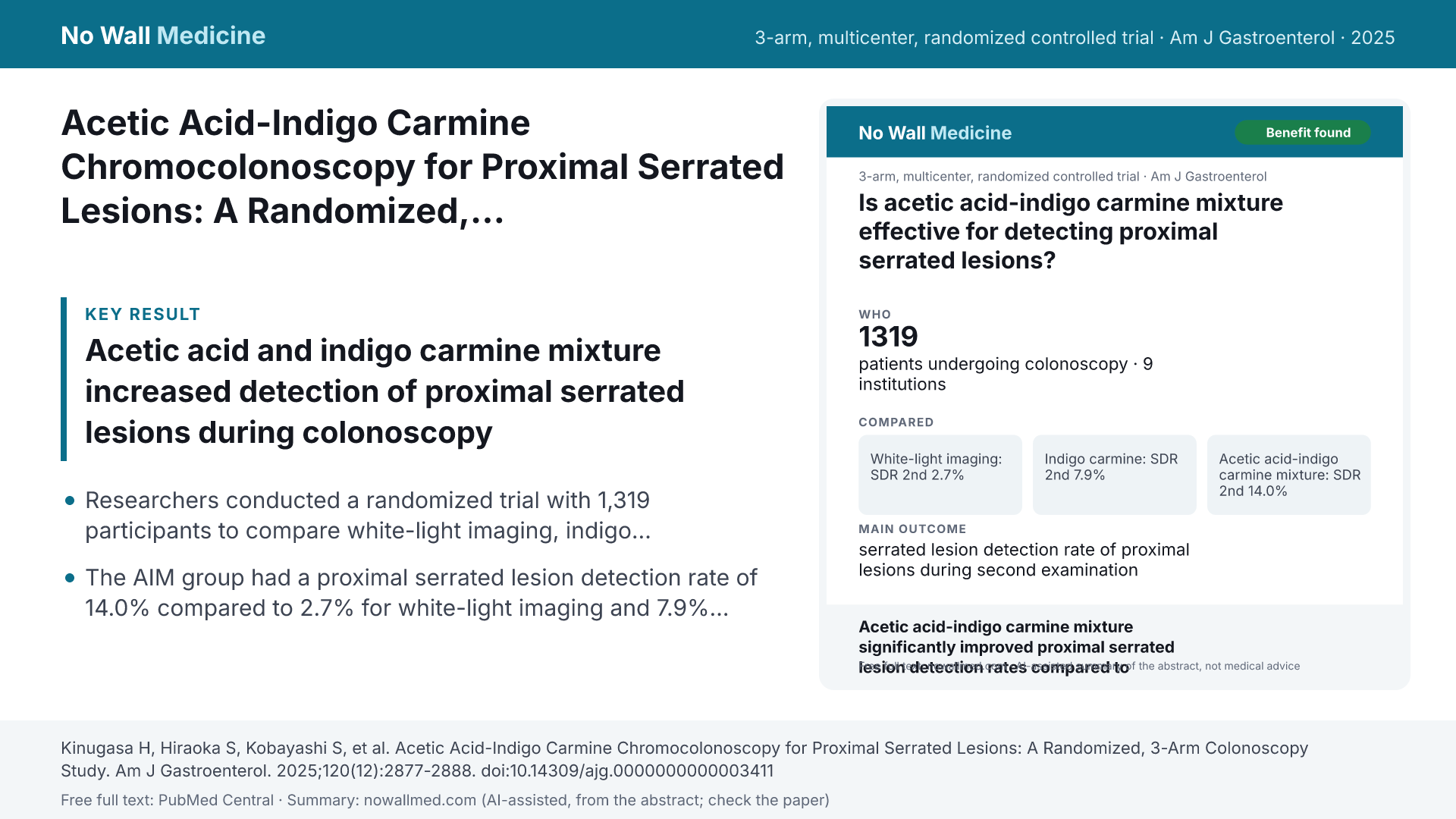
Acetic acid and indigo carmine mixture increased detection of proximal serrated lesions during colonoscopy
Acetic Acid-Indigo Carmine Chromocolonoscopy for Proximal Serrated Lesions: A Randomized, 3-Arm Colonoscopy Study
3-arm, multicenter, randomized controlled trialBenefit found
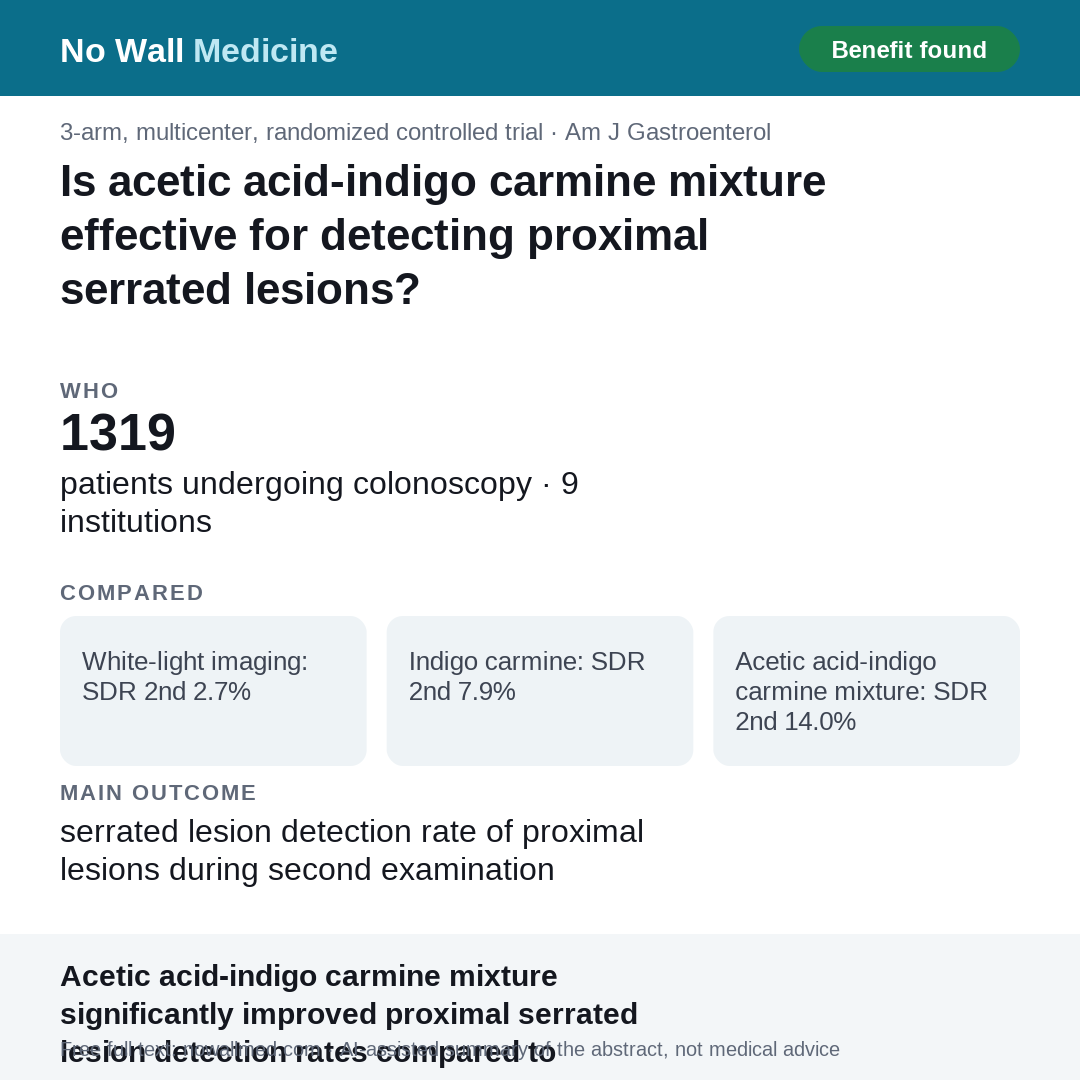
Is acetic acid-indigo carmine mixture effective for detecting proximal serrated lesions?
Who
1319
patients undergoing colonoscopy · 9 institutions
Compared
White-light imaging: SDR 2nd 2.7%
Indigo carmine: SDR 2nd 7.9%
Acetic acid-indigo carmine mixture: SDR 2nd 14.0%
Main outcome
serrated lesion detection rate of proximal lesions during second examination
Result: odds ratio 7.79 (95% confidence interval 3.76-17.08)
Bottom line: Acetic acid-indigo carmine mixture significantly improved proximal serrated lesion detection rates compared to white-light imaging or indigo carmine.
Limitation: The relationship between serrated lesion detection and colorectal cancer incidence warrants further investigation.
Am J Gastroenterol · 2025-03-13Download image
Clinical question: Is acetic acid-indigo carmine mixture effective for detecting proximal serrated lesions?
Why it matters: Evidence from randomized trials is limited regarding whether using acetic acid-indigo carmine mixtures improves the detection of serrated lesions in the proximal colon.
Key points
- Researchers conducted a randomized trial with 1,319 participants to compare white-light imaging, indigo carmine dye, and an acetic acid-indigo carmine mixture (AIM) for detecting lesions.
- The AIM group had a proximal serrated lesion detection rate of 14.0% compared to 2.7% for white-light imaging and 7.9% for indigo carmine.
- The additional rate of serrated lesion detection was 69.3% with the AIM mixture, compared to 22.4% for white-light imaging and 45.8% for indigo carmine.
Headline and key points written with AI from the paper’s abstract, with every number checked against it. Read the paper before relying on them.
Was this summary helpful?
Subject terms
Cite this article
Kinugasa H, Hiraoka S, Kobayashi S, Matsubara M, Nagahara T, Higashi R. Acetic Acid-Indigo Carmine Chromocolonoscopy for Proximal Serrated Lesions: A Randomized, 3-Arm Colonoscopy Study. Am J Gastroenterol. 2025. doi:10.14309/ajg.0000000000003411
Spotted a mistake? Suggest a correction