Specific gene alterations increased in blood samples after treatment with ribociclib and endocrine therapy
Acquired gene alterations in patients treated with ribociclib plus endocrine therapy or endocrine therapy alone using baseline and end-of-treatment circulating tumor DNA samples in the MONALEESA-2, -3, and -7 trials
Analysis of paired circulating tumor DNA samplesMixed results
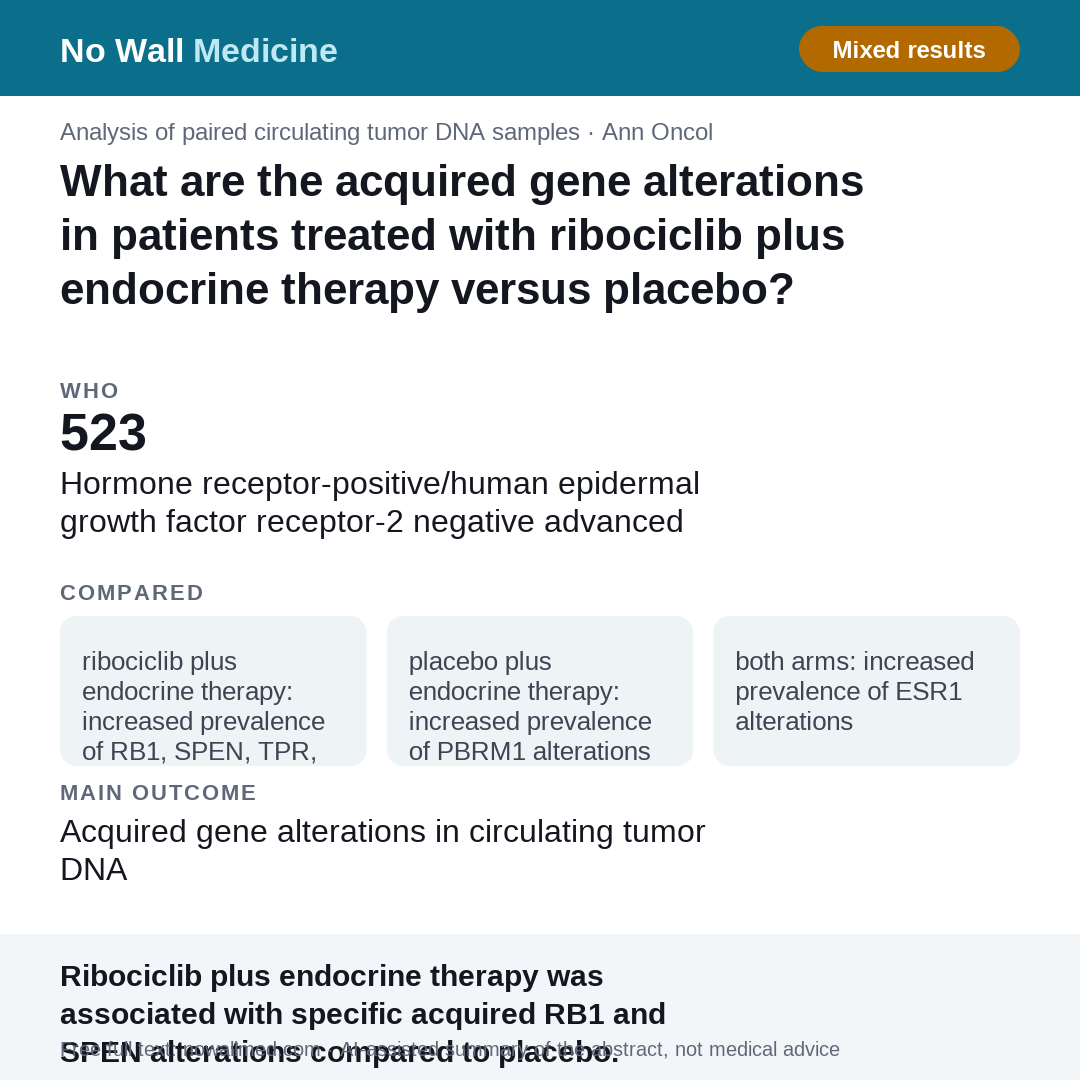
What are the acquired gene alterations in patients treated with ribociclib plus endocrine therapy versus placebo?
Who
523
Hormone receptor-positive/human epidermal growth factor receptor-2 negative advanced breast cancer patients · MONALEESA-2, -3, and -7 trials
Compared
ribociclib plus endocrine therapy: increased prevalence of RB1, SPEN, TPR, PCDH15, and FGFR2 alterations
placebo plus endocrine therapy: increased prevalence of PBRM1 alterations
both arms: increased prevalence of ESR1 alterations
Main outcome
Acquired gene alterations in circulating tumor DNA
Bottom line: Ribociclib plus endocrine therapy was associated with specific acquired RB1 and SPEN alterations compared to placebo.
Ann Oncol · 2024-09-21Download image
Clinical question: What are the acquired gene alterations in patients treated with ribociclib plus endocrine therapy versus placebo?
Why it matters: It is unknown which specific gene alterations emerge in the blood during treatment with ribociclib plus endocrine therapy compared to endocrine therapy alone.
Key points
- Researchers analyzed 523 paired baseline and end-of-treatment circulating tumor DNA samples from patients in the MONALEESA-2, -3, and -7 clinical trials.
- In the ribociclib plus endocrine therapy group, an increased prevalence of RB1 and SPEN alterations at the end of treatment was associated with the medication.
- ESR1 mutations increased at the end of treatment in both the ribociclib and placebo arms, while PIK3CA hotspot mutation prevalence remained similar.
Headline and key points written with AI from the paper’s abstract, with every number checked against it. Read the paper before relying on them.
Topics
Cite this article
André F, Solovieff N, Su F, Bardia A, Neven P, Yap YS. Acquired gene alterations in patients treated with ribociclib plus endocrine therapy or endocrine therapy alone using baseline and end-of-treatment circulating tumor DNA samples in the MONALEESA-2, -3, and -7 trials. Ann Oncol. 2024. doi:10.1016/j.annonc.2024.09.010
Spotted a mistake? Suggest a correction
Top studies every Monday
The week’s key trials and guidelines in your specialties, plus any topics you follow. By email, free.
Get the weekly digest