Patients with chronic lymphocytic leukemia acquired BTK mutations after progressing on zanubrutinib or ibrutinib
Acquired mutations in patients with relapsed/refractory CLL who progressed in the ALPINE study
Observational analysis of randomized trial dataMixed results
What mutations occur in patients with relapsed or refractory chronic lymphocytic leukemia progressing on BTK inhibitors?
Who
52
Patients with relapsed or refractory chronic lymphocytic leukemia · ALPINE study
Compared
zanubrutinib: 82.4% (11/14) at C481
ibrutinib: 82.4% (3/3) at C481
Main outcome
Acquired BTK and PLCG2 mutations at progressive disease
Bottom line: Low BTK mutation incidence suggests other mechanisms drive most early progressive disease in these patients.
Blood Adv · 2025-01-24Download image
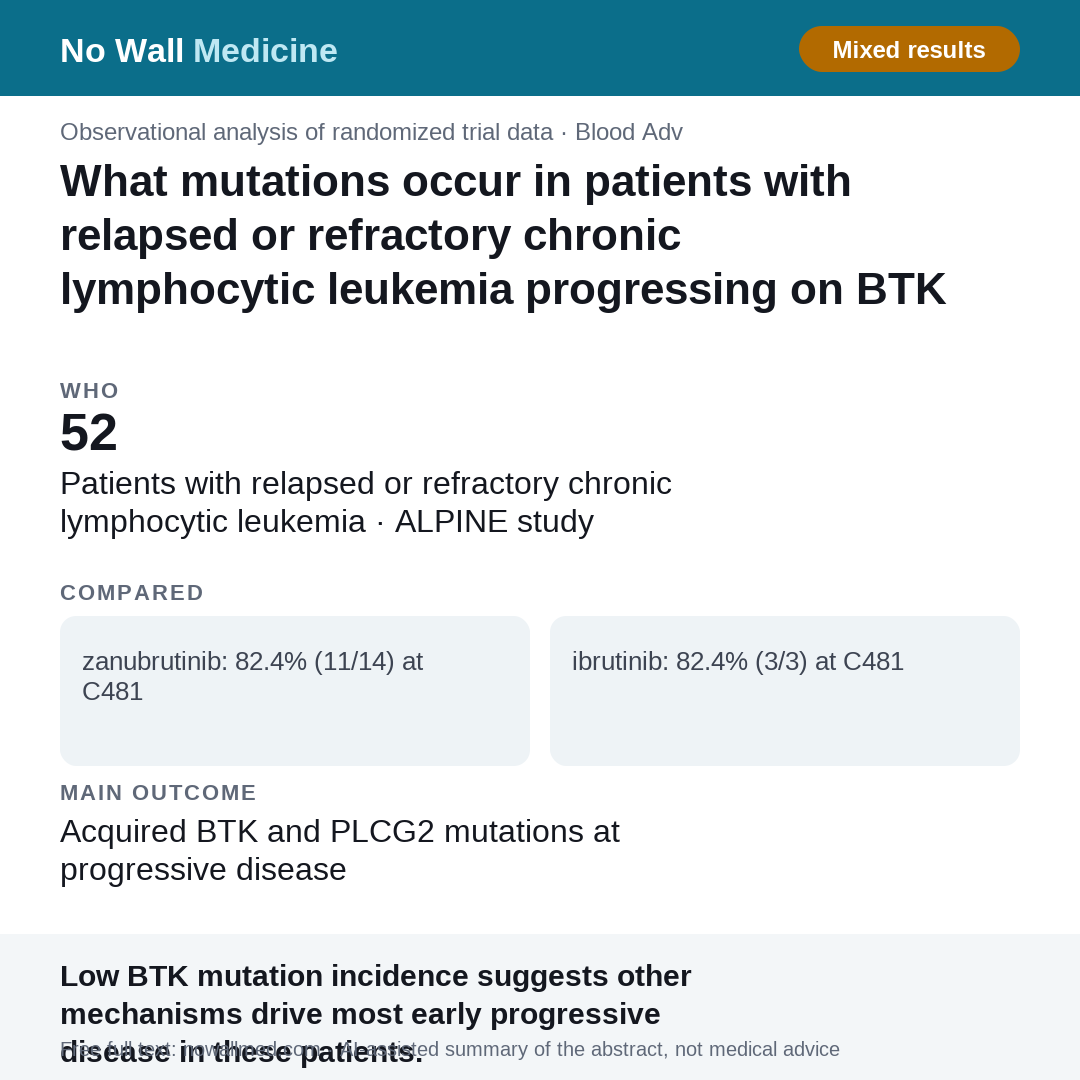
Clinical question: What mutations occur in patients with relapsed or refractory chronic lymphocytic leukemia progressing on BTK inhibitors?
Why it matters: It is unknown which specific genetic mutations drive resistance in patients with chronic lymphocytic leukemia who experience disease progression during covalent Bruton tyrosine kinase inhibitor treatment.
Key points
- Researchers analyzed 52 patients with chronic lymphocytic leukemia who progressed during treatment with either zanubrutinib or ibrutinib.
- At disease progression, 8 patients acquired 17 BTK mutations, with 82.4% of those mutations occurring at the C481 site.
- Patients with 2 or more baseline driver gene mutations were more likely to acquire BTK mutations at disease progression.
Limitation the authors note: The short treatment duration and low incidence of BTK mutations suggest other mechanisms may drive most early disease progression.
Headline and key points written with AI from the paper’s abstract, with every number checked against it. Read the paper before relying on them.
Abstract
Some patients with chronic lymphocytic leukemia who develop progressive disease (PD) during covalent Bruton tyrosine kinase (BTK) inhibitor treatment acquire resistance mutations in BTK or PLCG2. Here, we report gene mutation data from paired baseline and PD peripheral blood samples from 52 patients (zanubrutinib, n = 24; ibrutinib, n = 28) who, at an early median follow-up of 25.7 months, progressed on zanubrutinib or ibrutinib treatment in ALPINE. No BTK mutations were observed at baseline; at PD, 8 patients (zanubrutinib, n = 5; ibrutinib, n = 3) acquired 17 BTK mutations, 82.4% (zanubrutinib, n = 11/14; ibrutinib, n = 3/3) at C481. Non-C481 mutations occurred in 12.5% (3/24) of zanubrutinib-treated patients (L528W: n = 2; cancer cell fraction [CCF] = 9.58% and 17.6%; A428D: n = 1; CCF = 37.03%). At baseline, 48 of 52 patients had ≥1 driver gene mutation(s), most frequently in NOTCH1 (n = 21), TP53 (n = 19), BRAF (n = 10), SF3B1 (n = 8), and ATM (n = 8). At PD, acquired mutations occurred in 1 zanubrutinib-treated patient (TP53, XPO1) and 5 ibrutinib-treated patients (TP53, n = 1 patient; SETD2, n = 1; SF3B1, n = 1; ASXL1, n = 2). Baseline driver gene mutations were not associated with development of BTK mutations, but patients with ≥2 baseline driver gene mutations were more likely to acquire BTK mutations at PD. The short treatment duration and a low BTK mutations incidence suggests that mechanisms other than BTK/PLCG2 mutations drive most early PD. This trial was registered at www.ClinicalTrials.gov as #NCT03734016.
Abstract reproduced under the article’s CC BY NC ND licence.
Topics
Cite this article
Brown JR, Li J, Eichhorst BF, Lamanna N, O'Brien SM, Tam CS. Acquired mutations in patients with relapsed/refractory CLL who progressed in the ALPINE study. Blood Adv. 2025. doi:10.1182/bloodadvances.2024014206
Spotted a mistake? Suggest a correction
Top studies every Monday
The week’s key trials and guidelines in your specialties, plus any topics you follow. By email, free.
Get the weekly digest