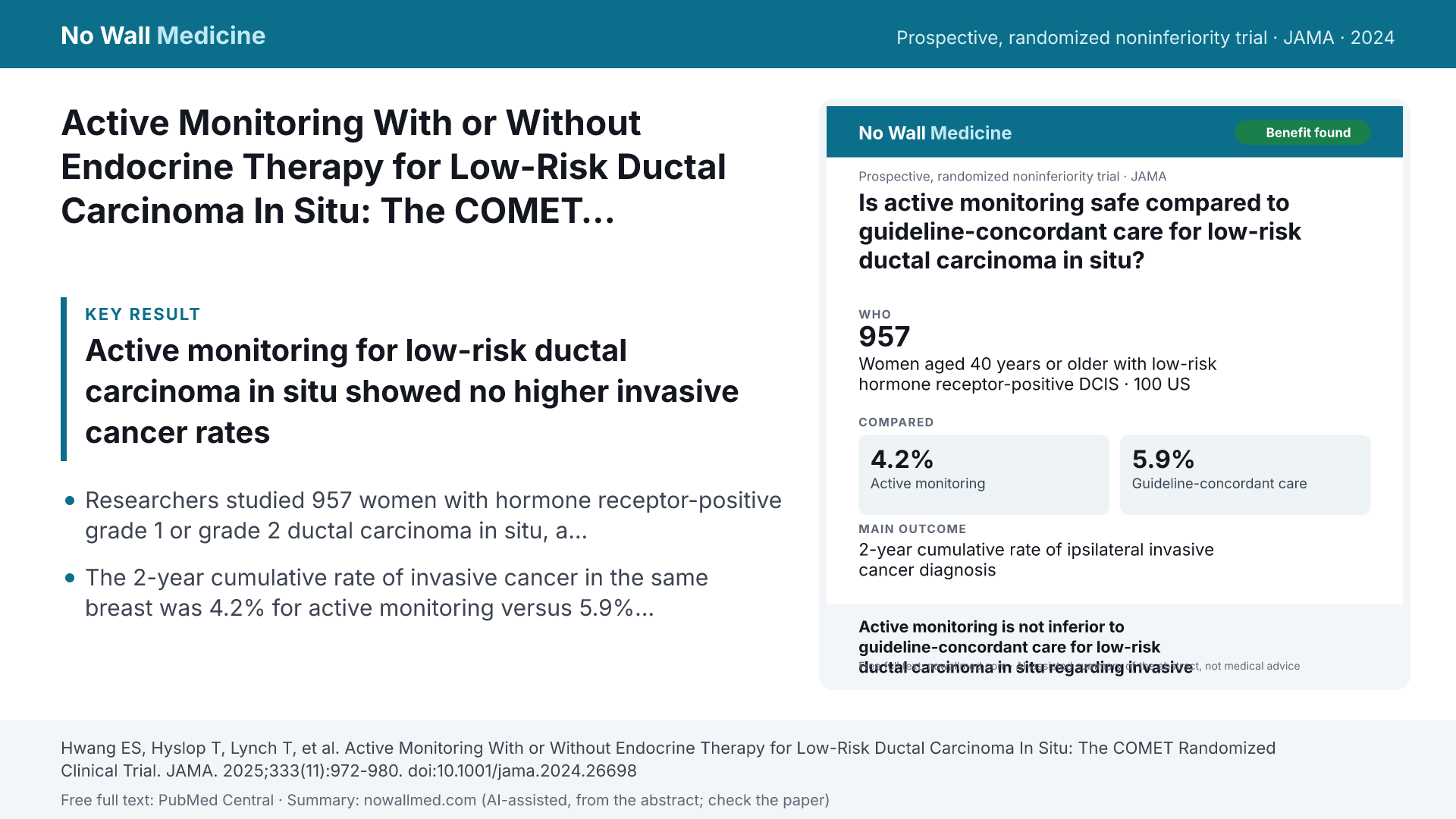
Active monitoring for low-risk ductal carcinoma in situ showed no higher invasive cancer rates
Active Monitoring With or Without Endocrine Therapy for Low-Risk Ductal Carcinoma In Situ: The COMET Randomized Clinical Trial
Prospective, randomized noninferiority trialBenefit found
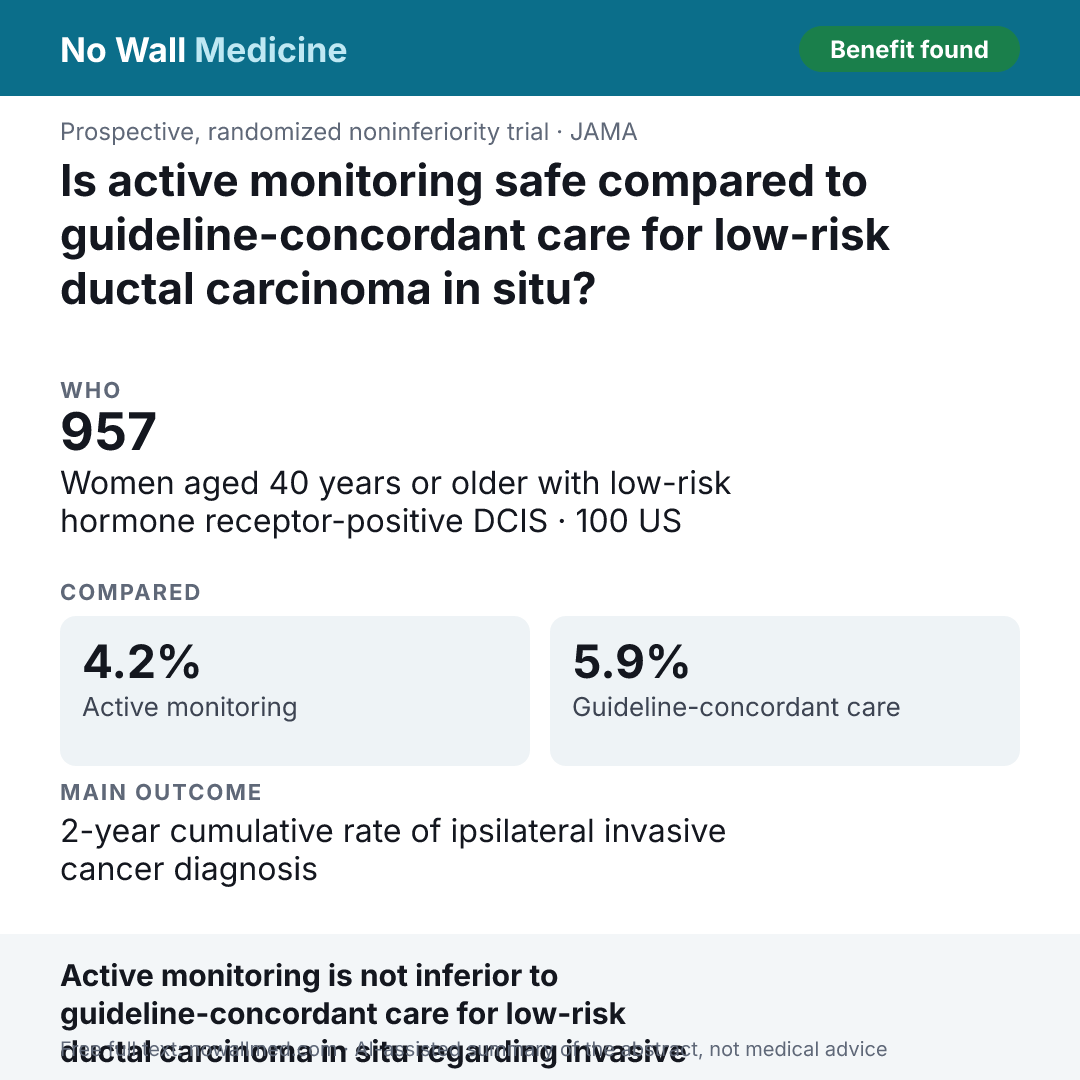
Is active monitoring safe compared to guideline-concordant care for low-risk ductal carcinoma in situ?
Who
957
Women aged 40 years or older with low-risk hormone receptor-positive DCIS · 100 US Alliance Cancer Cooperative Group clinical trial sites
Compared
4.2%Active monitoring
5.9%Guideline-concordant care
Main outcome
2-year cumulative rate of ipsilateral invasive cancer diagnosis
Result: difference of -1.7% (upper limit of the 95% CI, 0.95%)
Bottom line: Active monitoring is not inferior to guideline-concordant care for low-risk ductal carcinoma in situ regarding invasive cancer risk.
JAMA · 2024-12-12 · Save PNG
Same trial (NCT02926911)
Papers we list that report this registered trial, oldest first. Read a secondary analysis alongside the main results.
- Main results Benefit found
This paper JAMA 2024-12 - Secondary analysis No clear difference
Active monitoring for low-risk ductal carcinoma in situ showed similar patient outcomes to standard care JAMA Oncol 2024-12
Clinical question: Is active monitoring safe compared to guideline-concordant care for low-risk ductal carcinoma in situ?
Key points
- Researchers studied 957 women with hormone receptor-positive grade 1 or grade 2 ductal carcinoma in situ, a non-invasive breast cancer, comparing active monitoring to standard guideline-concordant care.
- The 2-year cumulative rate of invasive cancer in the same breast was 4.2% for active monitoring versus 5.9% for guideline-concordant care.
- The difference of -1.7% with an upper limit of 0.95% indicated that active monitoring was not inferior to standard care.
Headline and key points written with AI from the paper’s abstract, with every number checked against it. Read the paper before relying on them.
Was this summary helpful?
Subject terms
Headline, design, result, key points, caveat and citation as plain text.
Cite this article
Hwang ES, Hyslop T, Lynch T, et al. Active Monitoring With or Without Endocrine Therapy for Low-Risk Ductal Carcinoma In Situ: The COMET Randomized Clinical Trial. JAMA. 2025;333(11):972-980. doi:10.1001/jama.2024.26698
Spotted a mistake? Suggest a correction