Active referral and small financial incentives increased smoking abstinence in a community trial
Active referral plus a small financial incentive upon cessation services use on smoking abstinence: a community-based, cluster-randomised controlled trial
Cluster randomised controlled trialBenefit found
Does active referral plus a small financial incentive increase smoking abstinence?
Who
1093
Chinese adult smokers smoking at least 1 cigarette per day · 70 community sites in Hong Kong, China
Compared
Intervention group: 8.4% at 3 months and 7.5% at 6 months
Control group: 4.5% at 3 months and 4.5% at 6 months
Main outcome
Biochemically validated abstinence at 3 and 6 months
Result: risk ratio 1.88 (95% CI 1.01-3.51) at 3 months; RR 1.72 (95% CI 1.01-2.93) at 6 months
Bottom line: Active referral plus a small monetary incentive effectively increased smoking abstinence in community smokers.
Funded by: Hong Kong Council on Smoking and Health
Lancet Reg Health West Pac · 2021-07-05 · Save PNG
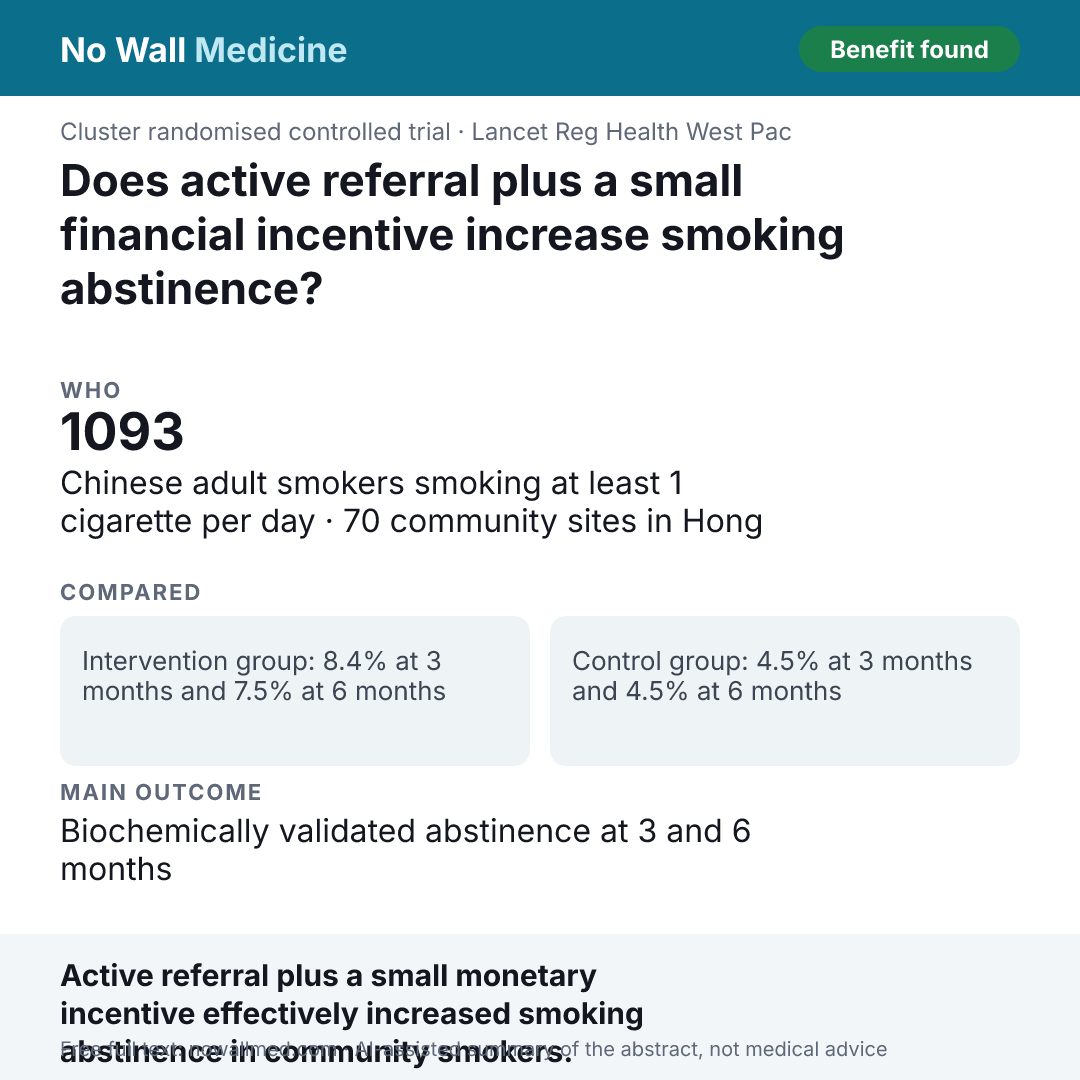
Clinical question: Does active referral plus a small financial incentive increase smoking abstinence?
Why it matters: Many smokers do not use existing free or low-cost smoking cessation services, and cost-effective ways to increase service use are needed.
Key points
- Researchers studied 1093 adult smokers in Hong Kong who were assigned to receive either active referral with a HK$300 incentive or general brief cessation advice.
- The intervention group had higher rates of biochemically validated abstinence at 3 months (8.4% vs. 4.5%) and 6 months (7.5% vs. 4.5%).
- The average cost per validated abstinence was US$ 421 in the intervention group compared to US$ 548 in the control group.
Headline and key points written with AI from the paper’s abstract, with every number checked against it. Read the paper before relying on them.
Was this summary helpful?
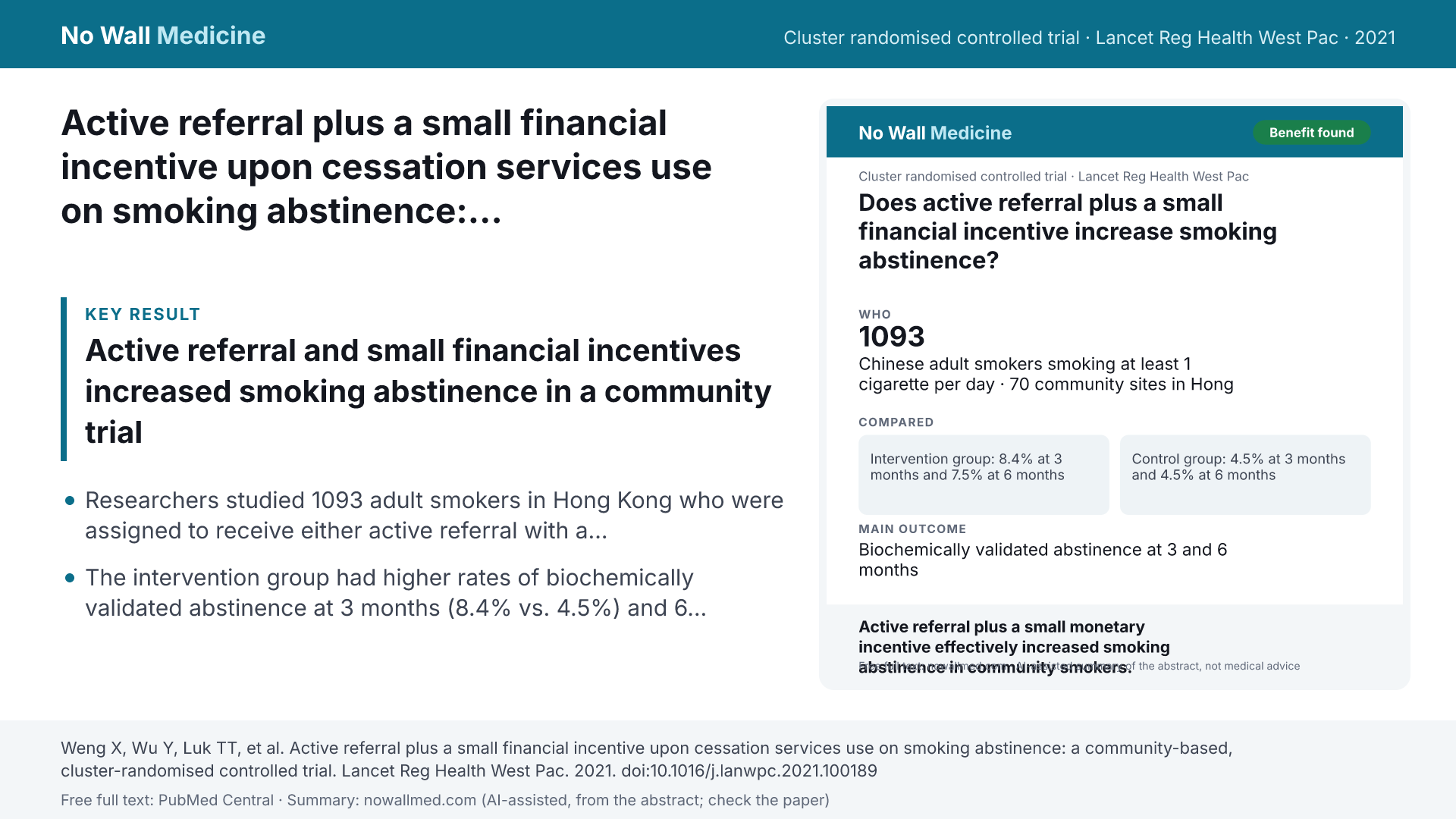
Headline, design, result, key points, caveat and citation as plain text.
Cite this article
Weng X, Wu Y, Luk TT, et al. Active referral plus a small financial incentive upon cessation services use on smoking abstinence: a community-based, cluster-randomised controlled trial. Lancet Reg Health West Pac. 2021. doi:10.1016/j.lanwpc.2021.100189
Spotted a mistake? Suggest a correction