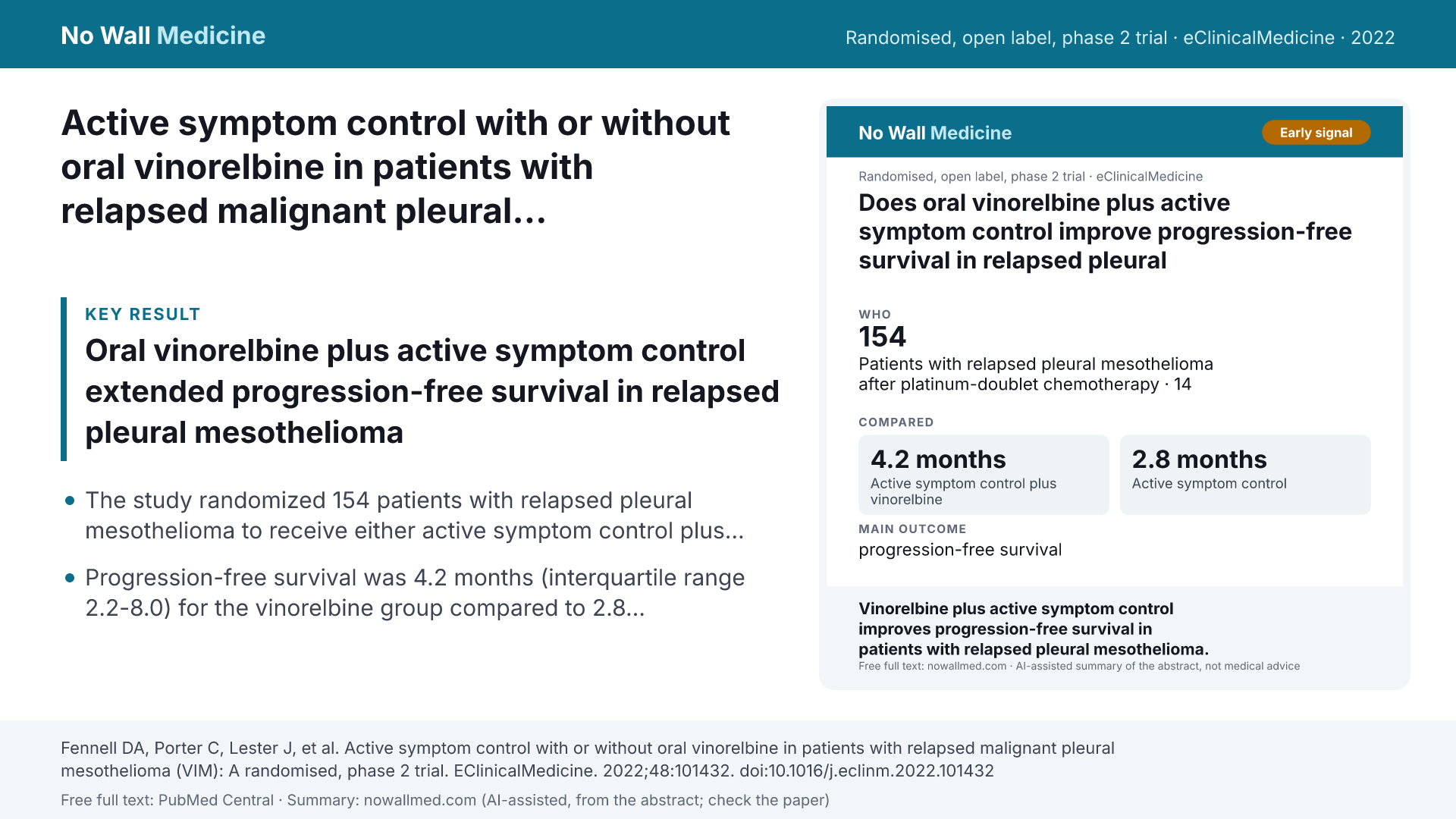
Active symptom control with or without oral vinorelbine in patients with relapsed malignant pleural mesothelioma (VIM): A randomised, phase 2 trial
Key result: Oral vinorelbine plus active symptom control extended progression-free survival in relapsed pleural mesothelioma
Key points
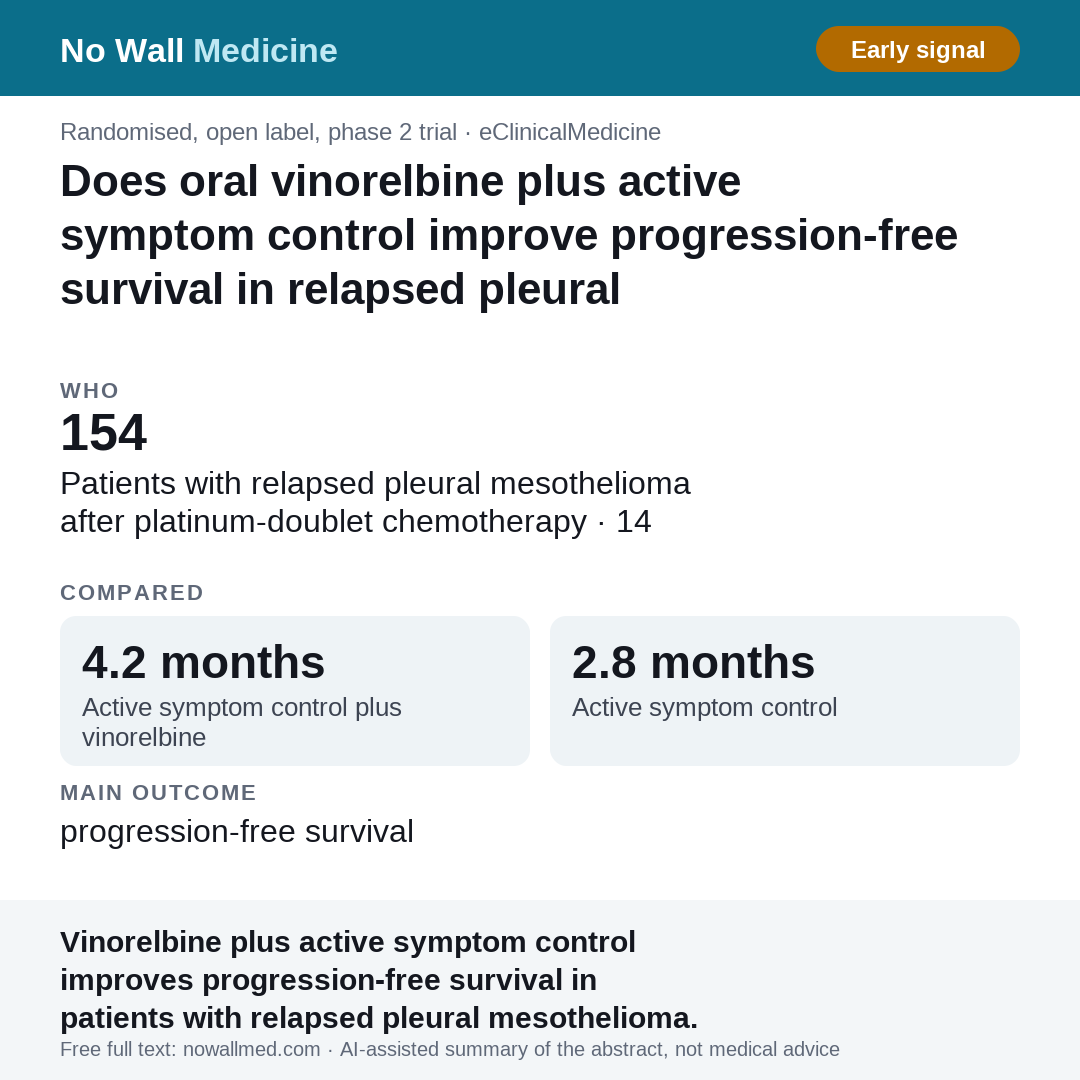
- The study randomized 154 patients with relapsed pleural mesothelioma to receive either active symptom control plus oral vinorelbine or active symptom control alone.
- Progression-free survival was 4.2 months (interquartile range 2.2-8.0) for the vinorelbine group compared to 2.8 months (interquartile range 1.4-4.1) for the symptom control group.
- Neutropenia, a low level of white blood cells, was the most common grade 3 or 4 adverse event in the vinorelbine group.
Why it matters: There is currently no US Food and Drug Administration approved therapy for patients with pleural mesothelioma who have relapsed after platinum-doublet based chemotherapy.
Discussion prompts
- Would these patients look like yours? Who was left out?
- Is the main outcome one that matters to patients?
- Is the difference large enough to change what you do?
Cite: Fennell DA, Porter C, Lester J, et al. Active symptom control with or without oral vinorelbine in patients with relapsed malignant pleural mesothelioma (VIM): A randomised, phase 2 trial. eClinicalMedicine. 2022. doi:10.1016/j.eclinm.2022.101432
Free full text: PubMed Central · Summary and visual abstract: nowallmed.com/a/active-symptom-control-with-or-without-oral-vinorelbine-in-patients-1bhl5s/ (AI-assisted from the abstract; check the paper before relying on it).