Low-load blood flow restriction exercise reduces breathing demand and shortness of breath in COPD patients
Acute cardiorespiratory responses to low-load blood-flow restriction vs high-load resistance exercise in COPD: a randomised crossover trial
Randomised crossover trialBenefit found
How do low-load blood-flow restriction and high-load resistance exercise affect cardiorespiratory responses in COPD?
Who
24
Patients with moderate to severe chronic obstructive pulmonary disease
Compared
Low-load blood-flow restriction: lower ventilation (-2.2 L/min), tidal volume (-0.08 L), oxygen uptake (-0.04 L/min), carbon dioxide output (-0.07 L/min), lower dyspnoea (RPE -0.7), higher leg effort (RPE +0.7)
High-load resistance exercise
Main outcome
Ventilation, tidal volume, oxygen uptake, carbon dioxide output, heart rate, and perceived exertion
Bottom line: Low-load blood-flow restriction reduces ventilatory and metabolic demands and dyspnoea compared to high-load resistance exercise in COPD.
Thorax · 2026-08-26Download image
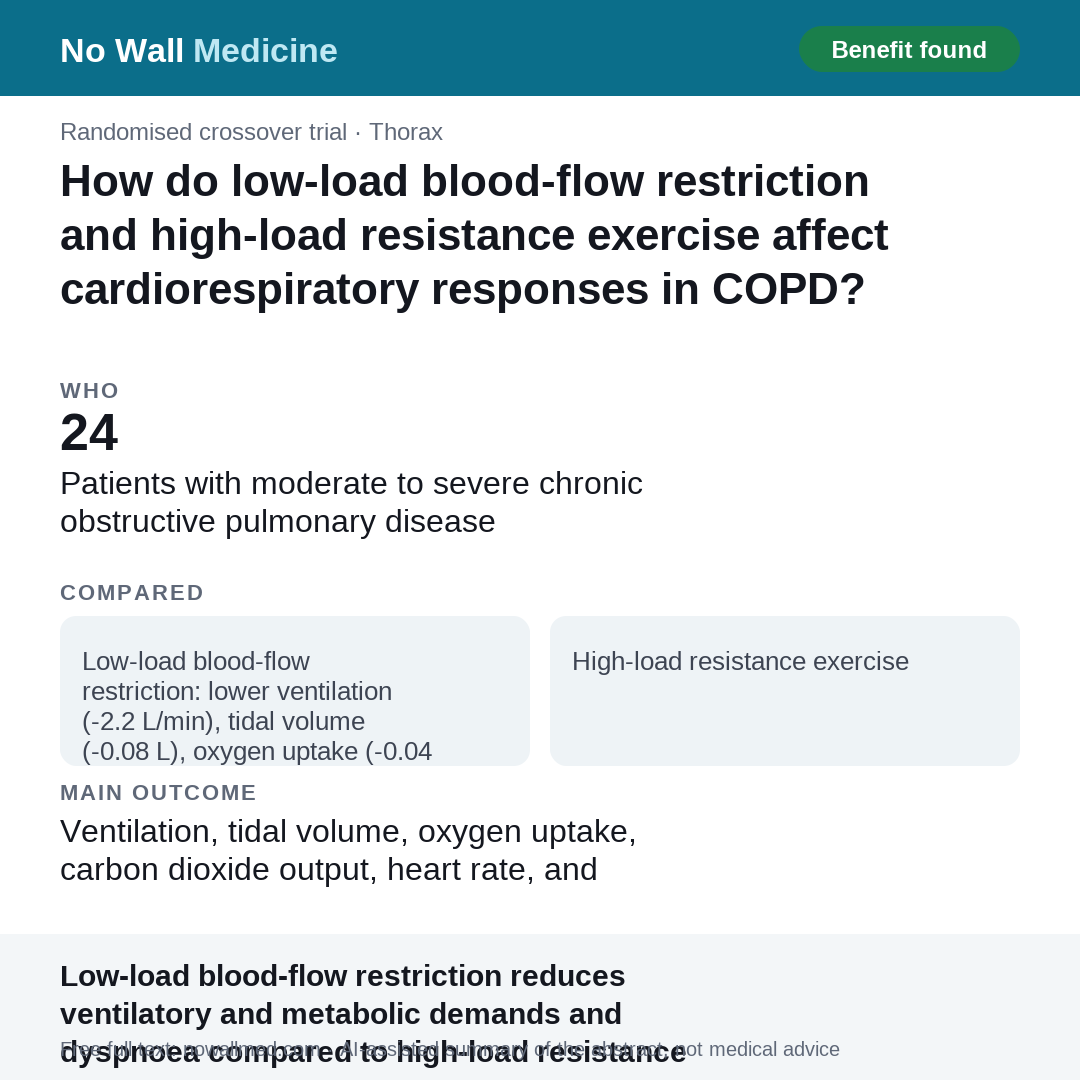
Clinical question: How do low-load blood-flow restriction and high-load resistance exercise affect cardiorespiratory responses in COPD?
Why it matters: The acute physiological and perceptual effects of low-load blood flow restriction exercise in patients with chronic obstructive pulmonary disease remain unclear.
Key points
- Researchers studied 24 patients with moderate to severe chronic obstructive pulmonary disease (COPD) comparing low-load blood flow restriction to traditional high-load resistance exercise.
- Low-load blood flow restriction resulted in lower ventilation (-2.2 L/min), tidal volume (-0.08 L), oxygen uptake (-0.04 L/min), and carbon dioxide output (-0.07 L/min) compared to high-load training.
- While shortness of breath was significantly reduced (rating of perceived exertion -0.7), perceived leg effort increased (rating of perceived exertion +0.7) during the low-load exercise.
Headline and key points written with AI from the paper’s abstract, with every number checked against it. Read the paper before relying on them.
Abstract
Introduction
Dyspnoea is a major barrier to effective pulmonary rehabilitation in patients with chronic obstructive pulmonary disease (COPD). Low-load blood flow restriction (LL-BFR) resistance exercise may reduce ventilatory demand and dyspnoea burden compared with traditional high-load resistance exercise (HL-TRA). However, its acute physiological and perceptual effects in COPD remain unclear. We compared the acute physiological and perceptual responses to LL-BFR and HL-TRA in patients with COPD. Methods
In a randomised crossover trial, 24 patients with moderate to severe COPD performed LL-BFR (30% of one-repetition maximum (1RM); four sets separated by three rest periods) and HL-TRA (70% of 1RM; three sets separated by two rest periods). Ventilation (V̇E), tidal volume (VT), oxygen uptake (V̇O₂), carbon dioxide output (V̇CO₂), heart rate and ratings of perceived exertion (RPE) were measured throughout. Linear mixed models with participant-level random intercepts were used to compare responses between conditions. Results
LL-BFR resulted in lower V̇E (-2.2 L/min), VT (-0.08 L), V̇O₂ (-0.04 L/min) and V̇CO₂ (-0.07 L/min) compared with HL-TRA. Heart rate and breathing rate were similar across both conditions. Dyspnoea was significantly reduced (RPE -0.7), while leg effort increased (RPE +0.7). LL-BFR was well tolerated, with no adverse events. Discussion
Compared with HL-TRA, LL-BFR was associated with lower ventilatory and metabolic demands and lower perceived dyspnoea despite higher perceived leg exertion. These findings suggest that LL-BFR may represent a useful resistance training strategy for patients with COPD who are primarily limited by dyspnoea during exercise. Trial registration number
NCT05163600.
Abstract reproduced under the article’s CC BY NC licence.
Cite this article
Kuhn M, Clarenbach CF, Kläy A, Kohler M, Baur DM, Senn O. Acute cardiorespiratory responses to low-load blood-flow restriction vs high-load resistance exercise in COPD: a randomised crossover trial. Thorax. 2026. doi:10.1136/thorax-2026-225047
Spotted a mistake? Suggest a correction