Acetazolamide reduces mean pulmonary artery pressure during exercise in patients with pulmonary vascular disease
Acute effect of acetazolamide on exercise haemodynamics in patients with pulmonary arterial and chronic thromboembolic pulmonary hypertension: a randomised controlled trial
Double-blind, randomised-controlled, crossover trialMixed results
What is the acute effect of acetazolamide on exercise haemodynamics in pulmonary vascular disease?
Who
24
Patients with pulmonary arterial or chronic thromboembolic pulmonary hypertension
Compared
Acetazolamide: reduced mPAP (mean difference -1.7 mmHg, 95% CI -2.9 to -0.5 mmHg)
Saline placebo
Main outcome
Pulmonary vascular resistance and its components during exercise
Result: mean difference -1.7 mmHg (95% CI -2.9 to -0.5 mmHg) for mPAP
Bottom line: Intravenous acetazolamide significantly but slightly decreased mean pulmonary artery pressure during exercise without changing cardiac output or resistance.
ERJ Open Res · 2025-05-27 · Save PNG
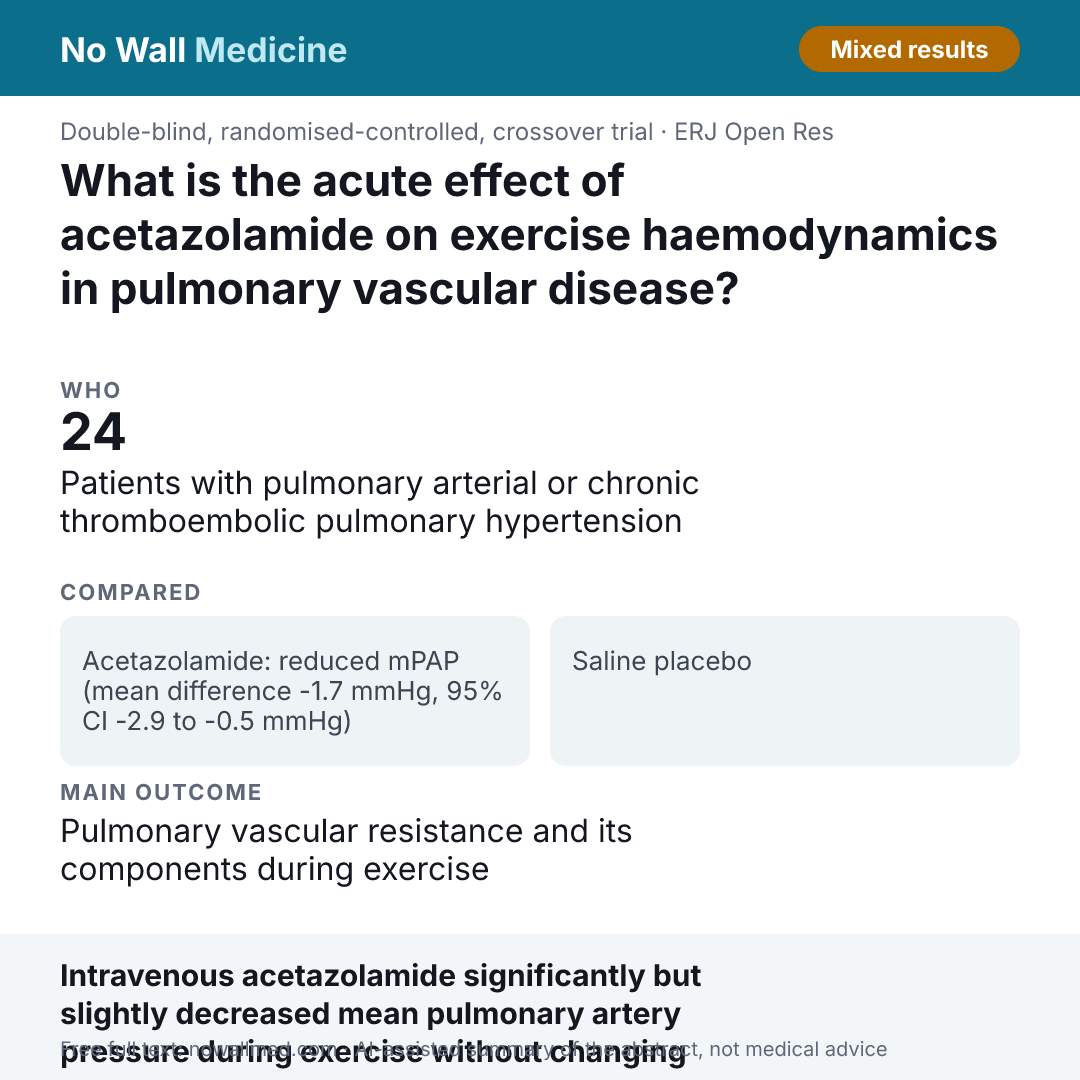
Clinical question: What is the acute effect of acetazolamide on exercise haemodynamics in pulmonary vascular disease?
Why it matters: The acute effect of acetazolamide on pulmonary hemodynamics, which refers to blood flow and pressure in the lungs, during exercise is unknown in patients with pulmonary vascular disease.
Key points
- Researchers studied 24 patients with pulmonary arterial hypertension or chronic thromboembolic pulmonary hypertension using a randomized crossover trial.
- Intravenous acetazolamide resulted in a mean difference of -1.7 mmHg in mean pulmonary artery pressure during exercise compared to a saline placebo.
- Acetazolamide was associated with no significant changes in end-exercise power, cardiac output, pulmonary vascular resistance, or pulmonary arterial wedge pressure.
Headline and key points written with AI from the paper’s abstract, with every number checked against it. Read the paper before relying on them.
Was this summary helpful?
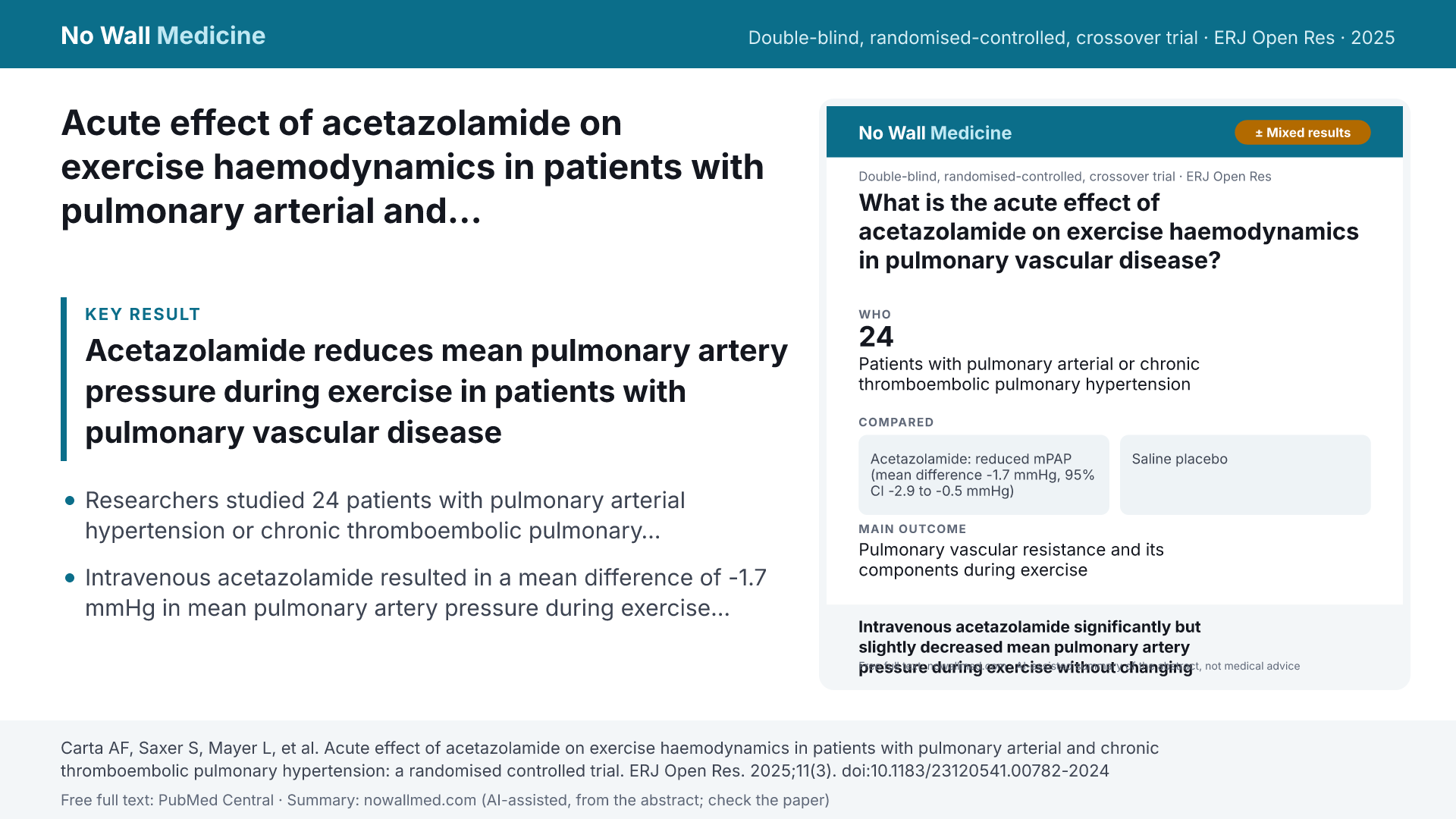
Headline, design, result, key points, caveat and citation as plain text.
Cite this article
Carta AF, Saxer S, Mayer L, et al. Acute effect of acetazolamide on exercise haemodynamics in patients with pulmonary arterial and chronic thromboembolic pulmonary hypertension: a randomised controlled trial. ERJ Open Res. 2025;11(3). doi:10.1183/23120541.00782-2024
Spotted a mistake? Suggest a correction