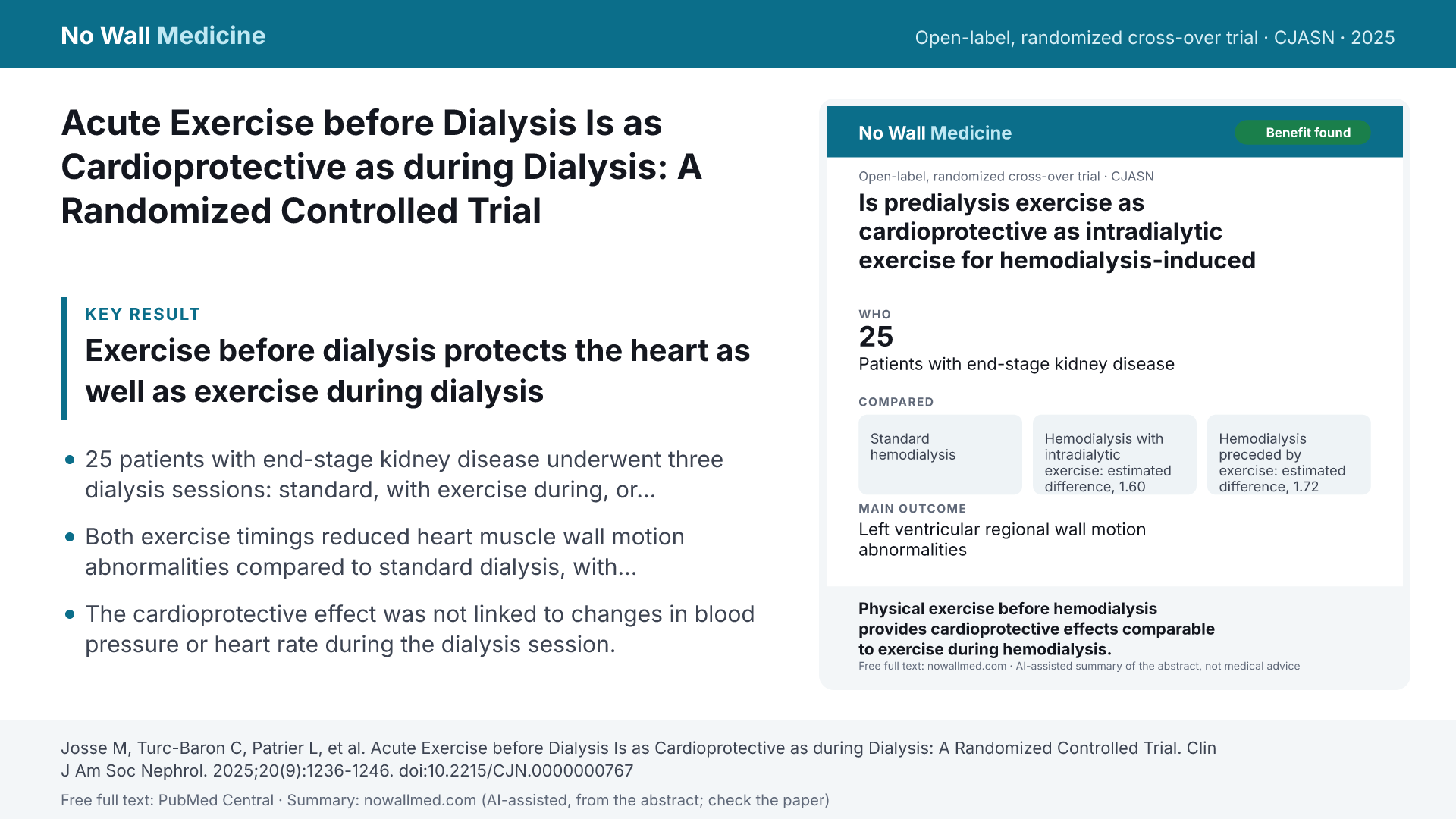
Acute Exercise before Dialysis Is as Cardioprotective as during Dialysis: A Randomized Controlled Trial
Open-label, randomized cross-over trialBenefit found
Is predialysis exercise as cardioprotective as intradialytic exercise for hemodialysis-induced myocardial stunning?
Who
25
Patients with end-stage kidney disease
Compared
Standard hemodialysis
Hemodialysis with intradialytic exercise: estimated difference, 1.60 segments (95% confidence interval, 0.09 to 3.10)
Hemodialysis preceded by exercise: estimated difference, 1.72 segments (95% confidence interval, 0.21 to 3.22)
Main outcome
Left ventricular regional wall motion abnormalities
Bottom line: Physical exercise before hemodialysis provides cardioprotective effects comparable to exercise during hemodialysis.
CJASN · 2025-08-12Download image
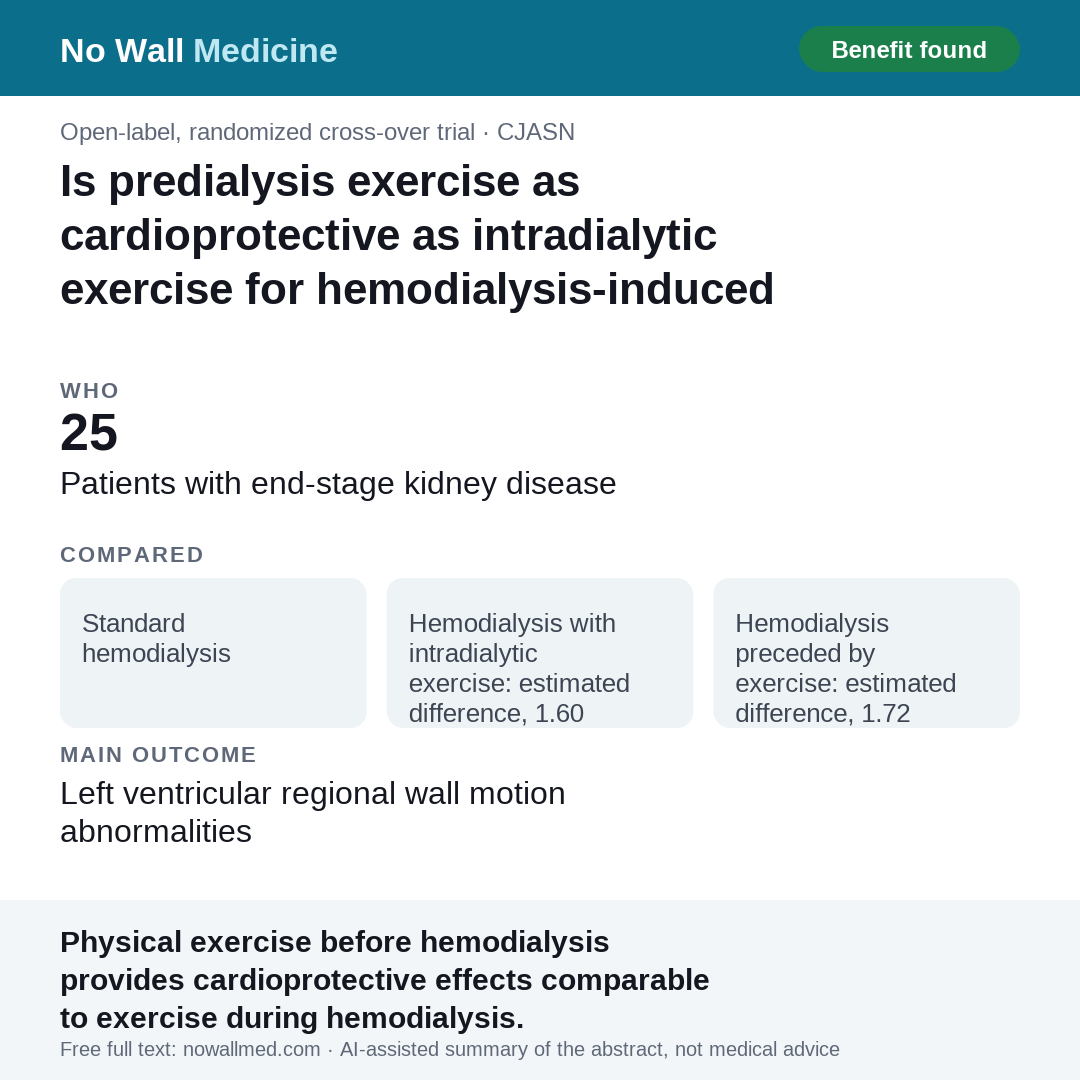
Clinical question: Is predialysis exercise as cardioprotective as intradialytic exercise for hemodialysis-induced myocardial stunning?
Abstract
Key points
Physical exercise before hemodialysis is as cardioprotective as intradialytic exercise. Predialytic exercise potentially addresses several modality-specific barriers and challenges encountered by both health care providers and patients. These are likely mediated by mechanisms inherent to exercise itself, rather than by transient central and/or systemic hemodynamic alterations. Background
Hemodialysis induces left ventricular regional wall motion abnormalities (RWMAs) due to myocardial hypoperfusion. Although acute intradialytic exercise (IDE) has shown cardioprotective effects, its routine implementation faces feasibility challenges, and the potential of predialysis exercise as an alternative remains unexplored. This study aimed to compare the effect of predialysis exercise and IDE on hemodialysis-induced myocardial stunning. Methods
In this open-label, randomized cross-over trial, 25 patients with ESKD underwent to each of three hemodialysis conditions, administrated in random order: standard hemodialysis (HD-CONT), hemodialysis with IDE (HD-PER), and hemodialysis preceded by exercise (HD-PRE). Two-dimensional echocardiography and whole blood viscosity (WBV) measurements were performed both immediately before hemodialysis onset (T0) and at peak stress of hemodialysis (Tpeak). Left ventricular longitudinal strain from an 18-segment model was used to assess the presence of RWMAs. Regular monitoring of cardiovascular hemodynamics was set up with measurements staggered every 30 minutes. Results
Compared with HD-CONT, there was a significant reduction in RWMAs during both HD-PER (estimated difference, 1.60 segments; 95% confidence interval, 0.09 to 3.10; P = 0.04) and HD-PRE (estimated difference, 1.72 segments; 95% confidence interval, 0.21 to 3.22; P = 0.02). The magnitude of the exercise-induced reduction in myocardial stunning did not differ between HD-PER and HD-PRE (P = 0.86). Apart from the exercise period itself, kinetics of all hemodynamic variables were similar between HD-CONT and HD-PER, whereas they were totally similar between HD-CONT and HD-PRE. No associations of changes in RWMAs and hemodynamics variables between HD-CONT versus HD-PRE or HD-PER were found (P > 0.42). Comparing HD-CONT versus HD-PER, WBV was preserved in HD-PER and changes in RWMAs were associated with changes in WBV at high shear rates (225 s−1: P = 0.006; 90 s−1: P = 0.04). Conclusions
Physical exercise performed before hemodialysis provides cardioprotective effects comparable with those of IDE. The mechanisms behind these benefits do not seem to involve hemodynamic factors. Clinical trial registry name and registration number:
NCT04831021.
Cite this article
Josse M, Turc-Baron C, Patrier L, Connes P, Grandperrin A, Nottin S. Acute Exercise before Dialysis Is as Cardioprotective as during Dialysis: A Randomized Controlled Trial. CJASN. 2025. doi:10.2215/CJN.0000000767
Spotted a mistake? Suggest a correction
Top studies every Monday
The week’s key trials and guidelines in your specialties, plus any topics you follow. By email, free.
Get the weekly digest