Acute Exercise Challenge and Airway Dynamics in Youth With Sickle Cell Anemia: A Multicenter Study
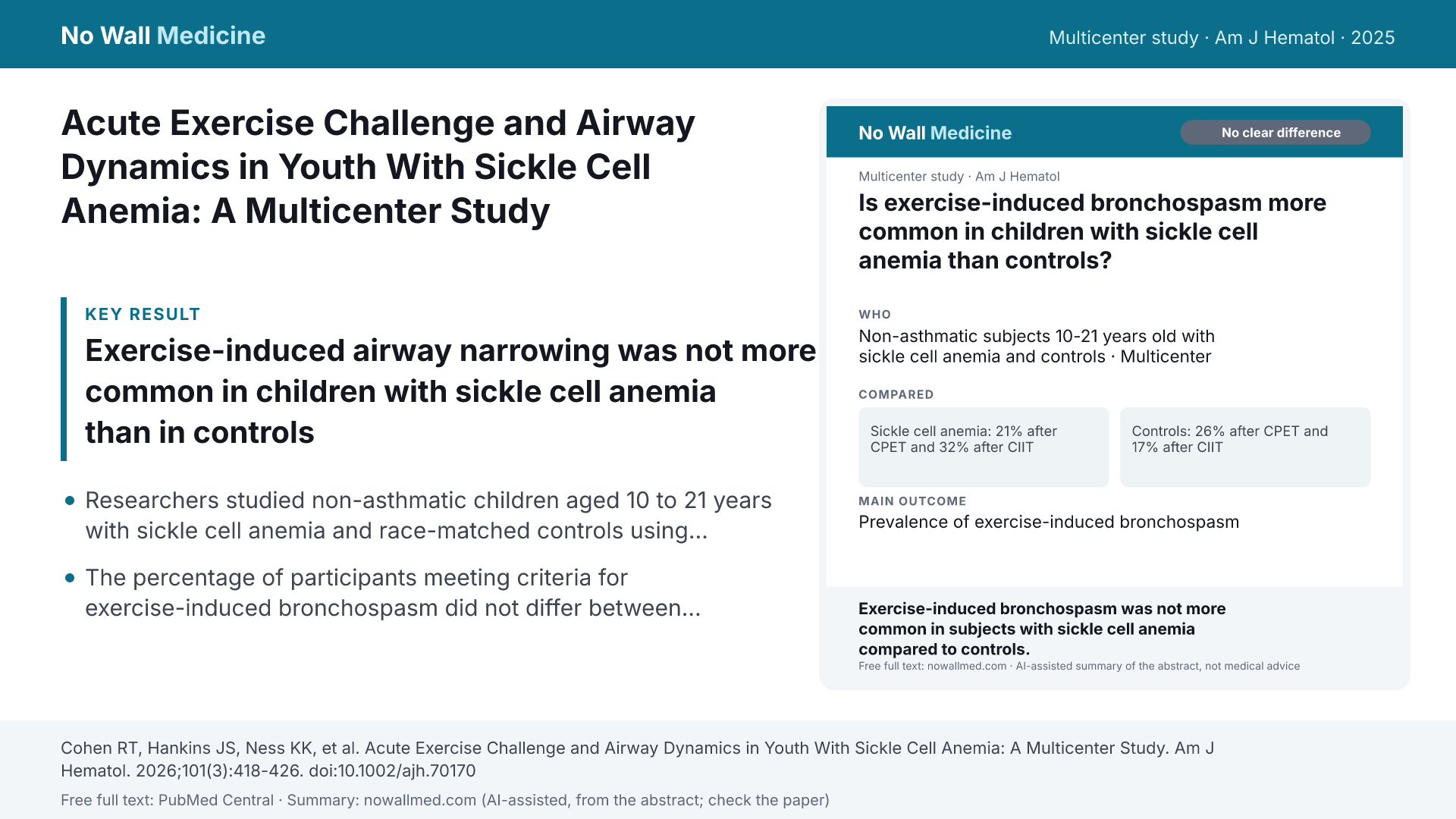
Key result: Exercise-induced airway narrowing was not more common in children with sickle cell anemia than in controls
Multicenter studyNo clear difference
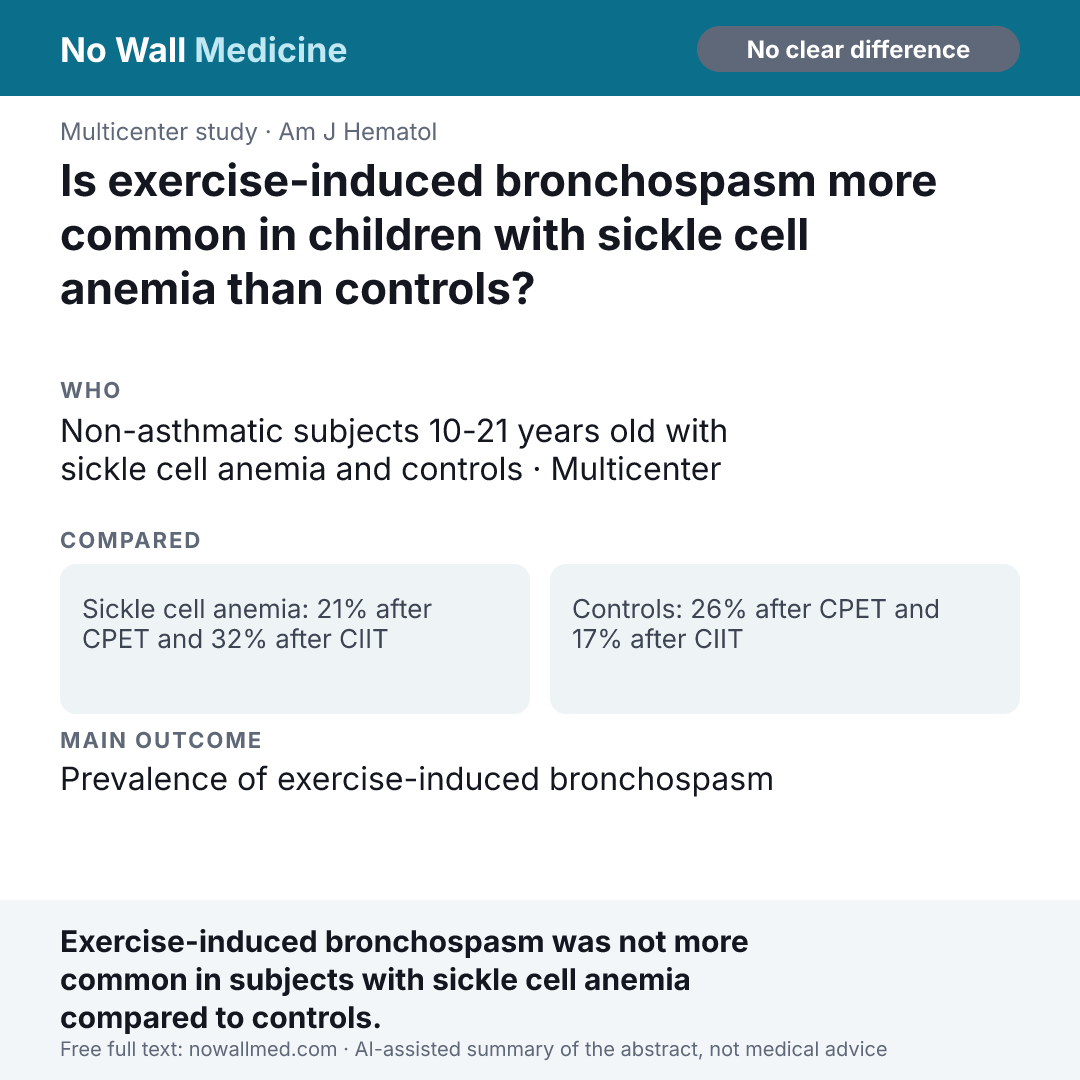
Is exercise-induced bronchospasm more common in children with sickle cell anemia than controls?
Who
Non-asthmatic subjects 10-21 years old with sickle cell anemia and controls · Multicenter
Compared
Sickle cell anemia: 21% after CPET and 32% after CIIT
Controls: 26% after CPET and 17% after CIIT
Main outcome
Prevalence of exercise-induced bronchospasm
Bottom line: Exercise-induced bronchospasm was not more common in subjects with sickle cell anemia compared to controls.
Am J Hematol · 2025-12-20 · Save PNG
Key points
- Researchers studied non-asthmatic children aged 10 to 21 years with sickle cell anemia and race-matched controls using maximal exercise testing and interval cycling.
- The percentage of participants meeting criteria for exercise-induced bronchospasm did not differ between groups after maximal exercise (21% vs 26%, p = 0.537) or interval testing (32% vs 17%, p = 0.126).
- Subjects with sickle cell anemia had lower hemoglobin, reduced baseline spirometry values, and decreased maximal workload compared to the control group.
Why it matters: The prevalence of exercise-induced bronchospasm, which is the narrowing of airways during physical activity, is understudied in children with sickle cell anemia.
Discussion prompts
- Would these patients look like yours? Who was left out?
- Is the main outcome one that matters to patients?
- Is the difference large enough to change what you do?
Cite: Cohen RT, Hankins JS, Ness KK, et al. Acute Exercise Challenge and Airway Dynamics in Youth With Sickle Cell Anemia: A Multicenter Study. Am J Hematol. 2026;101(3):418-426. doi:10.1002/ajh.70170
Free full text: PubMed Central · Summary and visual abstract: nowallmed.com/a/acute-exercise-challenge-and-airway-dynamics-in-youth-with-sickle-ez44jk/ (AI-assisted from the abstract; check the paper before relying on it).