Acute Myocardial Infarction versus Acute Decompensated Heart Failure in Cardiogenic Shock: A Systematic Review and Meta-Analysis of Clinical Phenotypes and Mortality
Systematic review and meta-analysisHarm found
How do acute myocardial infarction and acutely decompensated heart failure compare in cardiogenic shock?
Who
497,368
Patients with cardiogenic shock
Compared
Acute myocardial infarction: higher short-term mortality (OR 1.58, 1.06-2.37)
Acutely decompensated heart failure
Main outcome
short-term mortality
Result: OR 1.58 (95% CI 1.06-2.37)
Bottom line: Acute myocardial infarction cardiogenic shock has higher short-term mortality and more frequent mechanical circulatory support than heart failure cardiogenic shock.
Limitation: Phenotype-defining variables were extractable in less than 1.1% of the pooled cohort.
Eur J Heart Fail · 2026-06-09Download image
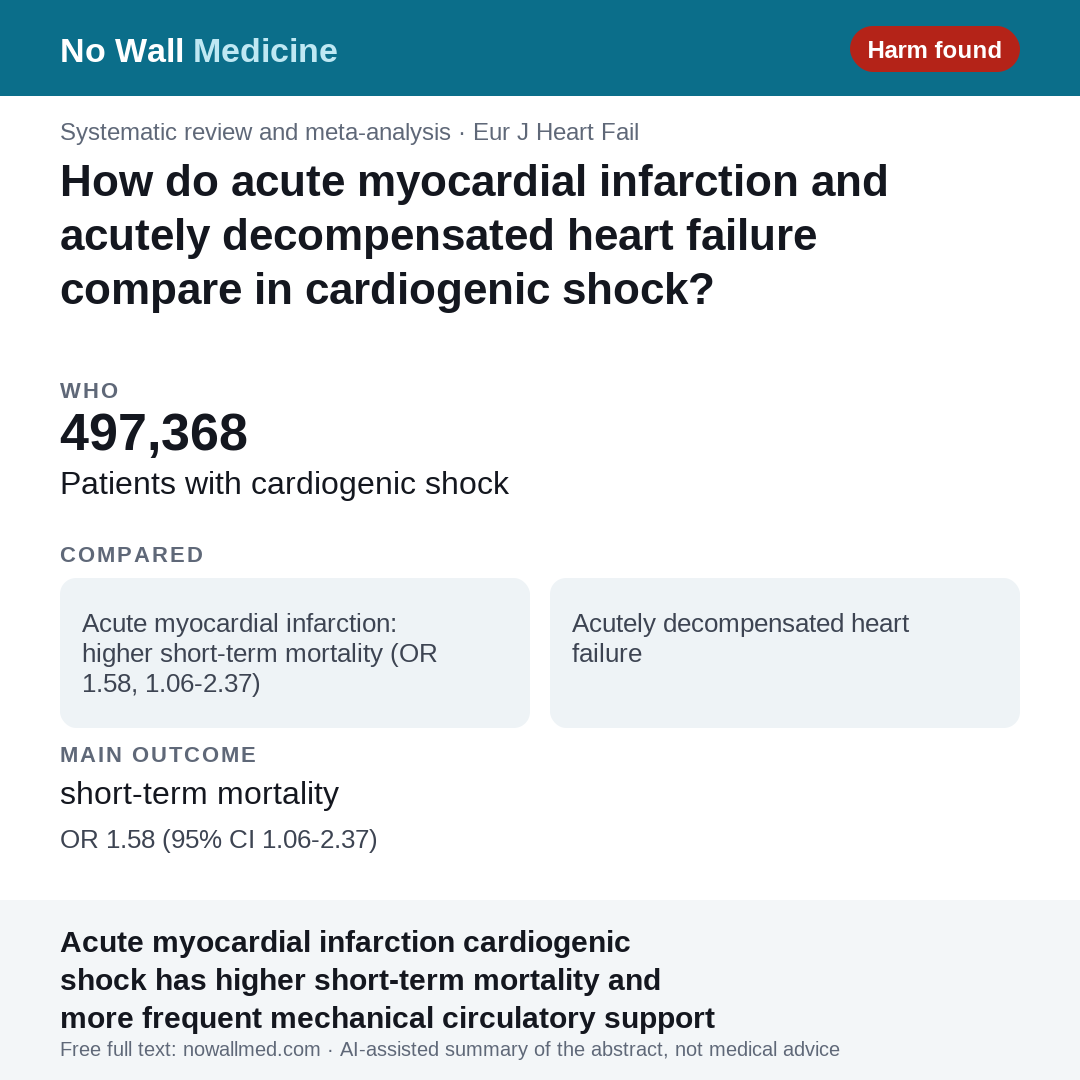
Clinical question: How do acute myocardial infarction and acutely decompensated heart failure compare in cardiogenic shock?
Abstract
Background/aim
Cardiogenic shock (CS) encompasses distinct phenotypes driven by acute myocardial infarction (AMI-CS) and acutely decompensated heart failure (ADHF-CS). Consolidated comparative evidence remains limited. This meta-analysis compared presentation, management, and short-term mortality between AMI-CS and ADHF-CS. Methods
Observational studies between 2019 and 2025 comparing AMI-CS and ADHF-CS were summarised in accordance with PRISMA 2020. Random-effects models (REML with Hartung-Knapp) were used to estimate odds ratios (ORs) and mean differences (MDs) with 95% confidence intervals. The primary outcome was short-term (in-hospital/30-day) mortality. Results
Twenty-nine studies (497,368 patients) were pooled. AMI-CS patients were older (MD 4.76 years, 95% CI 0.37-9.14) with higher ejection fraction at presentation (MD 6.04%, 4.53-7.55). AMI-CS presented more fulminantly, with greater odds of cardiac arrest (OR 2.03, 1.04-3.98) and SCAI stage D/E shock (OR 1.50, 1.33-1.70); invasive filling pressures did not differ. Phenotype-defining variables (LVEF, SCAI stage, invasive haemodynamics) were extractable in <1.1% of the pooled cohort. Temporary mechanical circulatory support was more frequent in AMI-CS (any device OR 5.44, 2.83-10.46; IABP OR 4.73; pVAD OR 2.67; VA-ECMO OR 3.27). Destination therapy was much less frequent (OR 0.09, 0.03-0.24); major bleeding was modestly higher (OR 1.36, 1.02-1.82). Short-term mortality was higher in AMI-CS (OR 1.58, 1.06-2.37). Conclusion
AMI-CS presents more fulminantly than ADHF-CS, with markedly greater mechanical support use and higher short-term mortality. A dual-axis framework integrating shock severity with aetiology is proposed as an organising principle for hypothesis generation; validation in prospective, phenotype-rich cohorts is required.
Cite this article
Yilmaz MB, Kilic ME, Biegus J, Citro R, Geavlete O, Omerovic E. Acute Myocardial Infarction versus Acute Decompensated Heart Failure in Cardiogenic Shock: A Systematic Review and Meta-Analysis of Clinical Phenotypes and Mortality. Eur J Heart Fail. 2026. doi:10.1093/ejhf/xuag186
Spotted a mistake? Suggest a correction