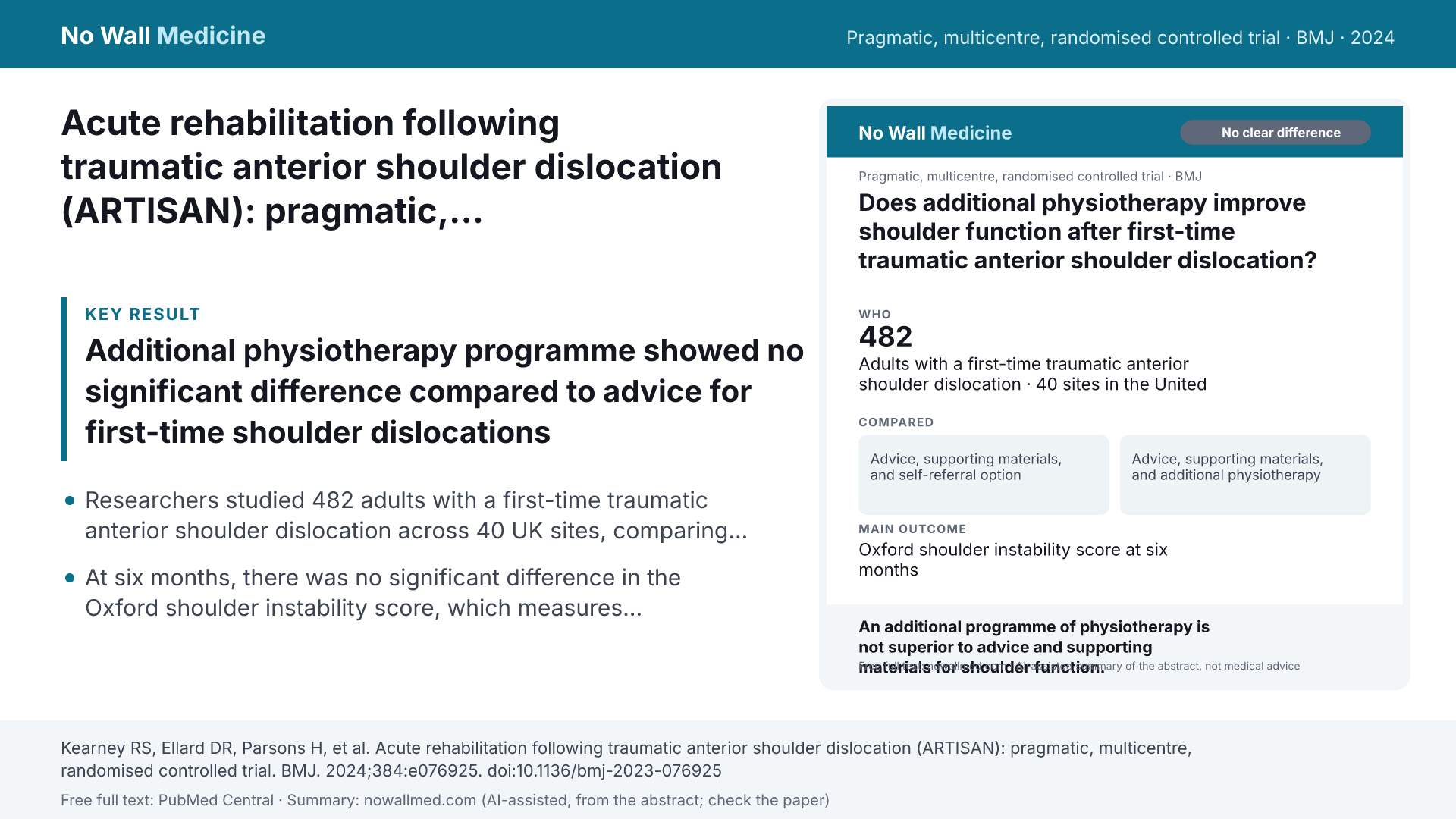
Additional physiotherapy programme showed no significant difference compared to advice for first-time shoulder dislocations
Acute rehabilitation following traumatic anterior shoulder dislocation (ARTISAN): pragmatic, multicentre, randomised controlled trial
Pragmatic, multicentre, randomised controlled trialNo clear difference
Does additional physiotherapy improve shoulder function after first-time traumatic anterior shoulder dislocation?
Who
482
Adults with a first-time traumatic anterior shoulder dislocation · 40 sites in the United Kingdom
Compared
Advice, supporting materials, and self-referral option
Advice, supporting materials, and additional physiotherapy
Main outcome
Oxford shoulder instability score at six months
Result: between group difference favouring physiotherapy 1.5 (95% confidence interval -0.3 to 3.5)
Bottom line: An additional programme of physiotherapy is not superior to advice and supporting materials for shoulder function.
BMJ · 2024-01-17Download image
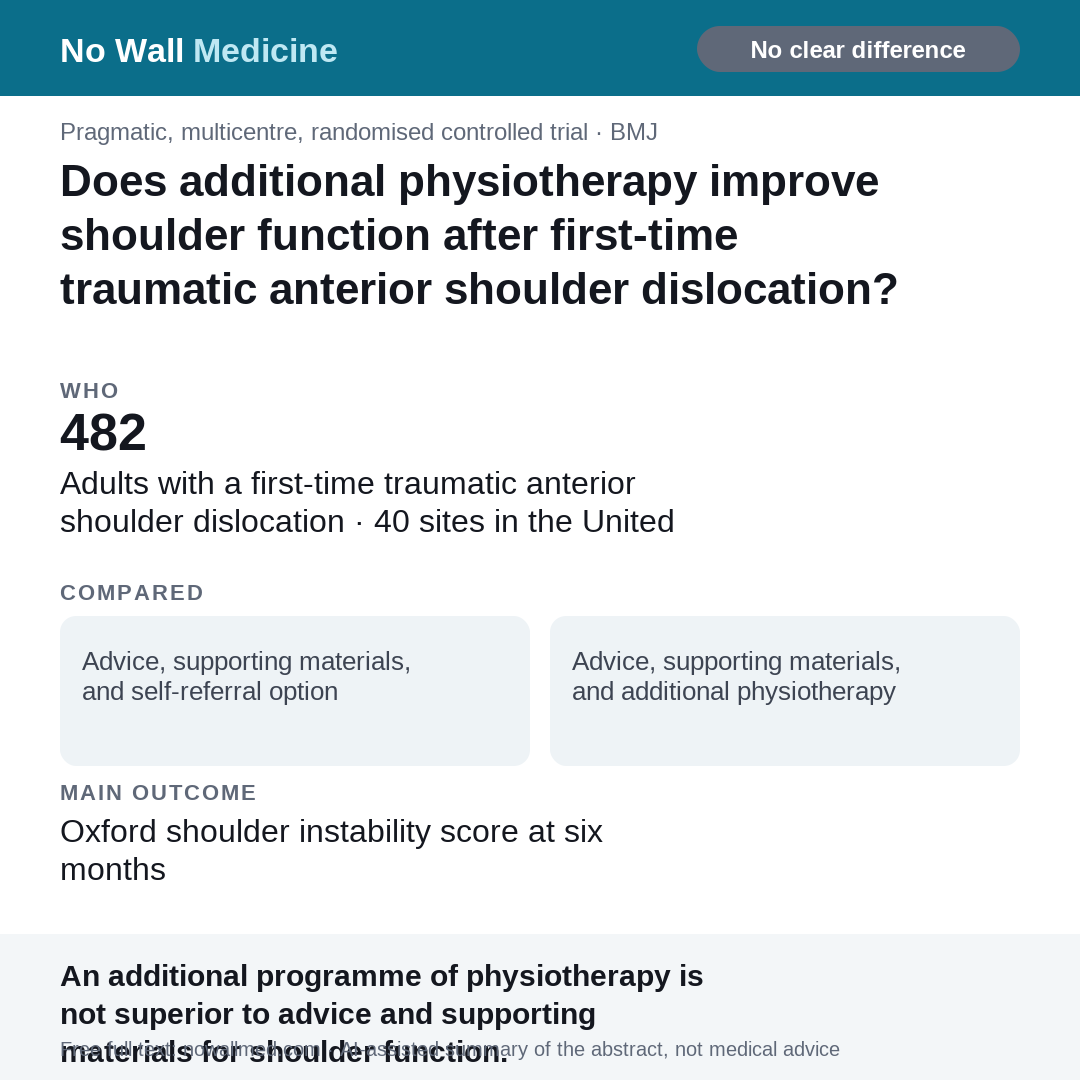
Clinical question: Does additional physiotherapy improve shoulder function after first-time traumatic anterior shoulder dislocation?
Key points
- Researchers studied 482 adults with a first-time traumatic anterior shoulder dislocation across 40 UK sites, comparing an additional physiotherapy programme to advice and self-referral options.
- At six months, there was no significant difference in the Oxford shoulder instability score, which measures shoulder function, between the two groups (difference of 1.5; 95% confidence interval -0.3 to 3.5).
- Complication profiles were similar across both the advice-only group and the group receiving additional physiotherapy.
Headline and key points written with AI from the paper’s abstract, with every number checked against it. Read the paper before relying on them.
Was this summary helpful?
Abstract
Objective
To assess the effects of an additional programme of physiotherapy in adults with a first-time traumatic shoulder dislocation compared with single session of advice, supporting materials, and option to self-refer to physiotherapy. Design
Pragmatic, multicentre, randomised controlled trial (ARTISAN). Setting and participants
Trauma research teams at 41 UK NHS Trust sites screened adults with a first time traumatic anterior shoulder dislocation confirmed radiologically, being managed non-operatively. People were excluded if they presented with both shoulders dislocated, had a neurovascular complication, or were considered for surgical management. Interventions
One session of advice, supporting materials, and option to self-refer to physiotherapy (n=240) was assessed against the same advice and supporting materials and an additional programme of physiotherapy (n=242). Analyses were on an intention-to-treat basis with secondary per protocol analyses. Main outcome measures
The primary outcome was the Oxford shoulder instability score (a single composite measure of shoulder function), measured six months after treatment allocation. Secondary outcomes included the QuickDASH, EQ-5D-5L, and complications. Results
482 participants were recruited from 40 sites in the UK. 354 (73%) participants completed the primary outcome score (n=180 allocated to advice only, n=174 allocated to advice and physiotherapy). Participants were mostly male (66%), with a mean age of 45 years. No significant difference was noted between advice compared with advice and a programme of physiotherapy at six months for the primary intention-to-treat adjusted analysis (between group difference favouring physiotherapy 1.5 (95% confidence interval -0.3 to 3.5)) or at earlier three month and six week timepoints. Complication profiles were similar across the two groups (P>0.05). Conclusions
An additional programme of current physiotherapy is not superior to advice, supporting materials, and the option to self-refer to physiotherapy. Trial registration
Current Controlled Trials ISRCTN63184243.
Abstract reproduced under the article’s CC BY licence.
Subject terms
Headline, design, result, key points, caveat and citation as plain text.
Cite this article
Kearney RS, Ellard DR, Parsons H, et al. Acute rehabilitation following traumatic anterior shoulder dislocation (ARTISAN): pragmatic, multicentre, randomised controlled trial. BMJ. 2024. doi:10.1136/bmj-2023-076925
Spotted a mistake? Suggest a correction