Blocking sympathetic nervous system activity increases insulin-mediated blood flow in people with obesity
Acute Sympathetic Blockade Improves Insulin-Mediated Microvascular Blood Flow in the Forearm of Adult Human Subjects With Obesity
Randomized crossover studyBenefit found
Does acute sympathetic blockade improve insulin-mediated microvascular blood flow in obesity?
Who
12
Adult subjects with obesity
Compared
Saline control: 0.23±0.65 arbitrary intensity units per second
Phentolamine sympathetic blockade: 2.51±3.01 arbitrary intensity units per second
Main outcome
Microvascular flow velocity
Bottom line: Sympathetic blockade improves insulin-mediated microvascular recruitment and blood flow in adults with obesity.
J Am Heart Assoc · 2024-08-09Download image
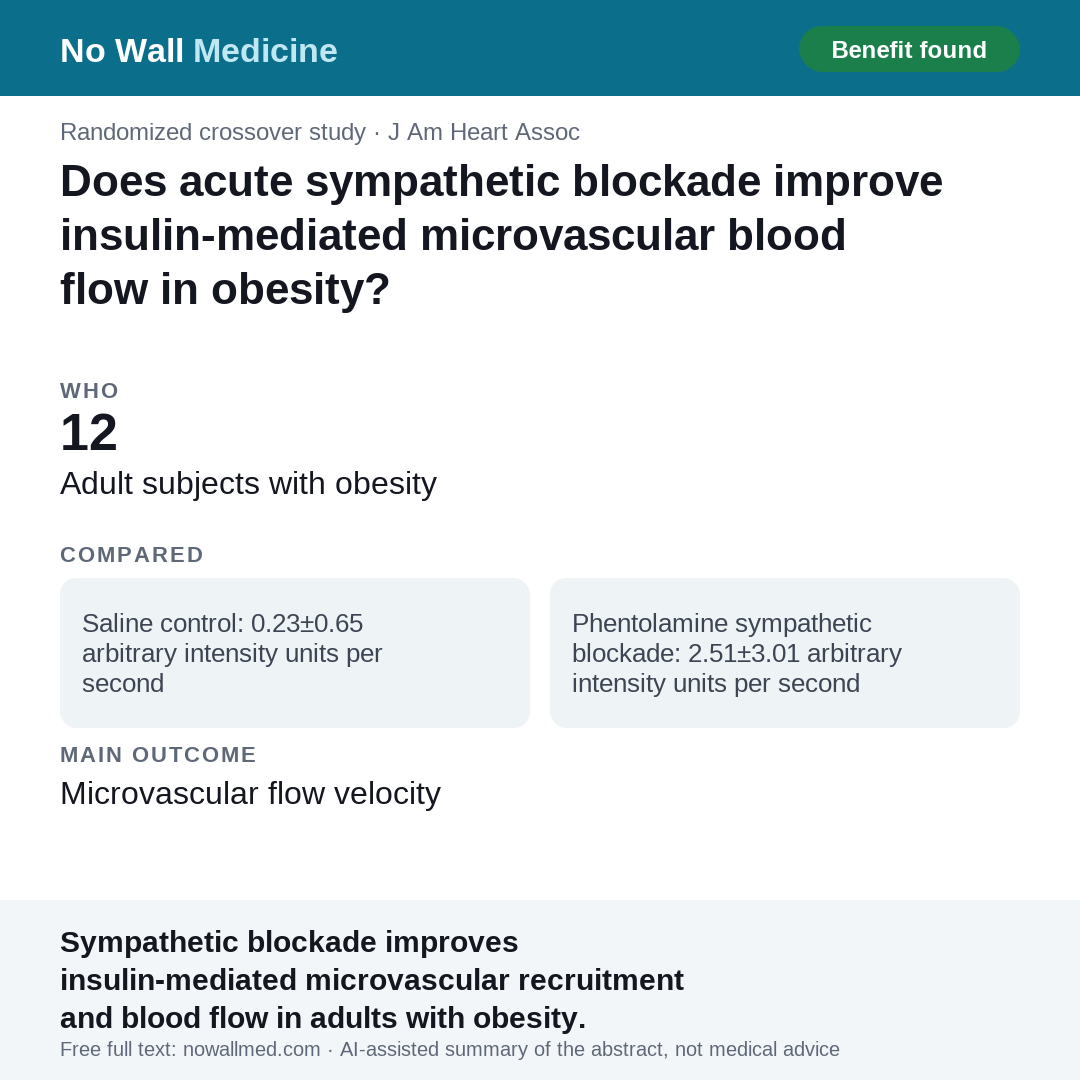
Clinical question: Does acute sympathetic blockade improve insulin-mediated microvascular blood flow in obesity?
Why it matters: It was unknown whether sympathetic nervous system activation contributes to impaired insulin-mediated blood vessel dilation and microvascular recruitment in adults with obesity.
Key points
- In a randomized crossover study of 12 adults with obesity, researchers measured forearm blood flow and microvascular recruitment during insulin infusion with or without phentolamine, a sympathetic blockade.
- Sympathetic blockade was associated with a greater increase in microvascular flow velocity (2.51±3.01 versus 0.23±0.65 arbitrary intensity units per second), blood volume, and blood flow compared to saline.
- In a separate group of 6 subjects, insulin-induced changes in microvascular flow velocity were 58% during phentolamine compared to 29% during sodium nitroprusside, a drug used for vasodilation.
Headline and key points written with AI from the paper’s abstract, with every number checked against it. Read the paper before relying on them.
Topics
Cite this article
Smith EC, Patel JN, Wahba A, Cluckey A, Celedonio J, Park J. Acute Sympathetic Blockade Improves Insulin-Mediated Microvascular Blood Flow in the Forearm of Adult Human Subjects With Obesity. J Am Heart Assoc. 2024. doi:10.1161/JAHA.123.030775
Spotted a mistake? Suggest a correction
Top studies every Monday
The week’s key trials and guidelines in your specialties, plus any topics you follow. By email, free.
Get the weekly digest