Removing disease severity markers from nutritional scores may better predict response to nutritional therapy
Adaptation of nutritional risk screening tools may better predict response to nutritional treatment: a secondary analysis of the randomized controlled trial Effect of early nutritional therapy on Frailty, Functional Outcomes, and Recovery of malnourished medical inpatients Trial (EFFORT)
Secondary analysis of a randomized controlled trialBenefit found
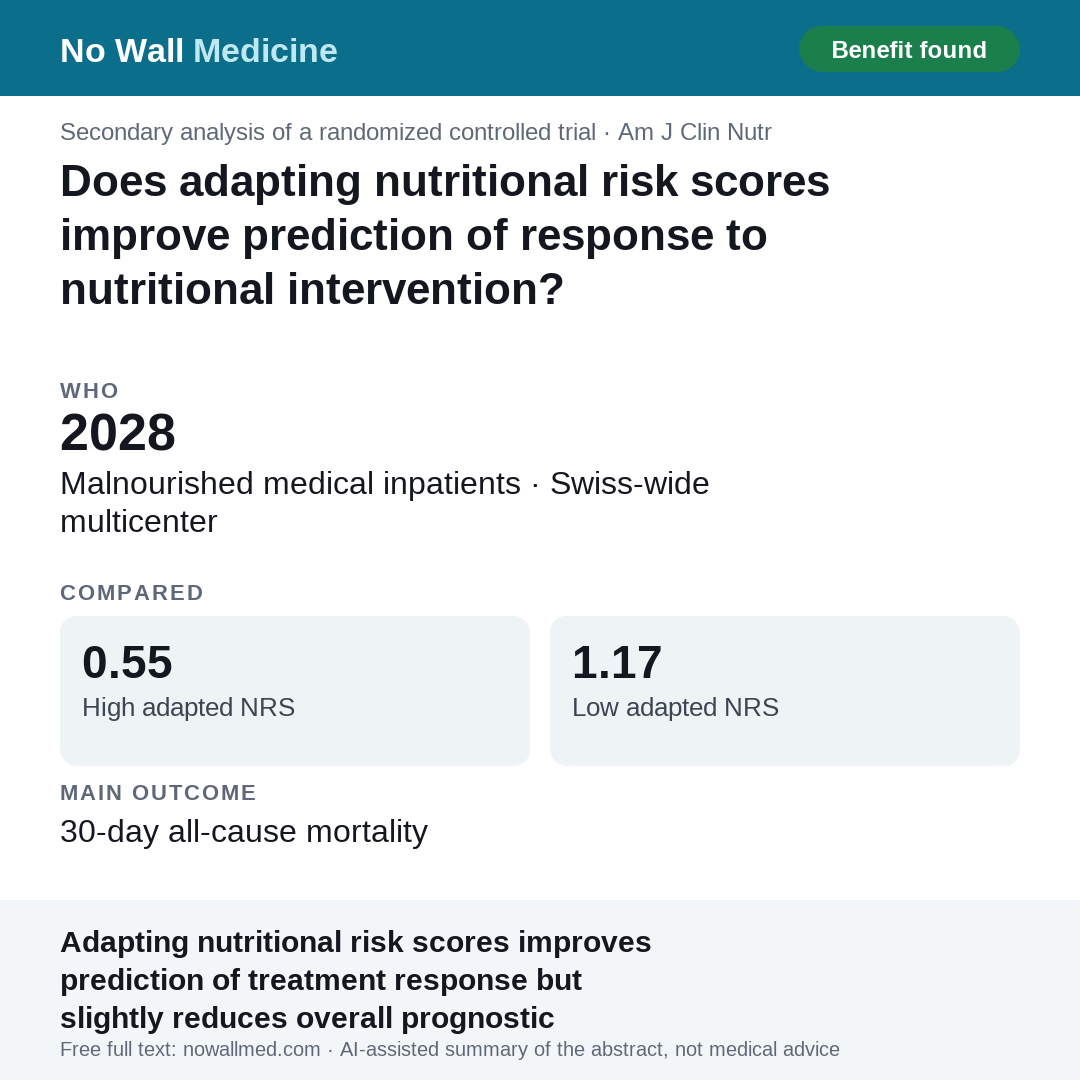
Does adapting nutritional risk scores improve prediction of response to nutritional intervention?
Who
2028
Malnourished medical inpatients · Swiss-wide multicenter
Compared
0.55High adapted NRS (95% CI: 0.37, 0.80)
1.17Low adapted NRS (95% CI: 0.70, 1.93)
Main outcome
30-day all-cause mortality
Result: interaction coefficient 0.48 (95% CI 0.25 to 0.94)
Bottom line: Adapting nutritional risk scores improves prediction of treatment response but slightly reduces overall prognostic performance for mortality.
Am J Clin Nutr · 2024-01-28Download image
Clinical question: Does adapting nutritional risk scores improve prediction of response to nutritional intervention?
Why it matters: It is unknown whether nutritional screening tools can identify which specific patients are most likely to benefit from nutritional interventions.
Key points
- Researchers reanalyzed 2028 patients from a multicenter randomized controlled trial comparing individualized nutritional support to usual care in medical inpatients.
- Patients with a high adapted Nutritional Risk Screening 2002 score showed a survival benefit with an adjusted hazard ratio of 0.55 [95% CI: 0.37, 0.80] compared to 1.17 [95% CI: 0.70, 1.93] for those with low scores.
- The original scores were slightly superior to the adapted versions at predicting mortality.
Headline and key points written with AI from the paper’s abstract, with every number checked against it. Read the paper before relying on them.
Was this summary helpful?
Subject terms
Cite this article
Wunderle C, Siegenthaler J, Seres D, Owen-Michaane M, Tribolet P, Stanga Z. Adaptation of nutritional risk screening tools may better predict response to nutritional treatment: a secondary analysis of the randomized controlled trial Effect of early nutritional therapy on Frailty, Functional Outcomes, and Recovery of malnourished medical inpatients Trial (EFFORT). Am J Clin Nutr. 2024. doi:10.1016/j.ajcnut.2024.01.013
Spotted a mistake? Suggest a correction
Top studies every Monday
The week’s key trials and guidelines in your specialties, plus any topics you follow. By email, free.
Get the weekly digest