Adaptive trial designs could have identified futility earlier in a multiple myeloma clinical trial
Adaptive designs in randomized clinical trials: reanalysis of the HOVON87/NMSG18 multiple myeloma trial
Retrospective reanalysis of a randomized trialBenefit found
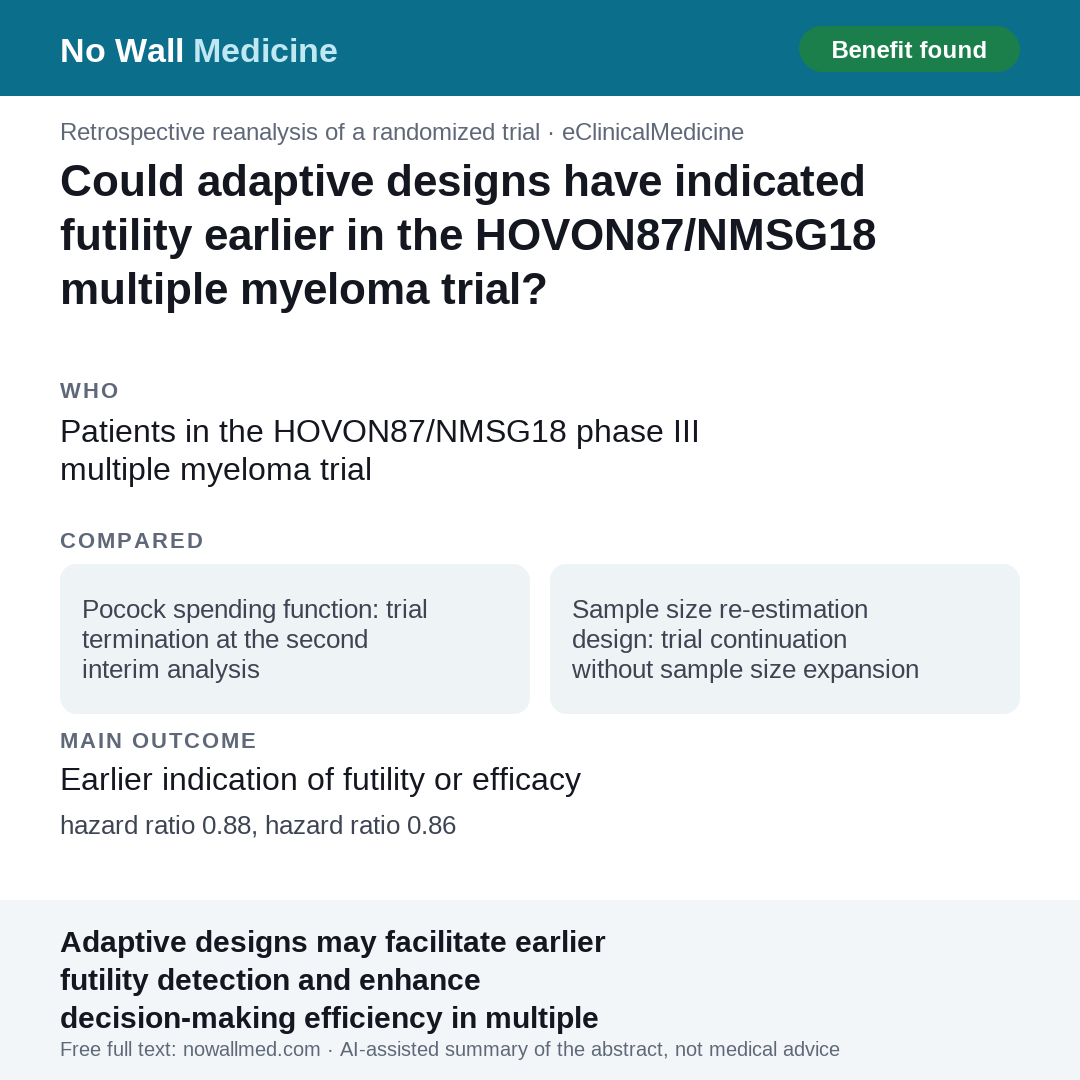
Could adaptive designs have indicated futility earlier in the HOVON87/NMSG18 multiple myeloma trial?
Who
Patients in the HOVON87/NMSG18 phase III multiple myeloma trial
Compared
Pocock spending function: trial termination at the second interim analysis
Sample size re-estimation design: trial continuation without sample size expansion
Main outcome
Earlier indication of futility or efficacy
Result: hazard ratio 0.88, hazard ratio 0.86
Bottom line: Adaptive designs may facilitate earlier futility detection and enhance decision-making efficiency in multiple myeloma trials.
Limitation: This was a retrospective reanalysis of an existing trial.
Funded by: Dutch Cancer Society, Norwegian Cancer Society, and Celgene
eClinicalMedicine · 2025-10-30Download image
Clinical question: Could adaptive designs have indicated futility earlier in the HOVON87/NMSG18 multiple myeloma trial?
Why it matters: Longer follow-up times for improved survival can challenge the feasibility of randomized clinical trials, creating a need for more efficient decision-making tools.
Key points
- Researchers retrospectively modeled two adaptive designs on the HOVON87/NMSG18 phase III randomized trial for multiple myeloma, which failed its primary endpoint.
- The Pocock spending function indicated trial termination at the second interim analysis with a hazard ratio of 0.88 exceeding the futility boundary of 0.85.
- The sample size re-estimation design at 67% of events showed an observed hazard ratio of 0.86, which was in the unfavourable zone.
Headline and key points written with AI from the paper’s abstract, with every number checked against it. Read the paper before relying on them.
Was this summary helpful?
Cite this article
Seefat MR, van der Maas NG, Nasserinejad K, van der Holt B, Waage A, Mellqvist UH. Adaptive designs in randomized clinical trials: reanalysis of the HOVON87/NMSG18 multiple myeloma trial. eClinicalMedicine. 2025. doi:10.1016/j.eclinm.2025.103605
Spotted a mistake? Suggest a correction
Top studies every Monday
The week’s key trials and guidelines in your specialties, plus any topics you follow. By email, free.
Get the weekly digest