Adaptive telephone support provided no additional benefit for weight loss maintenance compared to monthly support
Adaptive vs Monthly Support for Weight-Loss Maintenance: A Randomized Clinical Trial
Randomized clinical trialNo clear difference
Does adaptive or static telephone-based extended care better reduce weight regain?
Who
255
Adults with obesity who lost 5% or more baseline weight · Gainesville, Florida
Compared
adaptive schedule: 1.27 (95% CI, 0.07 to 2.47) kg
static schedule: 1.75 (95% CI, 0.43 to 3.06) kg
Main outcome
weight change from month 4 to month 24
Bottom line: Adaptive telephone-based extended care provided no additional benefit for weight-loss maintenance compared to a static monthly schedule.
JAMA Netw Open · 2025-09-02Download image
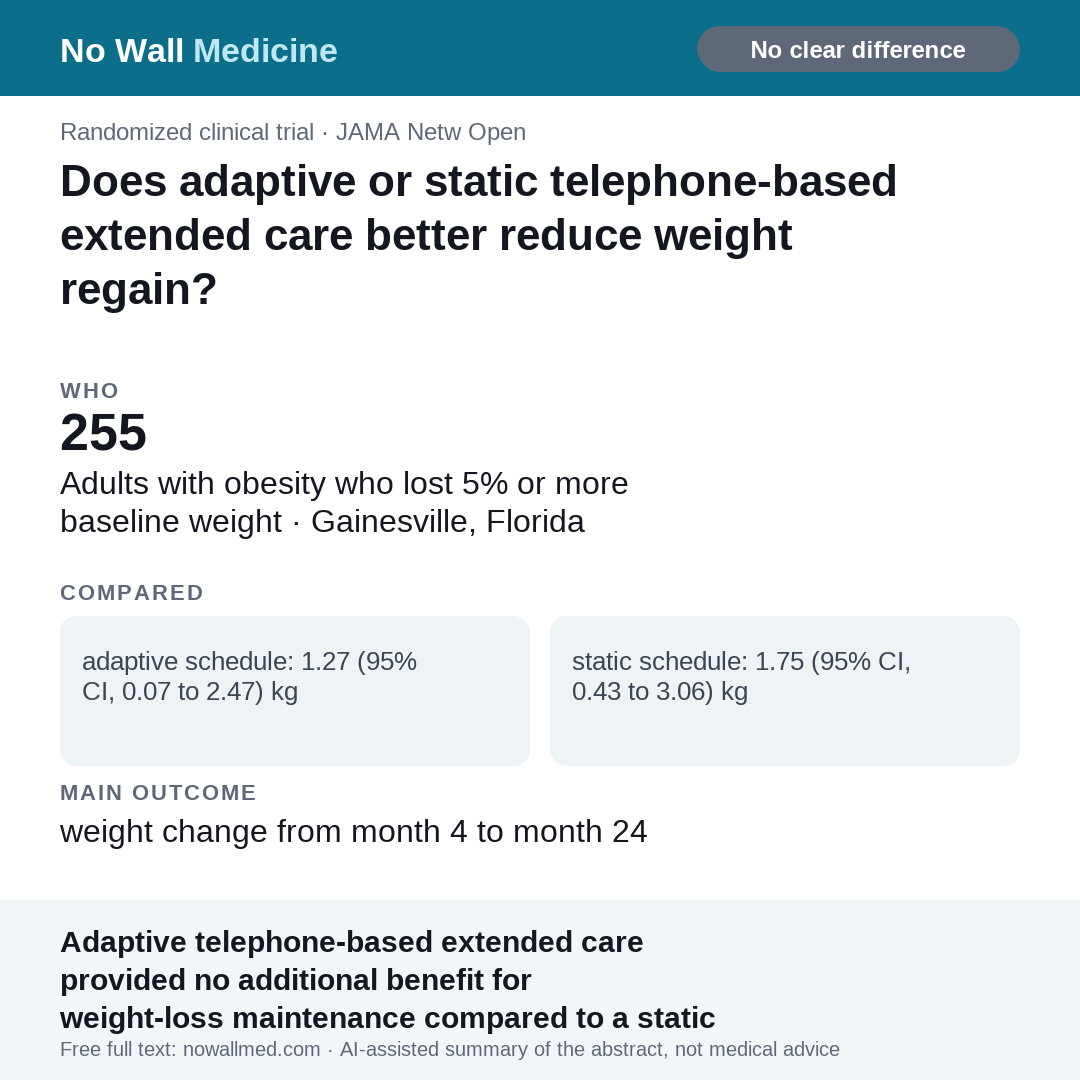
Clinical question: Does adaptive or static telephone-based extended care better reduce weight regain?
Why it matters: Existing extended care programs that provide monthly sessions show only modest effects on long-term weight loss, and it is unclear if adaptive scheduling improves outcomes.
Key points
- Researchers studied 255 adults with obesity who were randomized to receive 20 months of telephone-based support on either an adaptive or a static monthly schedule.
- Weight regain from month 4 to 24 was 1.27 kg in the adaptive group and 1.75 kg in the static group, showing no difference between conditions.
- At month 24, 59.5% of adaptive participants and 59.8% of static participants maintained a weight loss of 5% or more.
Headline and key points written with AI from the paper’s abstract, with every number checked against it. Read the paper before relying on them.
Topics
Cite this article
Ross KM, Shankar MN, Qiu P, Tian Z, Ruiz J, Anthony L. Adaptive vs Monthly Support for Weight-Loss Maintenance: A Randomized Clinical Trial. JAMA Netw Open. 2025. doi:10.1001/jamanetworkopen.2025.32681
Spotted a mistake? Suggest a correction
Top studies every Monday
The week’s key trials and guidelines in your specialties, by email. Free.
Get the weekly digest