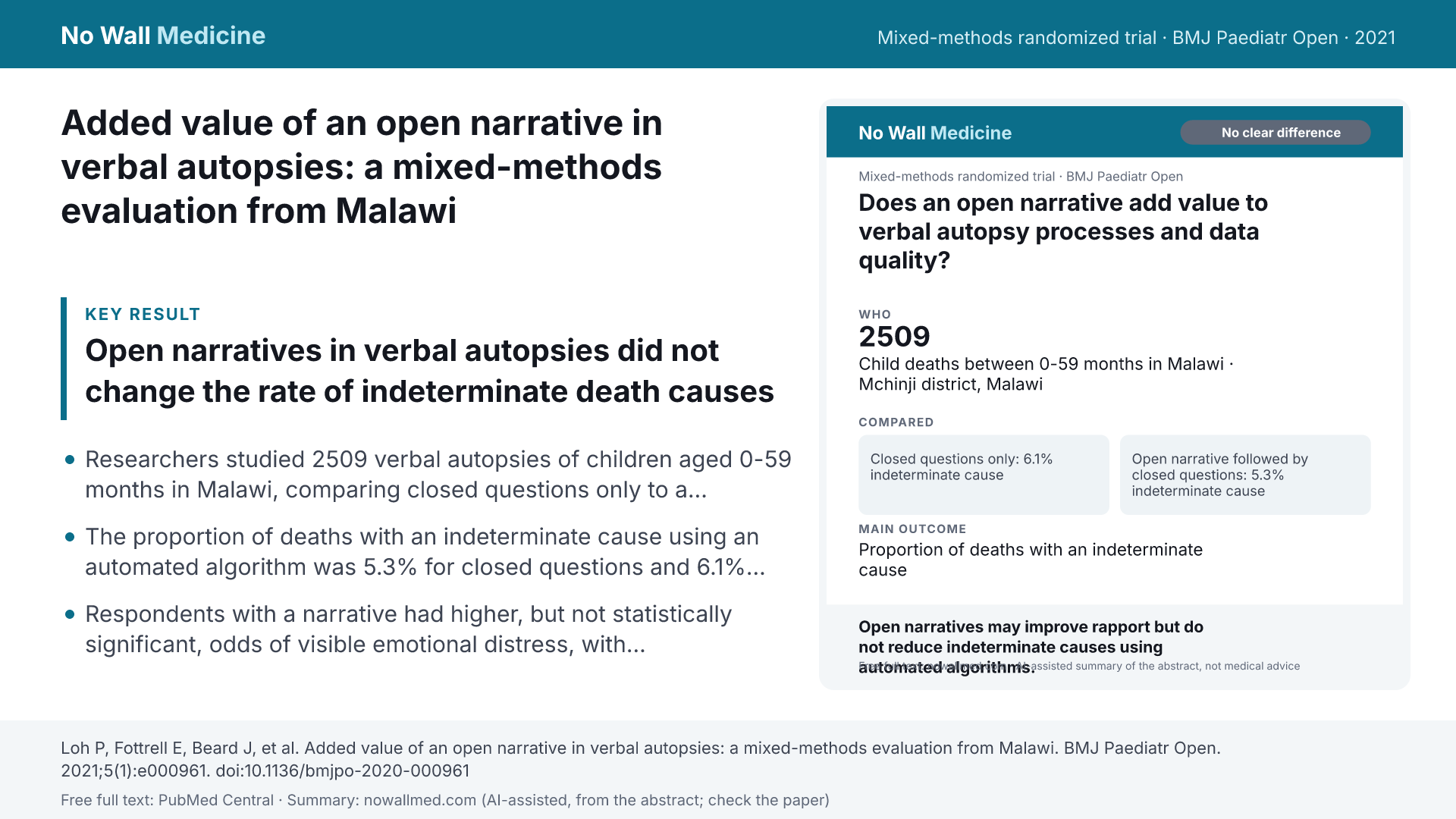
Open narratives in verbal autopsies did not change the rate of indeterminate death causes
Added value of an open narrative in verbal autopsies: a mixed-methods evaluation from Malawi
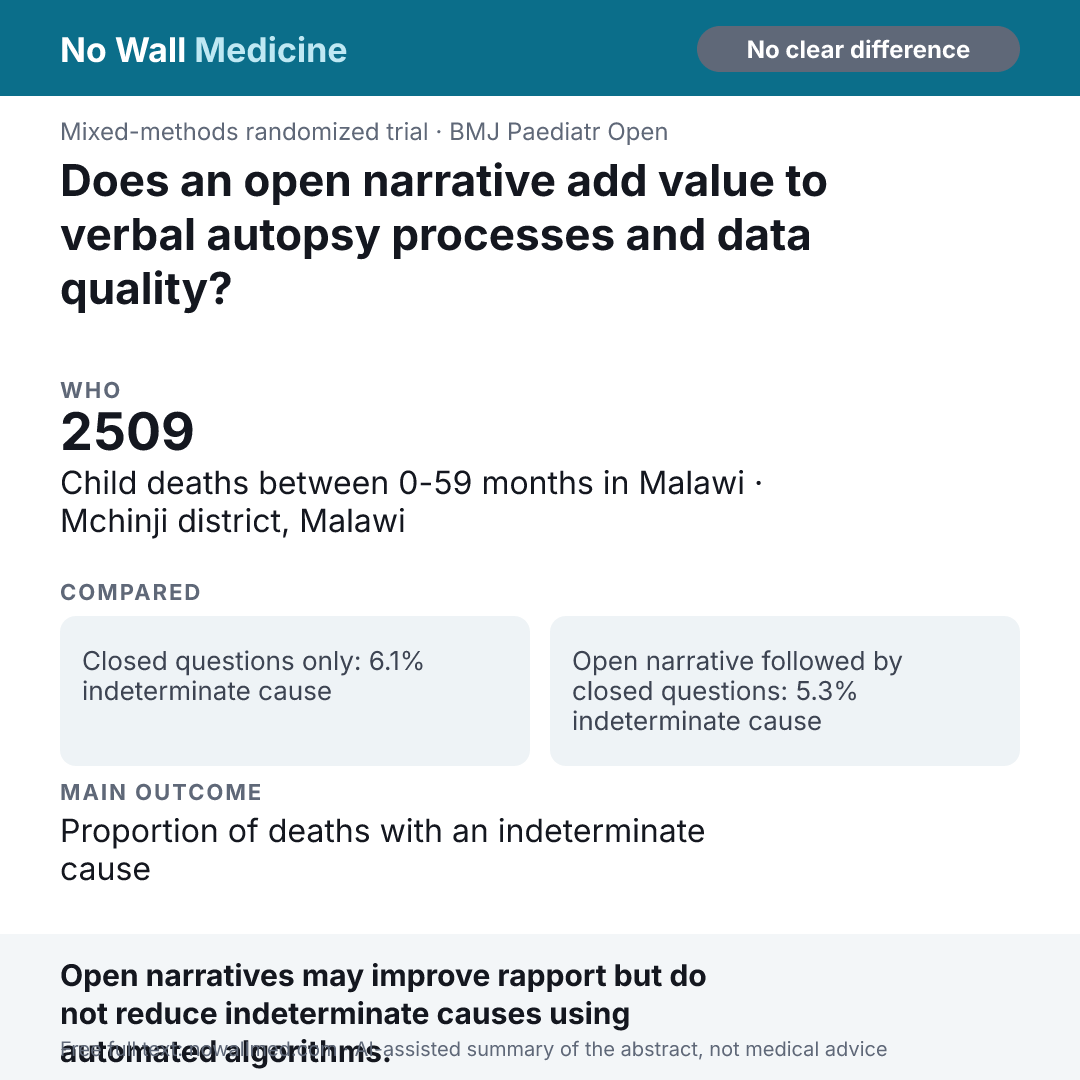
Mixed-methods randomized trialNo clear difference
Does an open narrative add value to verbal autopsy processes and data quality?
Who
2509
Child deaths between 0-59 months in Malawi · Mchinji district, Malawi
Compared
Closed questions only: 6.1% indeterminate cause
Open narrative followed by closed questions: 5.3% indeterminate cause
Main outcome
Proportion of deaths with an indeterminate cause
Result: adjusted OR: 1.20 (95% CI: 0.98 to 1.47) for emotional distress
Bottom line: Open narratives may improve rapport but do not reduce indeterminate causes using automated algorithms.
BMJ Paediatr Open · 2021-02-05 · Save PNG
Clinical question: Does an open narrative add value to verbal autopsy processes and data quality?
Key points
- Researchers studied 2509 verbal autopsies of children aged 0-59 months in Malawi, comparing closed questions only to a method including an open narrative.
- The proportion of deaths with an indeterminate cause using an automated algorithm was 5.3% for closed questions and 6.1% for those with narratives.
- Respondents with a narrative had higher, but not statistically significant, odds of visible emotional distress, with an adjusted odds ratio of 1.20 (95% CI: 0.98 to 1.47).
Headline and key points written with AI from the paper’s abstract, with every number checked against it. Read the paper before relying on them.
Was this summary helpful?
Abstract
Background
The WHO standardised verbal autopsy (VA) instrument includes closed questions, ascertaining signs and symptoms of illness preceding death, and an optional open narrative. As VA analyses increasingly use automated algorithms, inclusion of narratives should be justified. We evaluated the role of open narratives on VA processes, data quality and respondent's emotional stress. Methods
A mixed-methods analysis was conducted using VA data for child deaths (0-59 months), between April 2013 and November 2016 in Mchinji district, Malawi. Deaths were prospectively randomised to receive closed questions only or open narrative followed by closed questions. On concluding the VA, interviewers self-completed questions on respondents' emotional stress. Logistic regression was used to determine associations with visible emotional distress during VAs. A group discussion with interviewers was conducted at the project end, to understand field experiences and explore future recommendations; data were coded using deductive themes. Results
2509 VAs were included, with 49.8% (n=1341) randomised to open narratives. Narratives lasted a median of 7 minuntes (range: 1-113). Interviewers described improved rapport and felt narratives improved data quality, although there was no difference in the proportion of deaths with an indeterminate cause using an automated algorithm (5.3% vs 6.1%). The majority of respondents did not display visible emotional stress (81%). Those with a narrative had higher, but not statistically significant, odds of emotional distress (adjusted OR: 1.20; 95% CI: 0.98 to 1.47). Factors associated with emotional stress were: infant deaths versus neonates; deaths at a health centre or en-route to hospital versus home; and higher socioeconomic status. Non-parental respondents and increased time between death and interview were associated with lower odds of emotional distress. Conclusion
Conducting an open narrative may help build rapport, something valued by the interviewers. However, additional time and emotional burdens should be further justified, with quality and utility of narratives promoted through standardised recommendations.
Abstract reproduced under the article’s CC BY NC licence.
Subject terms
Headline, design, result, key points, caveat and citation as plain text.
Cite this article
Loh P, Fottrell E, Beard J, et al. Added value of an open narrative in verbal autopsies: a mixed-methods evaluation from Malawi. BMJ Paediatr Open. 2021;5(1):e000961. doi:10.1136/bmjpo-2020-000961
Spotted a mistake? Suggest a correction