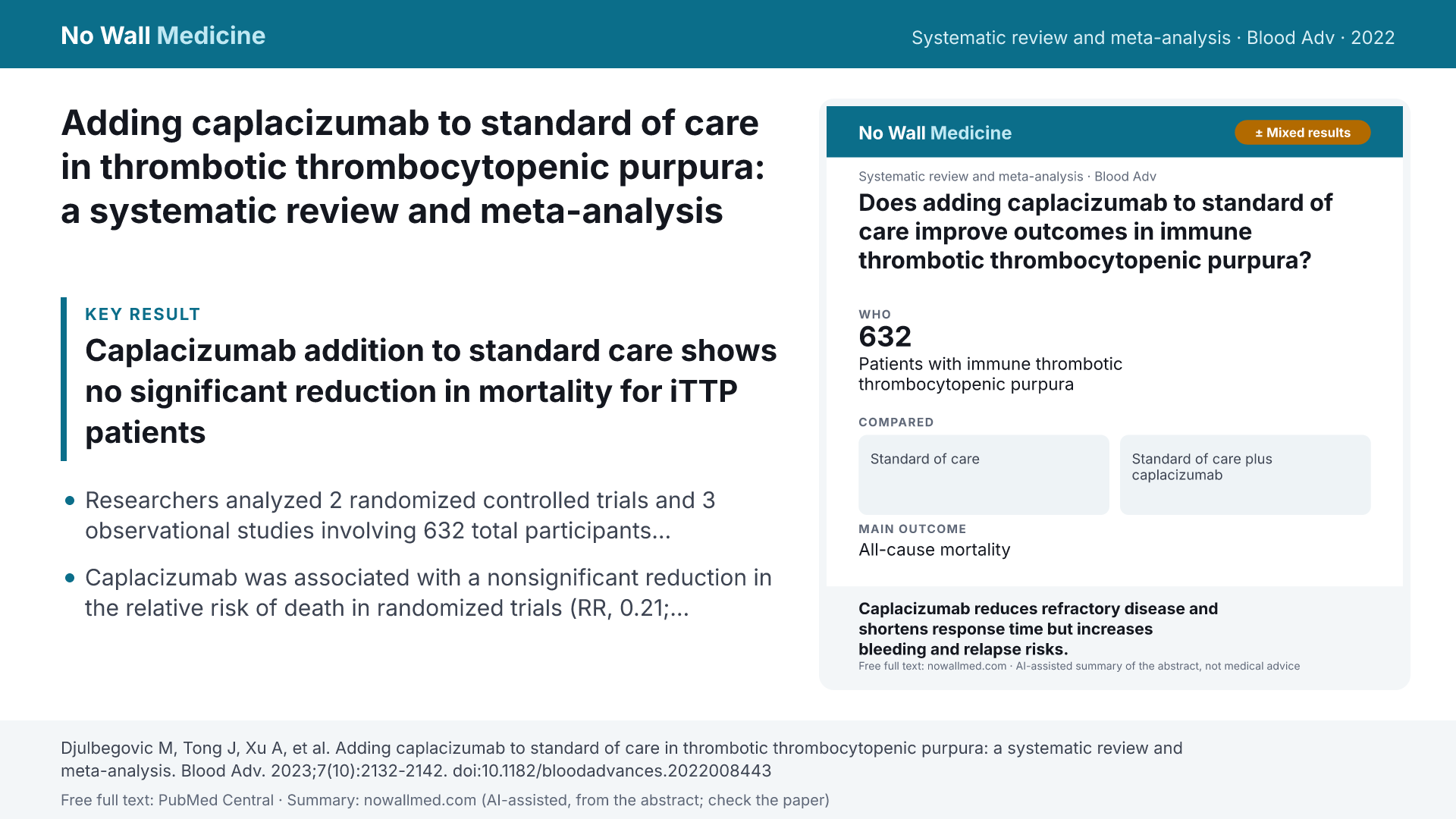
Caplacizumab addition to standard care shows no significant reduction in mortality for iTTP patients
Adding caplacizumab to standard of care in thrombotic thrombocytopenic purpura: a systematic review and meta-analysis
Systematic review and meta-analysisMixed results
Does adding caplacizumab to standard of care improve outcomes in immune thrombotic thrombocytopenic purpura?
Who
632
Patients with immune thrombotic thrombocytopenic purpura
Compared
Standard of care
Standard of care plus caplacizumab
Main outcome
All-cause mortality
Result: relative risk 0.21 (95% CI 0.05-1.74) in randomized controlled trials
Bottom line: Caplacizumab reduces refractory disease and shortens response time but increases bleeding and relapse risks.
Limitation: Observational studies were at high risk of bias.
Blood Adv · 2022-09-03Download image
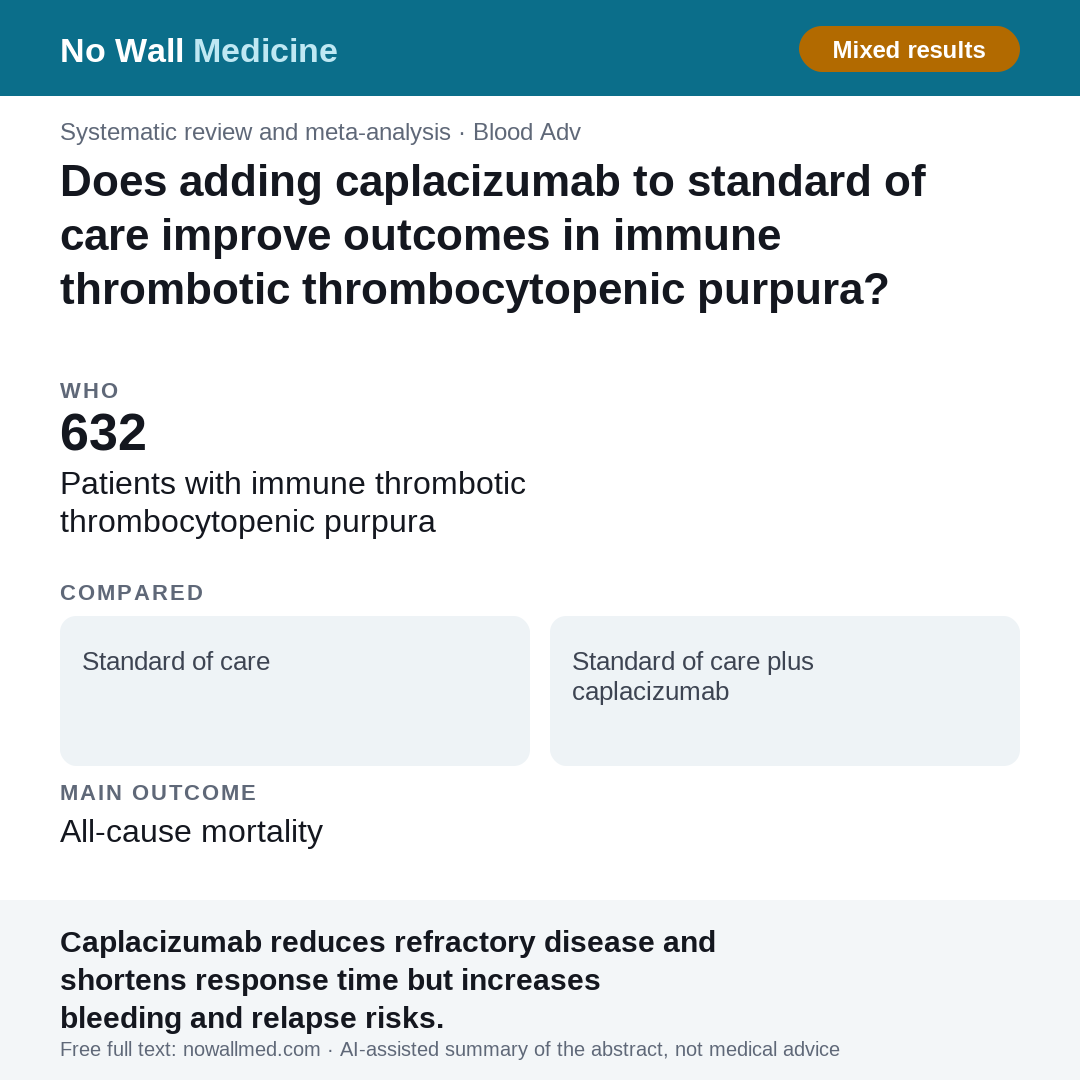
Clinical question: Does adding caplacizumab to standard of care improve outcomes in immune thrombotic thrombocytopenic purpura?
Key points
- Researchers analyzed 2 randomized controlled trials and 3 observational studies involving 632 total participants with immune thrombotic thrombocytopenic purpura.
- Caplacizumab was associated with a nonsignificant reduction in the relative risk of death in randomized trials (RR, 0.21; 95% CI, 0.05-1.74) and observational studies (RR, 0.62; 95% CI, 0.07-4.41).
- The addition of caplacizumab was associated with an increased bleeding risk in randomized trials (RR, 1.37; 95% CI, 1.06-1.77) but not in observational studies.
Limitation the authors note: The included observational studies were at high risk of bias.
Headline and key points written with AI from the paper’s abstract, with every number checked against it. Read the paper before relying on them.
Was this summary helpful?
Abstract
Immune thrombotic thrombocytopenic purpura (iTTP) is an acquired, fatal microangiopathy if untreated. Randomized controlled trials (RCTs) demonstrated faster time to response with addition of caplacizumab to standard of care (SOC). However, concerns about RCT selection bias and the high cost of caplacizumab warrant examination of all evidence, including real-world observational studies. In this systematic review and meta-analysis, we searched for comparative studies evaluating SOC with or without caplacizumab for the treatment of iTTP. We assessed risk of bias using the Cochrane risk-of-bias-2 tool (RCTs) and the Newcastle-Ottawa Scale (observational studies). The primary efficacy and safety outcomes were all-cause mortality and treatment-emergent bleeding, respectively. Secondary outcomes included exacerbation and relapse, refractory iTTP, and time to response. We included 2 high-quality RCTs and 3 observational studies at high risk of bias comprising 632 total participants. Compared with SOC, caplacizumab was associated with a nonsignificant reduction in the relative risk [RR] of death in RCTs (RR, 0.21; 95% confidence interval [CI], 0.05-1.74) and observational studies (RR, 0.62; 95% CI, 0.07-4.41). Compared with SOC, caplacizumab was associated with an increased bleeding risk in RCTs (RR, 1.37; 95% CI, 1.06-1.77). In observational studies, bleeding risk was not significantly increased (RR, 7.10; 95% CI, 0.90-56.14). Addition of caplacizumab was associated with a significant reduction in refractory iTTP and exacerbation risks and shortened response time but increased relapse risk. Frontline addition of caplacizumab does not significantly reduce all-cause mortality compared with SOC alone, although it reduces refractory disease risk, shortens time to response, and improves exacerbation rates at the expense of increased relapse and bleeding risk.
Abstract reproduced under the article’s CC BY NC ND licence.
Subject terms
Headline, design, result, key points, caveat and citation as plain text.
Cite this article
Djulbegovic M, Tong J, Xu A, et al. Adding caplacizumab to standard of care in thrombotic thrombocytopenic purpura: a systematic review and meta-analysis. Blood Adv. 2022. doi:10.1182/bloodadvances.2022008443
Spotted a mistake? Suggest a correction