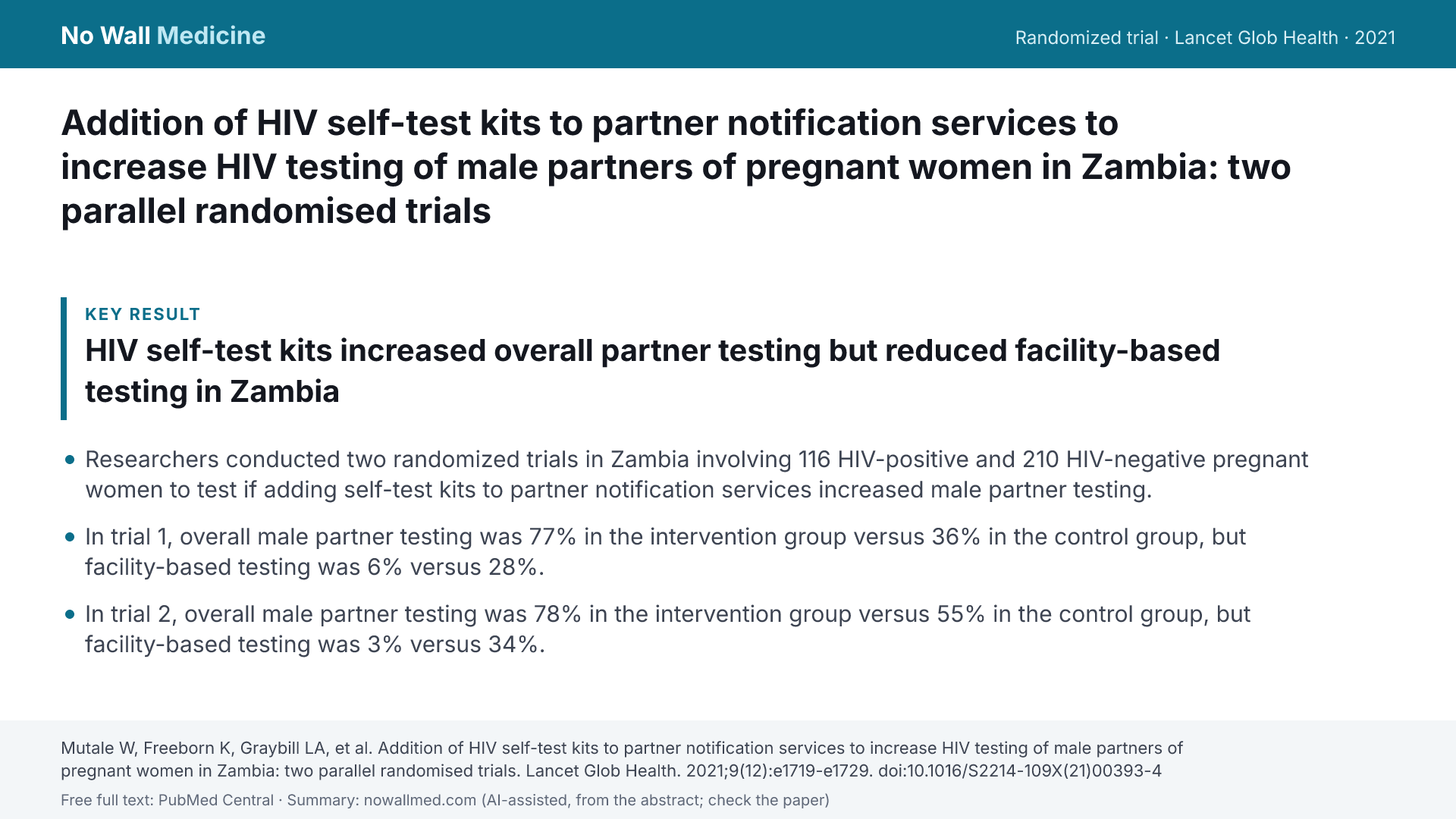
Addition of HIV self-test kits to partner notification services to increase HIV testing of male partners of pregnant women in Zambia: two parallel randomised trials
Key result: HIV self-test kits increased overall partner testing but reduced facility-based testing in Zambia
Key points
- Researchers conducted two randomized trials in Zambia involving 116 HIV-positive and 210 HIV-negative pregnant women to test if adding self-test kits to partner notification services increased male partner testing.
- In trial 1, overall male partner testing was 77% in the intervention group versus 36% in the control group, but facility-based testing was 6% versus 28%.
- In trial 2, overall male partner testing was 78% in the intervention group versus 55% in the control group, but facility-based testing was 3% versus 34%.
Why it matters: Male partner HIV testing rates remain low during pregnancy, and it is unknown if providing self-test kits alongside traditional notification services increases total testing or reduces facility-based testing.
Discussion prompts
- Would these patients look like yours? Who was left out?
- Is the main outcome one that matters to patients?
- Is the difference large enough to change what you do?
Cite: Mutale W, Freeborn K, Graybill LA, et al. Addition of HIV self-test kits to partner notification services to increase HIV testing of male partners of pregnant women in Zambia: two parallel randomised trials. Lancet Glob Health. 2021;9(12):e1719-e1729. doi:10.1016/S2214-109X(21)00393-4
Free full text: PubMed Central · Summary and visual abstract: nowallmed.com/a/addition-of-hiv-self-test-kits-to-partner-notification-services-to-e4ojd6/ (AI-assisted from the abstract; check the paper before relying on it).