Recruitment intervention helped exceed participant targets for a trial on cerebral cavernous malformation management
Addressing barriers and identifying facilitators to support informed consent and recruitment in the Cavernous malformations A Randomised Effectiveness (CARE) pilot phase trial: insights from the integrated QuinteT recruitment intervention (QRI)
Pilot phase randomized trial with integrated interventionBenefit found
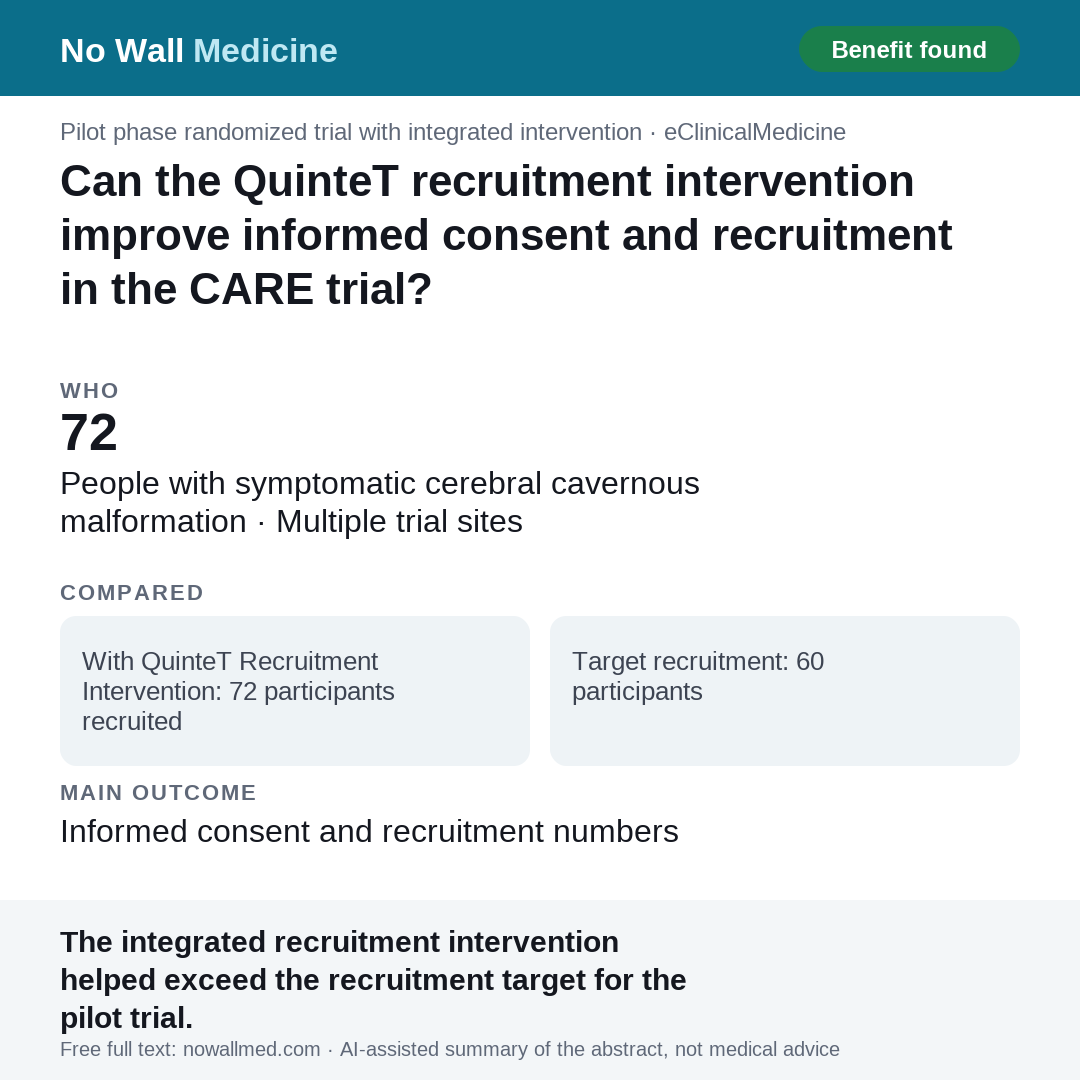
Can the QuinteT recruitment intervention improve informed consent and recruitment in the CARE trial?
Who
72
People with symptomatic cerebral cavernous malformation · Multiple trial sites
Compared
With QuinteT Recruitment Intervention: 72 participants recruited
Target recruitment: 60 participants
Main outcome
Informed consent and recruitment numbers
Bottom line: The integrated recruitment intervention helped exceed the recruitment target for the pilot trial.
Funded by: National Institute for Health and Care Research
eClinicalMedicine · 2024-04-18Download image
Clinical question: Can the QuinteT recruitment intervention improve informed consent and recruitment in the CARE trial?
Why it matters: Previous trials comparing surgical and medical management for intracranial vascular malformations failed to recruit enough participants to meet their targets.
Key points
- Researchers analyzed 28 screening logs and 79 recruitment discussions to identify barriers and facilitators for a pilot trial comparing medical management to surgery for cerebral cavernous malformations.
- The recruitment intervention led to 72 participants being recruited after a 5-month extension, which exceeded the original target of 60 participants.
- Barriers included challenges with clinical equipoise, which is the uncertainty regarding which treatment is better, and logistical issues with diagnosing patients for stereotactic radiosurgery.
Headline and key points written with AI from the paper’s abstract, with every number checked against it. Read the paper before relying on them.
Cite this article
Wade J, Farrar N, Realpe AX, Donovan JL, Forsyth L, Harkness KA. Addressing barriers and identifying facilitators to support informed consent and recruitment in the Cavernous malformations A Randomised Effectiveness (CARE) pilot phase trial: insights from the integrated QuinteT recruitment intervention (QRI). eClinicalMedicine. 2024. doi:10.1016/j.eclinm.2024.102557
Spotted a mistake? Suggest a correction
Top studies every Monday
The week’s key trials and guidelines in your specialties, by email. Free.
Get the weekly digest