Three-dimensional printed facial models were associated with increased expertise in facial reconstruction training
Addressing the Pandemic Training Deficiency: Filling the Void with Simulation in Facial Reconstruction
Cohort studyBenefit found
Is a 3D printed facial flap model effective for trainee education in facial reconstruction?
Who
Otolaryngology-Head and Neck Surgery trainees · single institution
Compared
3D printed facial flap simulator: statistically significant (p < 0.05) improvement in overall expertise
traditional paper facial flap exercise: no statistically significant improvement
Main outcome
expertise in facial flap procedures, design, and excision
Bottom line: The 3D printed facial flap simulator is an effective and realistic training tool for surgical education.
Laryngoscope · 2021-03-03Download image
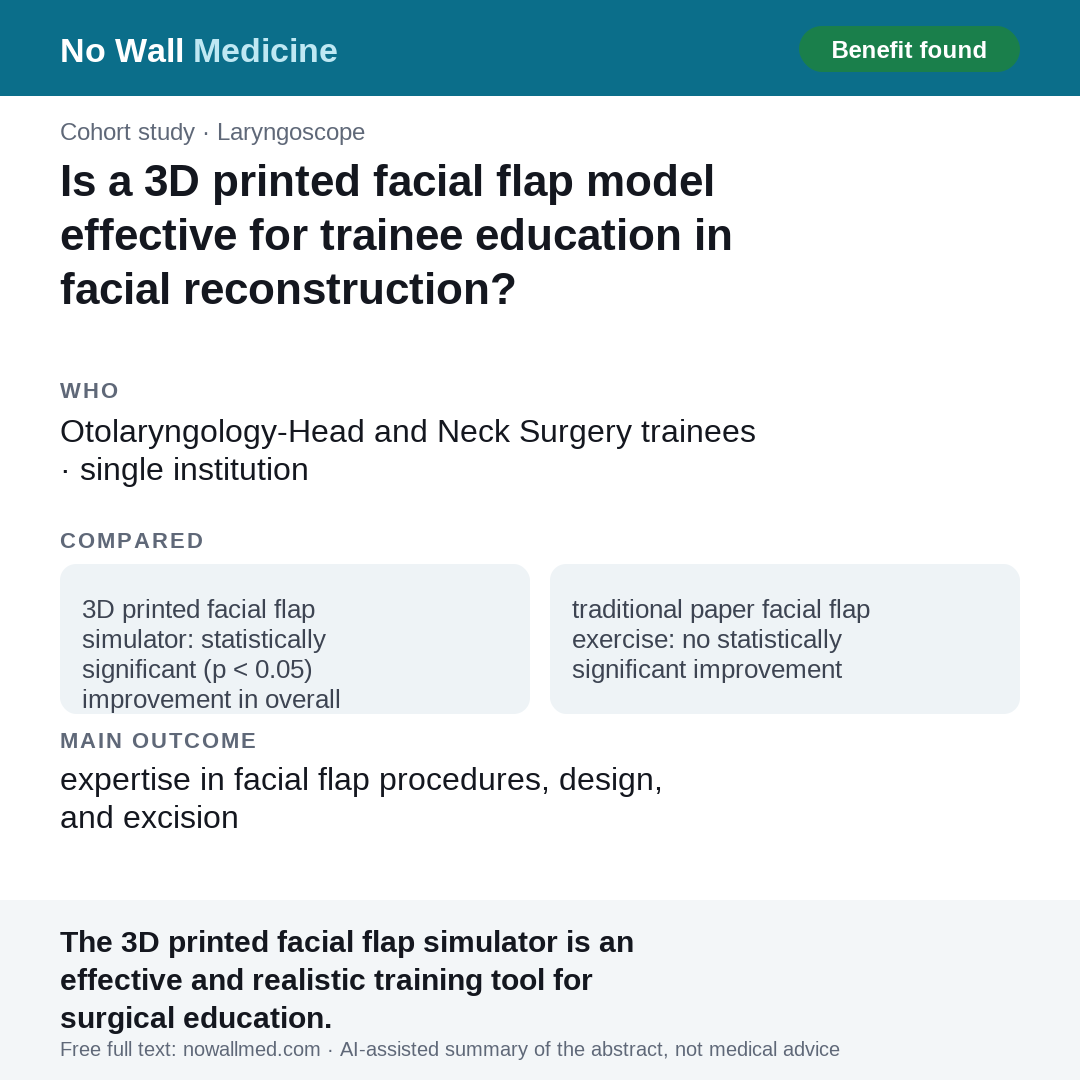
Clinical question: Is a 3D printed facial flap model effective for trainee education in facial reconstruction?
Why it matters: It was unknown if a low-cost, high-fidelity 3D printed silicone model could serve as an effective alternative for teaching facial reconstruction surgical techniques.
Key points
- Otolaryngology-Head and Neck Surgery trainees at a single institution were compared using a 3D printed silicone simulator versus a traditional paper exercise.
- Trainees using the 3D printed simulator reported a statistically significant (p < 0.05) improvement in expertise regarding facial flap procedures, design, and excision of cutaneous deformities.
- The control group using paper exercises showed no statistically significant improvement in these areas.
Headline and key points written with AI from the paper’s abstract, with every number checked against it. Read the paper before relying on them.
Was this summary helpful?
Subject terms
Cite this article
Yang SF, Powell A, Srinivasan S, Kim JC, Baker SR, Green GE. Addressing the Pandemic Training Deficiency: Filling the Void with Simulation in Facial Reconstruction. Laryngoscope. 2021. doi:10.1002/lary.29490
Spotted a mistake? Suggest a correction
Top studies every Monday
The week’s key trials and guidelines in your specialties, plus any topics you follow. By email, free.
Get the weekly digest