Handwashing adherence was linked to lower incidence and death from COVID-19 respiratory infections
Adherence to handwashing behaviour and its impact on the incidence and death of viral respiratory infectious diseases: a systematic review, meta-analysis and modelling study
Systematic review, meta-analysis and modelling studyBenefit found
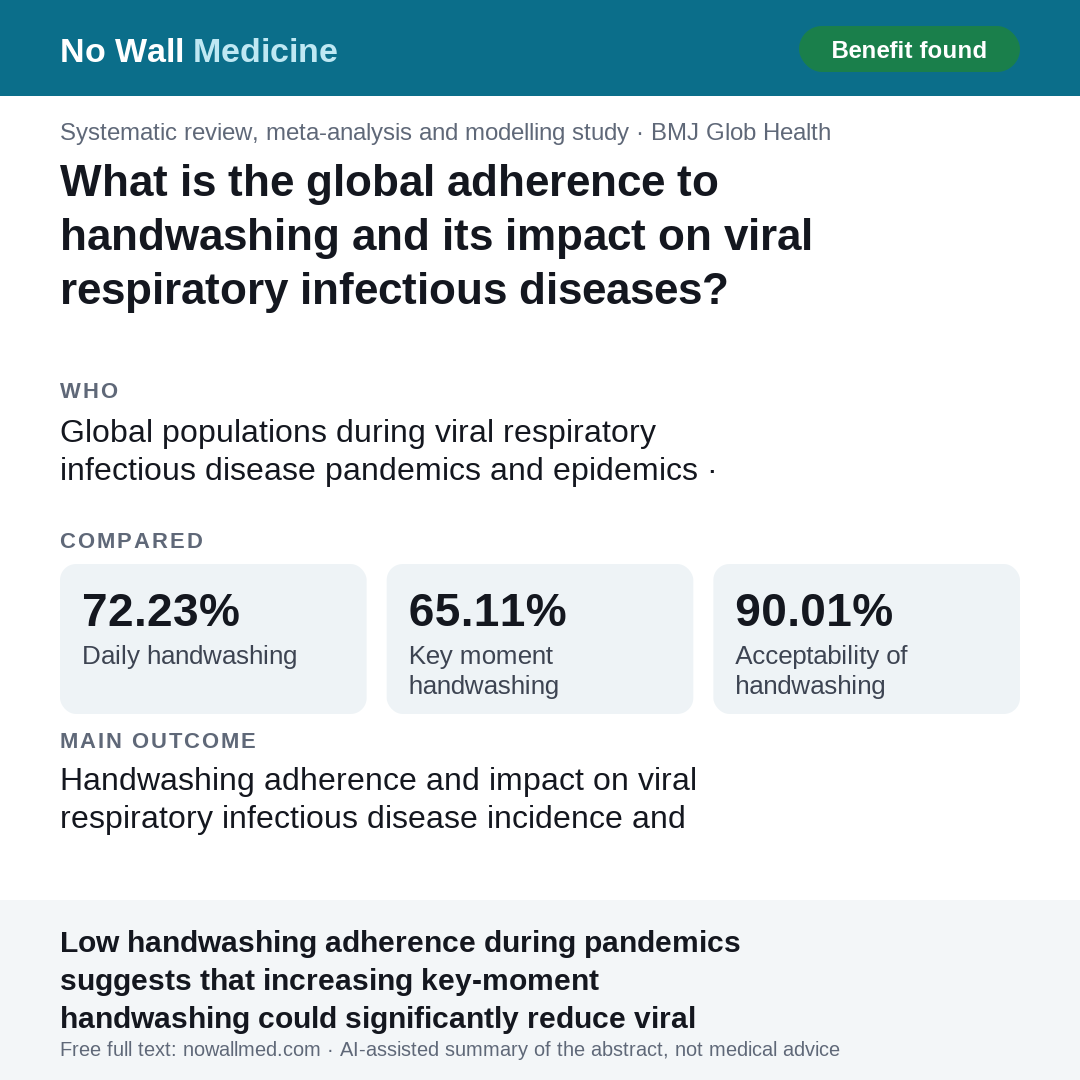
What is the global adherence to handwashing and its impact on viral respiratory infectious diseases?
Who
Global populations during viral respiratory infectious disease pandemics and epidemics · Global
Compared
72.23%Daily handwashing (95% CI 66.95% to 76.95%)
65.11%Key moment handwashing (95% CI 59.74% to 70.28%)
90.01%Acceptability of handwashing (95% CI 83.73% to 94.05%)
Main outcome
Handwashing adherence and impact on viral respiratory infectious disease incidence and death
Bottom line: Low handwashing adherence during pandemics suggests that increasing key-moment handwashing could significantly reduce viral respiratory disease incidence and death.
BMJ Glob Health · 2025-12-07Download image
Clinical question: What is the global adherence to handwashing and its impact on viral respiratory infectious diseases?
Why it matters: The study addresses the need to understand global adherence to handwashing and its impact on the incidence and death of viral respiratory infectious diseases.
Key points
- Researchers analyzed 108 articles containing 227 datasets to examine global handwashing rates during viral respiratory disease pandemics.
- The global pooled rate of daily handwashing was 72.23%, while key-moment handwashing was associated with lower COVID-19 incidence and mortality.
- Handwashing rates were lowest among public transportation workers at 18.15% and the elderly at 22.86% for key-moment washing.
Headline and key points written with AI from the paper’s abstract, with every number checked against it. Read the paper before relying on them.
Abstract
Objectives
Washing hands is considered an effective way for preventing viral respiratory infections. This study systematically investigated the global and regional adherence to hand-washing behaviour and its impact on the incidence and death of viral respiratory infectious diseases (VRIDs). Methods
In our systematic review and meta-analysis, we searched PubMed, Embase, Web of Science and Scopus for related studies. We included observational studies with raw data of adherence to handwashing (rates of acceptability of handwashing, daily habitual handwashing and key-moment handwashing) during VRID pandemics/epidemics. Pooled rates and effect of handwashing were calculated by random-effects model and generalised linear model. Results
We analysed 108 articles, generating 227 datasets. During VRID epidemics/pandemics, the global pooled rate of daily handwashing was 72.23% (95% CI 66.95% to 76.95%). The lowest rate was observed in Africa (pooled rate 59.46%, 95% CI 50.73% to 67.68%) and among public transportation workers (18.15%, 95% CI 6.54% to 41.26%). Global pooled rate of key moment handwashing was 65.11% (95% CI 59.74% to 70.28%), with the lowest rate being after handshaking (36.40%, 95% CI 18.49% to 56.52%) and among the elderly (22.86%, 95% CI 16.77% to 29.58%) and was higher during the COVID-19 pandemic than the 2009 H1N1 pandemic (72.02% vs 31.33%). The pooled rate of global acceptability of handwashing was 90.01% (95% CI 83.73% to 94.05%). Key-moment handwashing was associated with a reduction in COVID-19 incidence (β=-151.1, p=0.010), COVID-19 mortality (β=-0.066, p<0.001) and other COVID-19 related deaths (β=-0.112, p<0.001). Conclusion
During the VRID epidemics/pandemics, the handwashing behaviour adherence was relatively low. Health education efforts targeting public transportation workers and the elderly should be intensified. Augmented key-moment handwashing adherence potentially led to a significant reduction of the incidence and death of VRIDs. Prospero registration number
CRD42024499090.
Abstract reproduced under the article’s CC BY NC licence.
Topics
Cite this article
Zhou W, Chen C, Qi J, Chen M, Yuan Z, Miao J. Adherence to handwashing behaviour and its impact on the incidence and death of viral respiratory infectious diseases: a systematic review, meta-analysis and modelling study. BMJ Glob Health. 2025. doi:10.1136/bmjgh-2025-021363
Spotted a mistake? Suggest a correction