Medication adherence to PCSK9 inhibitors declines over time in real-world clinical practice
Adherence to PCSK9 Inhibitors in Clinical Practice: Systematic Review and Meta-Analysis of Observational Studies
Systematic review and meta-analysis of observational studiesMixed results
What is the prevalence of adherence to PCSK9 inhibitors in real-world practice?
Who
75,902
Patients using alirocumab, evolocumab, or inclisiran
Compared
91.7%Initiation (95% CI: 83.6-96.0)
95.1%Medication possession ratio at 6 months (95% CI: 92.7-97.5)
86.5%Medication possession ratio at 24 months (95% CI: 80.2-92.9)
69.7%12-month proportion of days covered (95% CI: 55.9-83.5)
Main outcome
Prevalence of adherence across initiation, implementation, and persistence phases
Bottom line: While initiation is high, medication adherence and persistence diminish over time in real-world practice.
Limitation: Limited evidence beyond 24 months of follow-up and for inclisiran.
JACC Adv · 2026-04-17 · Save PNG
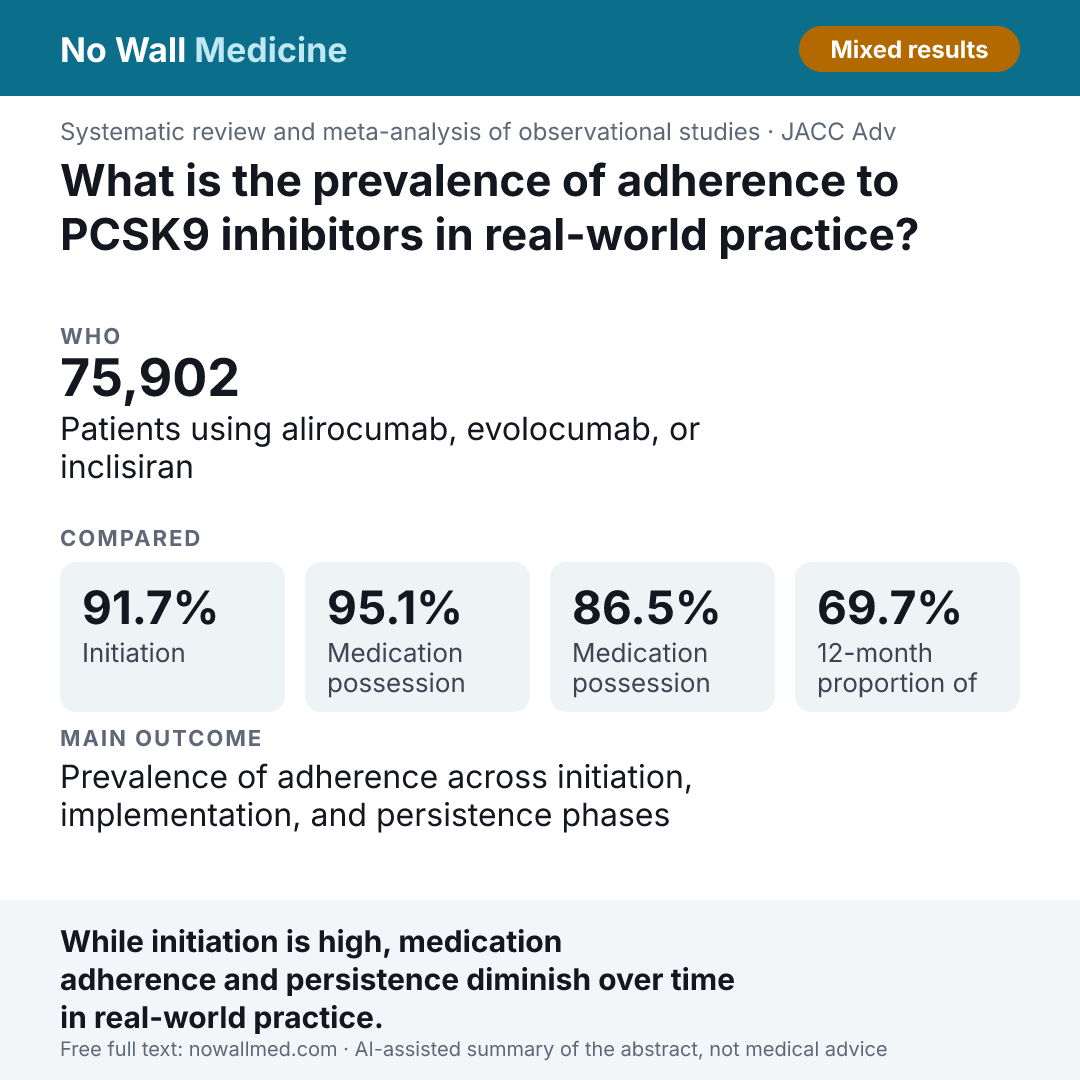
Clinical question: What is the prevalence of adherence to PCSK9 inhibitors in real-world practice?
Why it matters: Medication nonadherence is a barrier to the long-term effectiveness of PCSK9 inhibitors in clinical practice.
Key points
- Researchers analyzed 56 observational studies involving 75,902 patients to measure how well people used PCSK9 inhibitors, which are drugs used to lower cholesterol.
- While medication initiation was 91.7%, the medication possession ratio dropped from 95.1% at 6 months to 86.5% at 24 months.
- At 12 months, the proportion of days covered was 69.7%, persistence was 81.8%, and the discontinuation rate was 12.1%.
Limitation the authors note: The authors noted limited evidence beyond 24 months of follow-up and limited evidence for the drug inclisiran.
Headline and key points written with AI from the paper’s abstract, with every number checked against it. Read the paper before relying on them.
Was this summary helpful?
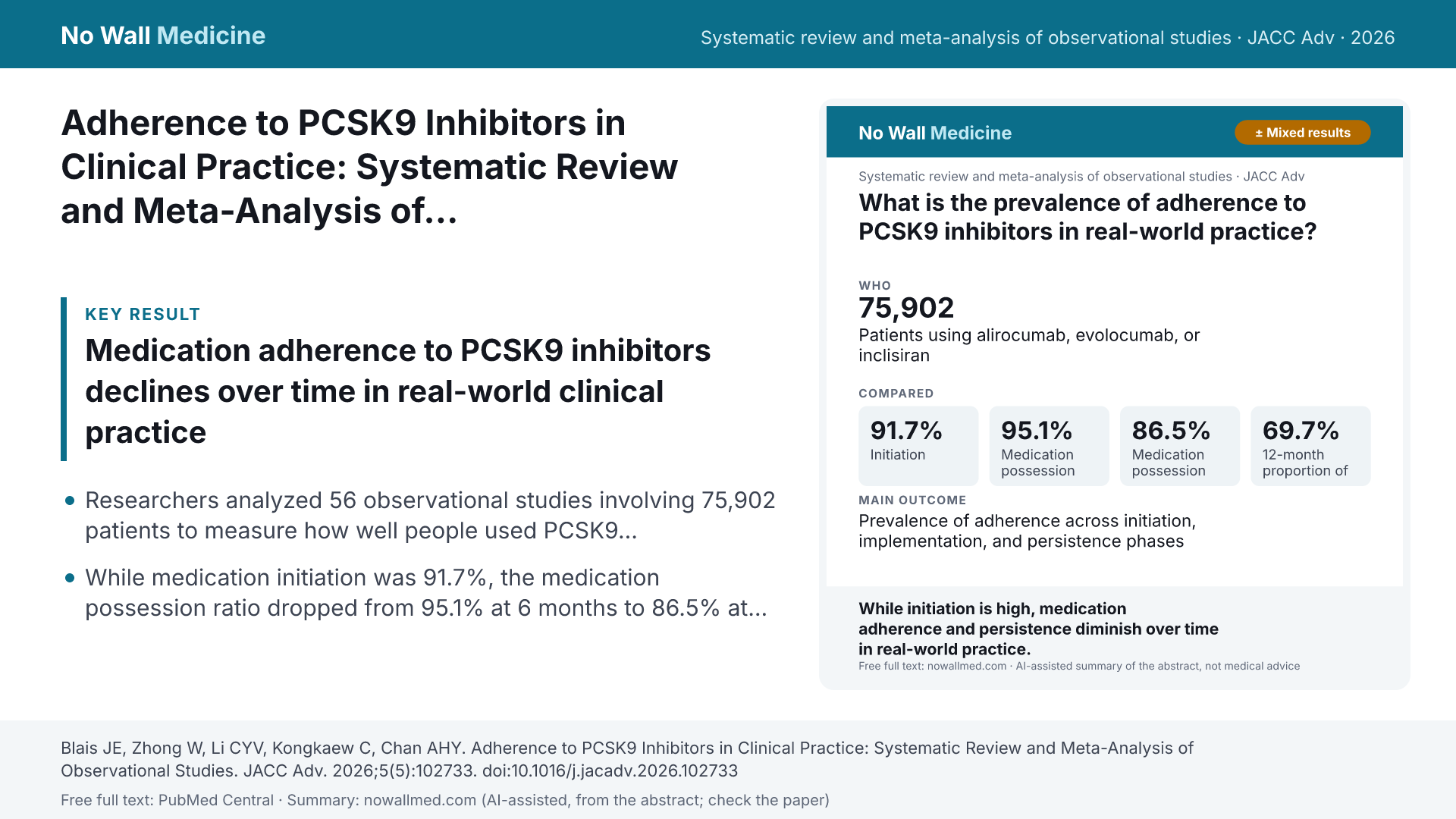
Headline, design, result, key points, caveat and citation as plain text.
Cite this article
Blais JE, Zhong W, Li CYV, Kongkaew C, Chan AHY. Adherence to PCSK9 Inhibitors in Clinical Practice: Systematic Review and Meta-Analysis of Observational Studies. JACC Adv. 2026;5(5):102733. doi:10.1016/j.jacadv.2026.102733
Spotted a mistake? Suggest a correction