Smartphone application did not improve adherence to antimicrobial prescribing guidelines compared to paper versions
Adherence to smartphone-delivered antimicrobial prescribing guidelines in hospitals in Lao PDR: A stepped-wedge cluster randomized controlled trial
Stepped-wedge cluster randomized controlled trialNo clear difference
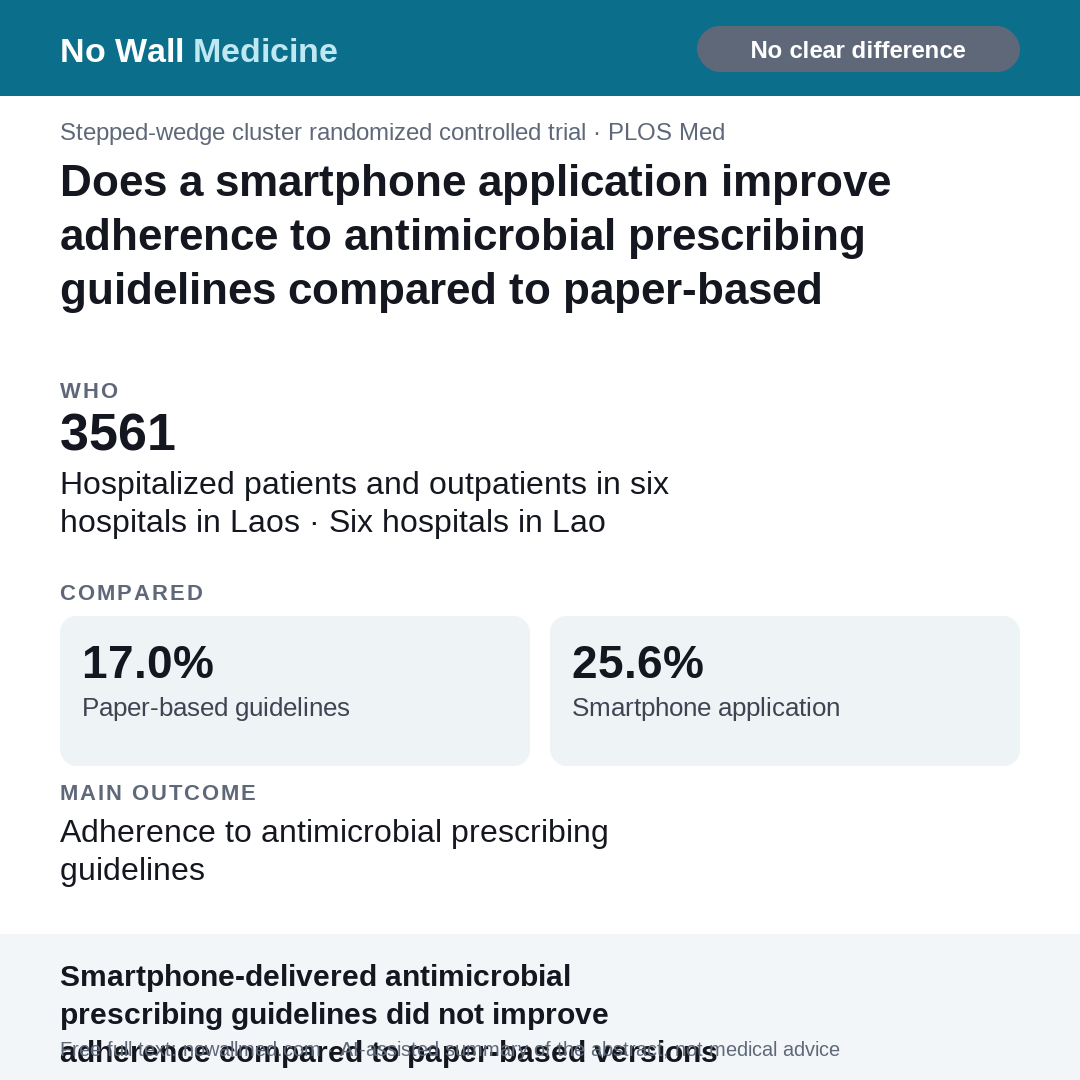
Does a smartphone application improve adherence to antimicrobial prescribing guidelines compared to paper-based versions?
Who
3561
Hospitalized patients and outpatients in six hospitals in Laos · Six hospitals in Lao People's Democratic Republic
Compared
17.0%Paper-based guidelines (95% confidence interval [15.0,19])
25.6%Smartphone application (95% CI [23.1,28.3])
Main outcome
Adherence to antimicrobial prescribing guidelines
Result: adjusted odds ratio 1.26 (95% CI [0.8,1.9])
Bottom line: Smartphone-delivered antimicrobial prescribing guidelines did not improve adherence compared to paper-based versions in Lao hospitals.
Limitation: Prescriptions could not be reliably linked to individual prescribers to evaluate individual behavior changes.
PLOS Med · 2026-08-27Download image
Clinical question: Does a smartphone application improve adherence to antimicrobial prescribing guidelines compared to paper-based versions?
Why it matters: Doctors need to know if smartphone applications can improve adherence to antimicrobial stewardship programs, which are efforts to use antibiotics more appropriately, in low-and middle-income countries.
Key points
- Researchers studied 3,561 hospitalized patient prescriptions and outpatient settings across six hospitals in Laos to compare smartphone application guidelines with paper-based versions.
- After adjusting for various factors, guideline adherence did not differ significantly between the smartphone group and the paper group for hospitalized patients (p = 0.276).
- In outpatient settings, adherence also showed no significant difference between the two delivery modes (p = 0.406).
Limitation the authors note: Prescriptions could not be reliably linked to individual prescribers, so changes in individual prescribing behavior could not be evaluated.
Headline and key points written with AI from the paper’s abstract, with every number checked against it. Read the paper before relying on them.
Topics
Cite this article
Chansamouth V, Chommanam D, Lee SJ, Vongphachanh S, Vongsouvath M, Keomany S. Adherence to smartphone-delivered antimicrobial prescribing guidelines in hospitals in Lao PDR: A stepped-wedge cluster randomized controlled trial. PLOS Med. 2026. doi:10.1371/journal.pmed.1005205
Spotted a mistake? Suggest a correction