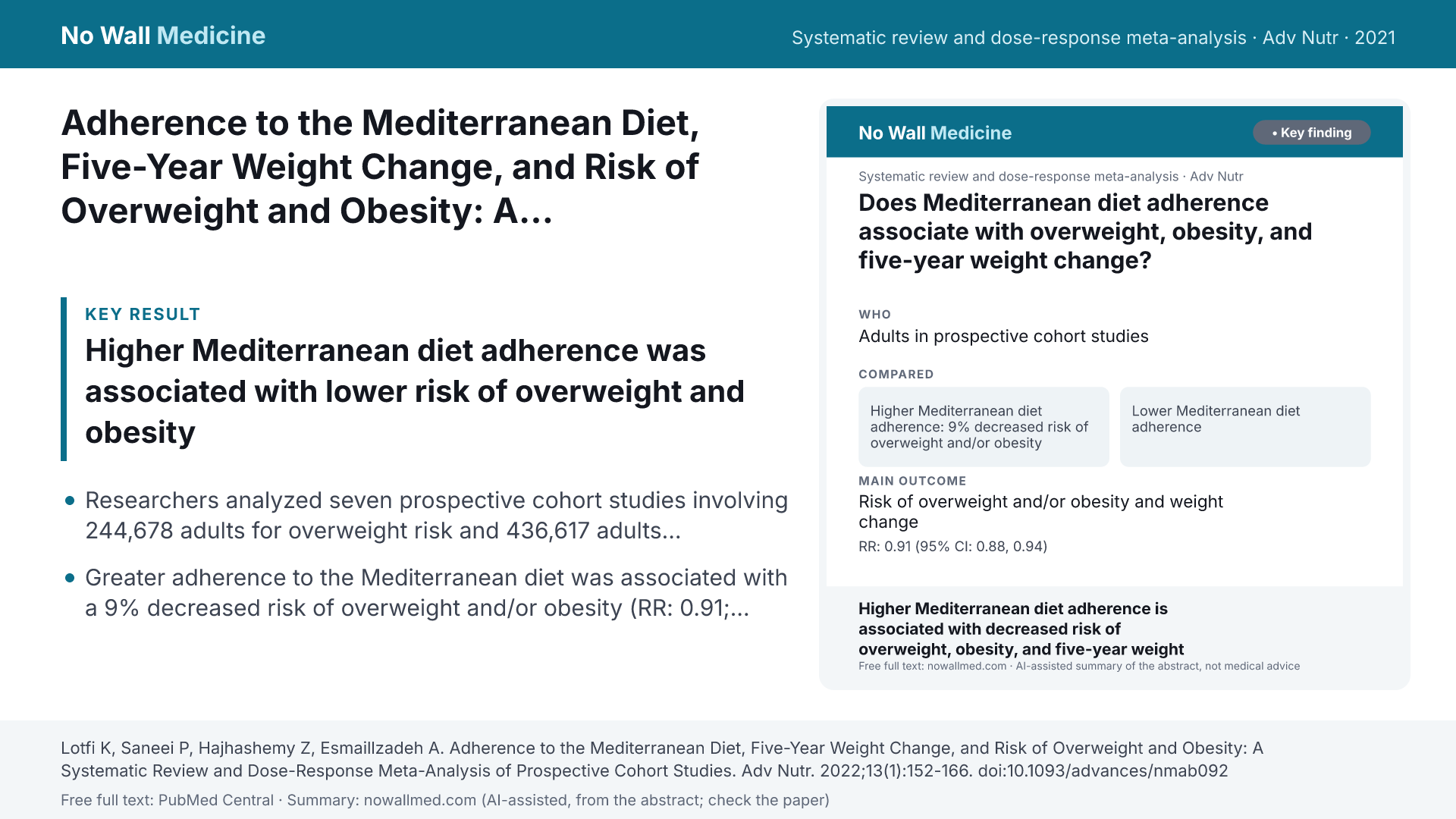
Higher Mediterranean diet adherence was associated with lower risk of overweight and obesity
Adherence to the Mediterranean Diet, Five-Year Weight Change, and Risk of Overweight and Obesity: A Systematic Review and Dose-Response Meta-Analysis of Prospective Cohort Studies
Systematic review and dose-response meta-analysisKey finding
Does Mediterranean diet adherence associate with overweight, obesity, and five-year weight change?
Who
Adults in prospective cohort studies
Compared
Higher Mediterranean diet adherence: 9% decreased risk of overweight and/or obesity
Lower Mediterranean diet adherence
Main outcome
Risk of overweight and/or obesity and weight change
Result: RR: 0.91 (95% CI: 0.88, 0.94)
Bottom line: Higher Mediterranean diet adherence is associated with decreased risk of overweight, obesity, and five-year weight gain.
Adv Nutr · 2021-08-06 · Save PNG
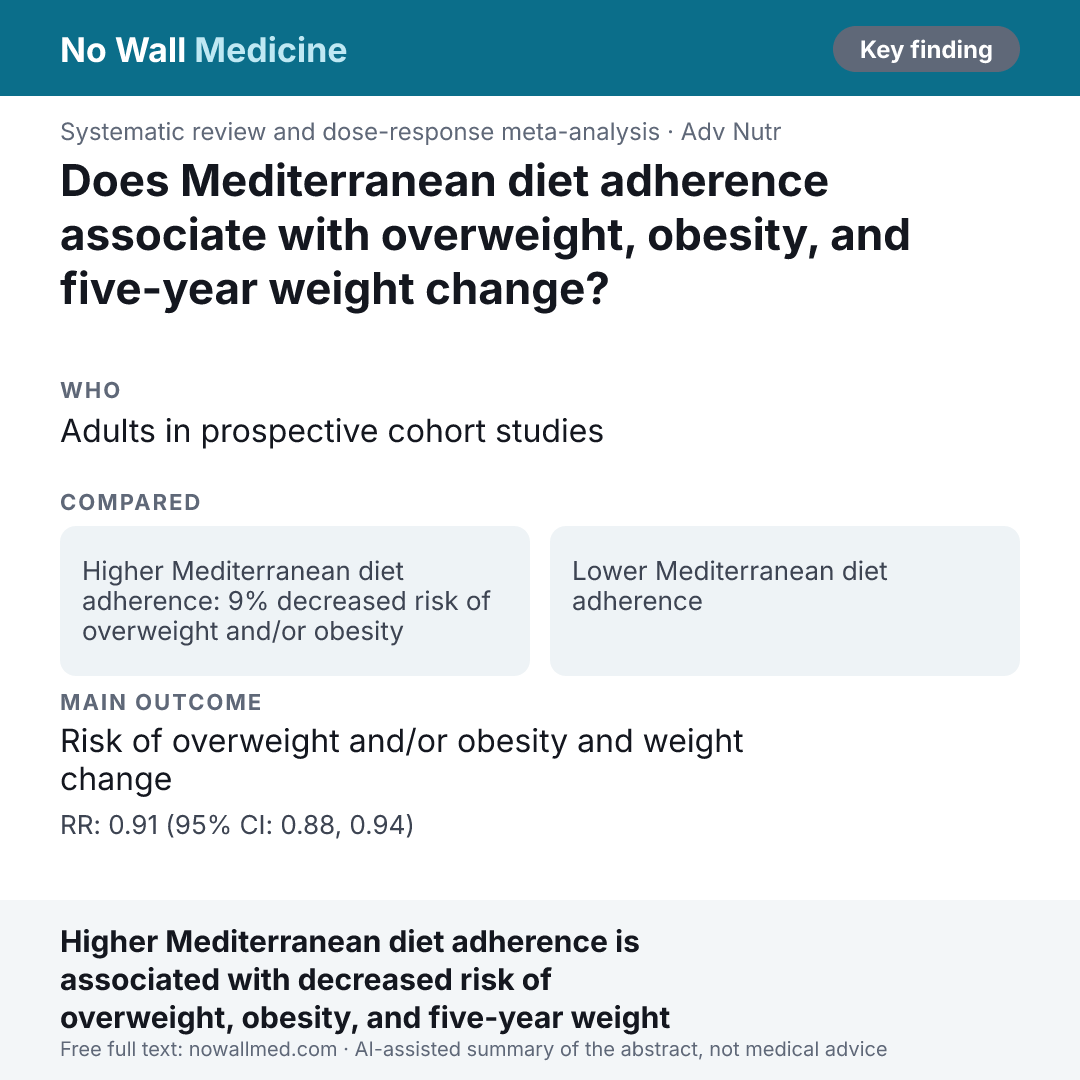
Clinical question: Does Mediterranean diet adherence associate with overweight, obesity, and five-year weight change?
Why it matters: Earlier studies investigating the association between Mediterranean diet adherence and the risk of overweight or obesity provided inconsistent findings.
Key points
- Researchers analyzed seven prospective cohort studies involving 244,678 adults for overweight risk and 436,617 adults for weight change.
- Greater adherence to the Mediterranean diet was associated with a 9% decreased risk of overweight and/or obesity (RR: 0.91; 95% CI: 0.88, 0.94).
- Each unit increase in the Mediterranean diet score was associated with 0.04 kg less weight gain over 5 years (-0.04 kg; 95% CI: -0.07, -0.02 kg).
Headline and key points written with AI from the paper’s abstract, with every number checked against it. Read the paper before relying on them.
Was this summary helpful?
Subject terms
Headline, design, result, key points, caveat and citation as plain text.
Cite this article
Lotfi K, Saneei P, Hajhashemy Z, Esmaillzadeh A. Adherence to the Mediterranean Diet, Five-Year Weight Change, and Risk of Overweight and Obesity: A Systematic Review and Dose-Response Meta-Analysis of Prospective Cohort Studies. Adv Nutr. 2022;13(1):152-166. doi:10.1093/advances/nmab092
Spotted a mistake? Suggest a correction