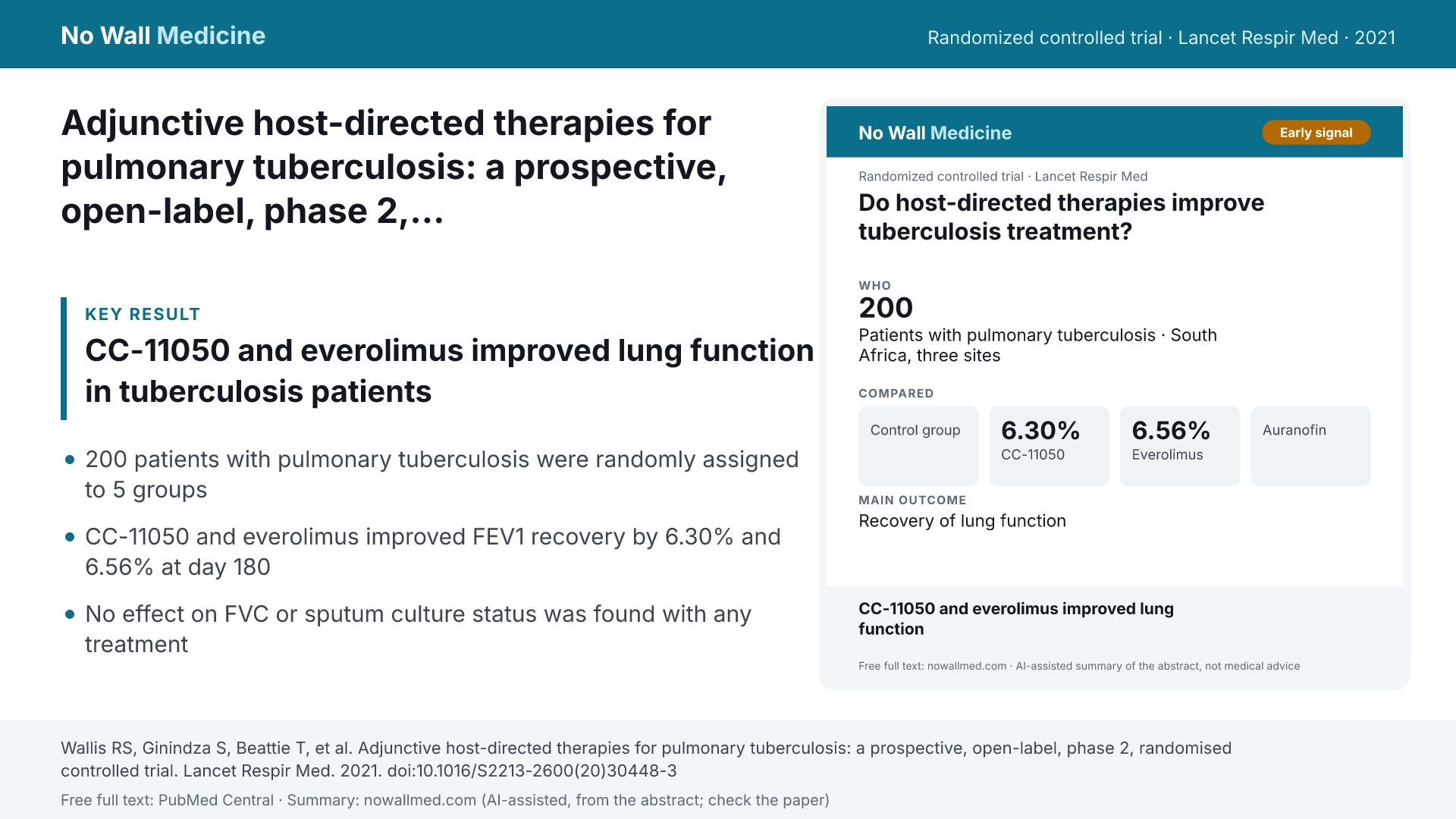
CC-11050 and everolimus improved lung function in tuberculosis patients
Adjunctive host-directed therapies for pulmonary tuberculosis: a prospective, open-label, phase 2, randomised controlled trial
Randomized controlled trialBenefit found
Do host-directed therapies improve tuberculosis treatment?
Who
200
Patients with pulmonary tuberculosis · South Africa, three sites
Compared
Control group
6.30%CC-11050 (0.06-12.54)
6.56%Everolimus (0.18-12.95)
Auranofin
Main outcome
Recovery of lung function
Bottom line: CC-11050 and everolimus improved lung function
Lancet Respir Med · 2021-03-16Download image
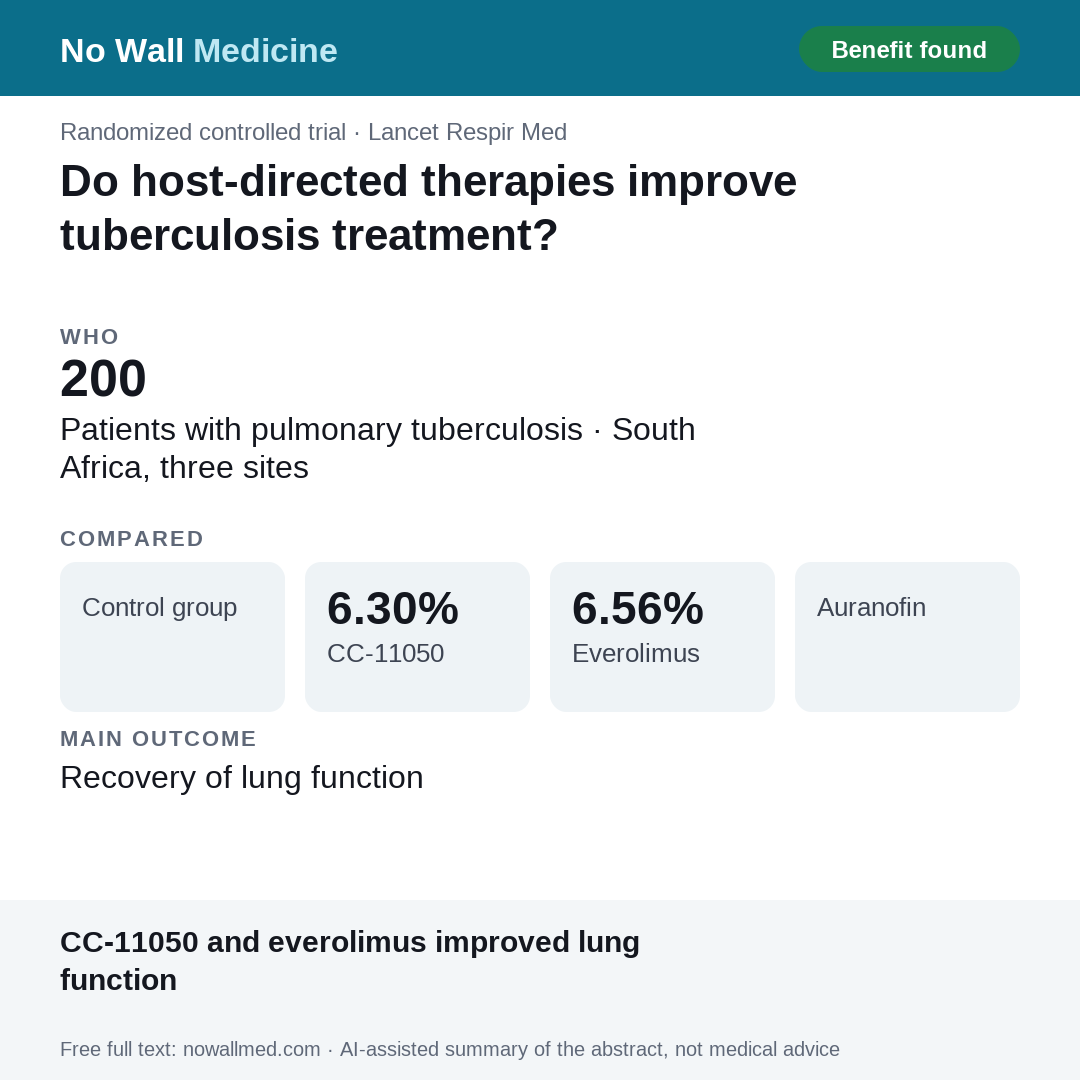
Clinical question: Do host-directed therapies improve tuberculosis treatment?
Why it matters: Current tuberculosis treatments can leave patients with lung injury and increased mortality
Key points
- 200 patients with pulmonary tuberculosis were randomly assigned to 5 groups.
- CC-11050 and everolimus improved FEV1 recovery by 6.30% and 6.56% at day 180.
- No effect on FVC or sputum culture status was found with any treatment.
Headline and key points written with AI from the paper’s abstract, with every number checked against it. Read the paper before relying on them.
Was this summary helpful?
Abstract
Background
Current tuberculosis treatments leave patients with clinically significant lung injury and increased all-cause mortality post-cure. Adjunctive host-directed therapies could protect the lungs, improve long-term survival, and shorten treatment duration; however, few have been tested clinically. Therefore, we aimed to assess the safety and preliminary efficacy of four host-directed therapies for tuberculosis. Methods
In this prospective, open-label, phase 2, randomised controlled trial, patients with pulmonary tuberculosis were recruited at three clinical sites in South Africa. Eligible patients were aged 18-65 years, HIV-1-negative, and had rifampicin-susceptible Mycobacterium tuberculosis, a sputum Xpert cycle threshold of less than 20, and moderately advanced or far advanced disease on chest radiography. By use of numbers generated in blocks of ten and stratification by site, eligible patients were randomly assigned (1:1:1:1:1) to receive one of the four oral host-directed treatments plus standard tuberculosis treatment or standard treatment alone (the control group). Host-directed treatments were: CC-11050 (200 mg twice daily, taken with food; day 1-112); everolimus (0·5 mg/day; day 1-112); auranofin (3 mg/day for seven doses, then 6 mg/day; day 1-112); and ergocalciferol (5 mg on day 1, then 2·5 mg on day 28 and day 56). All study participants received oral rifabutin-substituted standard tuberculosis treatment for 180 days. Patients and clinicians were not masked to treatment assignment. Spirometry and sputum culture with solid and liquid media were done at baseline and up to 180 days at specified intervals throughout treatment. The primary endpoint was safety and tolerability up to day 210. Secondary preliminary efficacy endpoints were treatment effects on sputum microbiology (culture status at day 56 and the hazard ratio for stable culture conversion up to day 180) and lung function (FEV1 and forced vital capacity [FVC]) measured by spirometry at day 56, day 180, and day 540. Safety was analysed in the intention-to-treat population and preliminary efficacy primarily in the per-protocol population. The trial is registered at ClinicalTrials.gov, NCT02968927. Post-treatment follow-up was completed in 2020. Findings
Between Nov 18, 2016, and Sept 27, 2018, 200 patients were screened and randomly assigned to different treatment groups (n=40 per group, apart from n=39 in the everolimus group after one patient withdrew consent). 11 treatment-emergent serious adverse events occurred either during treatment or within 30 days after treatment discontinuation, of which three were attributable to a host-directed treatment. Life-threatening thrombocytopenia occurred in an auranofin recipient; apparent intra-abdominal sepsis leading to death occurred in another auranofin recipient and was classified as a suspected unexpected serious adverse reaction. Tuberculous spondylitis occurred as an apparent paradoxical reaction in a patient receiving ergocalciferol. Two patients in the control group had life-threatening, treatment-attributable liver injury. No treatment-emergent, treatment-attributable serious adverse events occurred in patients receiving CC-11050 or everolimus. Mean FEV1 in the control group was 61·7% of predicted (95% CI 56·3-67·1) at baseline and 69·1% (62·3-75·8) at day 180. Patients treated with CC-11050 and everolimus had increased recovery of FEV1 at day 180 relative to the control group (mean difference from control group 6·30%, 95% CI 0·06-12·54; p=0·048; and 6·56%, 0·18-12·95; p=0·044, respectively), whereas auranofin and ergocalciferol recipients did not. None of the treatments had an effect on FVC during 180 days of follow-up or on measures of sputum culture status over the course of the study. Interpretation
CC-11050 and everolimus were safe and reasonably well tolerated as adjunctive therapies for tuberculosis, and analysis of preliminary efficacy suggests they might also enhance the recovery of FEV1, a key measure of lung function and predictor of all-cause mortality. Further studies of these candidates are warranted. Funding
The Bill & Melinda Gates Foundation and the South African Medical Research Council.
Abstract reproduced under the article’s CC BY licence.
Subject terms
Cite this article
Wallis RS, Ginindza S, Beattie T, Arjun N, Likoti M, Edward VA. Adjunctive host-directed therapies for pulmonary tuberculosis: a prospective, open-label, phase 2, randomised controlled trial. Lancet Respir Med. 2021. doi:10.1016/S2213-2600(20)30448-3
Spotted a mistake? Suggest a correction