Adding ivermectin to malaria drug administration showed no additional effect on infection prevalence
Adjunctive ivermectin mass drug administration for malaria control on the Bijagos Archipelago of Guinea-Bissau (MATAMAL): a quadruple-blinded, cluster-randomised, placebo-controlled trial
Quadruple-blinded, cluster-randomised, placebo-controlled trialNo clear difference
Does adding ivermectin to mass drug administration reduce malaria prevalence?
Who
25882
Residents of the Bijagos Archipelago, Guinea-Bissau · Bijagos Archipelago, Guinea-Bissau
Compared
6.64%Dihydroartemisinin-piperaquine and ivermectin (141/2083)
5.05%Dihydroartemisinin-piperaquine and placebo (118/2300)
Main outcome
Quantitative polymerase chain reaction prevalence of Plasmodium falciparum parasitaemia
Result: risk difference 1.67% (95% CI -1.44 to 4.78)
Bottom line: Adding ivermectin to mass drug administration had no additional effect on reducing malaria prevalence or vector parity.
Funded by: NIHR, Medical Research Council, Wellcome, and FCDO
Lancet Infect Dis · 2024-11-14Download image
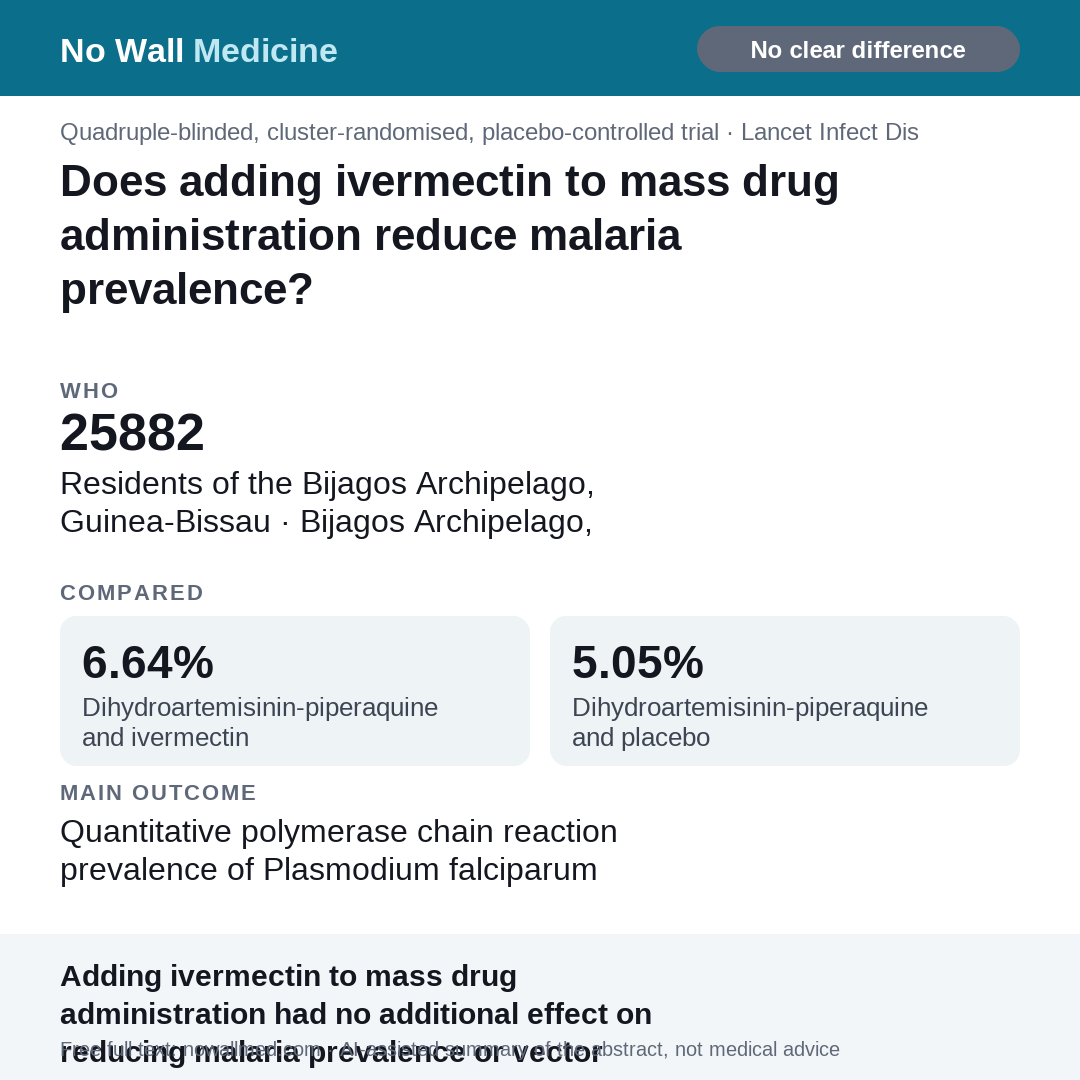
Clinical question: Does adding ivermectin to mass drug administration reduce malaria prevalence?
Why it matters: It was unclear if using ivermectin alongside mass drug administration with dihydroartemisinin-piperaquine would further reduce the burden of malaria.
Key points
- Researchers studied 25,882 residents in Guinea-Bissau, comparing mass drug administration with dihydroartemisinin-piperaquine plus ivermectin against dihydroartemisinin-piperaquine plus a placebo.
- The prevalence of Plasmodium falciparum infection was 6.64% in the intervention group and 5.05% in the control group, with an adjusted risk difference of 1.67% (p=0.28).
- The anopheline parity rate, a measure of mosquito age, was 72.3% in the intervention group and 67.8% in the control group, with an adjusted risk difference of -1.32 (p=0.84).
Headline and key points written with AI from the paper’s abstract, with every number checked against it. Read the paper before relying on them.
Abstract
Background
Arthropod vectors feeding on the blood of individuals treated with ivermectin have substantially increased mortality. Whether this effect will translate into a useful tool for reducing malaria burden at scale is not clear. Our trial aimed to assess whether using ivermectin as an adjunct to mass drug administration (MDA) with dihydroartemisinin-piperaquine would further reduce malaria prevalence. Methods
MATAMAL was a quadruple-blinded, cluster-randomised, placebo-controlled trial, conducted on the Bijagos Archipelago, Guinea-Bissau, an area of seasonal malaria transmission. All residents were invited to participate, with exclusions for drug safety. 24 clusters were randomised in a 1:1 ratio, using restriction randomisation, to either MDA with three daily oral doses of dihydroartemisinin-piperaquine and ivermectin (300 μg/kg per day) in three sequential months during the transmission season in 2021 and 2022, or MDA with dihydroartemisinin-piperaquine and placebo in the same schedule. The primary outcome was quantitative PCR prevalence of Plasmodium falciparum parasitaemia in all age groups, during peak transmission, after the second year of intervention. The primary entomological outcome was anopheline parity rate. The trial is registered with ClinicalTrials.gov (NCT04844905). Findings
Participants were recruited between June 7, 2021 and Sept 21, 2022. The baseline population was 25 882 (12 634 [50·6%] were female individuals and 12 317 [49·4%] were male individuals): 13 832 were in the intervention group and 12 050 in the control group. Cluster-level coverage for dihydroartemisinin-piperaquine ranged from 60·4% to 78·7%, and for ivermectin or ivermectin-placebo from 58·1 to 77·1%. Following the intervention, the prevalence of P falciparum infection was 118 (5·05%) of 2300 in the control group and 141 (6·64%) of 2083 in the intervention group. The adjusted risk difference was 1·67% (95% CI -1·44 to 4·78; p=0·28). There were 124 adverse events in the control group (1·0% of participants) and 267 in the intervention group (1·9% of participants). Two serious adverse events were reported, neither related to the intervention, and no treatment-related deaths. The anopheline parity rate was 1679 (67·8%) of 2475 in control clusters and 1740 (72·3%) of 2414 in intervention clusters. The adjusted risk difference was -1·32 (95% CI -14·77 to 12·12; p=0·84). Interpretation
Adding ivermectin to dihydroartemisinin-piperaquine MDA had no additional effect on reducing malaria prevalence or vector parity in this setting. The intervention was well tolerated. To our knowledge, this trial is the first to be designed to assess whether ivermectin has an additive effect on malaria when coadministered with dihydroartemisinin-piperaquine MDA. Funding
The National Institute for Health and Care Research, Medical Research Council, Wellcome, and Foreign, Commonwealth & Development Office.
Abstract reproduced under the article’s CC BY licence.
Topics
Cite this article
Hutchins H, Pretorius E, Bradley J, Teixeira da Silva E, Vasileva H, Ndiath MO. Adjunctive ivermectin mass drug administration for malaria control on the Bijagos Archipelago of Guinea-Bissau (MATAMAL): a quadruple-blinded, cluster-randomised, placebo-controlled trial. Lancet Infect Dis. 2024. doi:10.1016/S1473-3099(24)00580-2
Spotted a mistake? Suggest a correction
Top studies every Monday
The week’s key trials and guidelines in your specialties, by email. Free.
Get the weekly digest