Cognitive-behavioral therapy and peer recovery support did not increase opioid abstinence in patients using buprenorphine
Adjunctive Psychosocial Interventions and Opioid Abstinence Among Patients Receiving Buprenorphine: A Randomized Clinical Trial
Randomized clinical trialNo clear difference
Do psychosocial interventions improve opioid abstinence
Who
340
US adults with opioid use disorder · 5 US health centers
Compared
MOUD treatment as usual
MOUD plus CBT
MOUD plus PRS
MOUD plus CBT and PRS
Main outcome
urinalysis-confirmed opioid abstinence
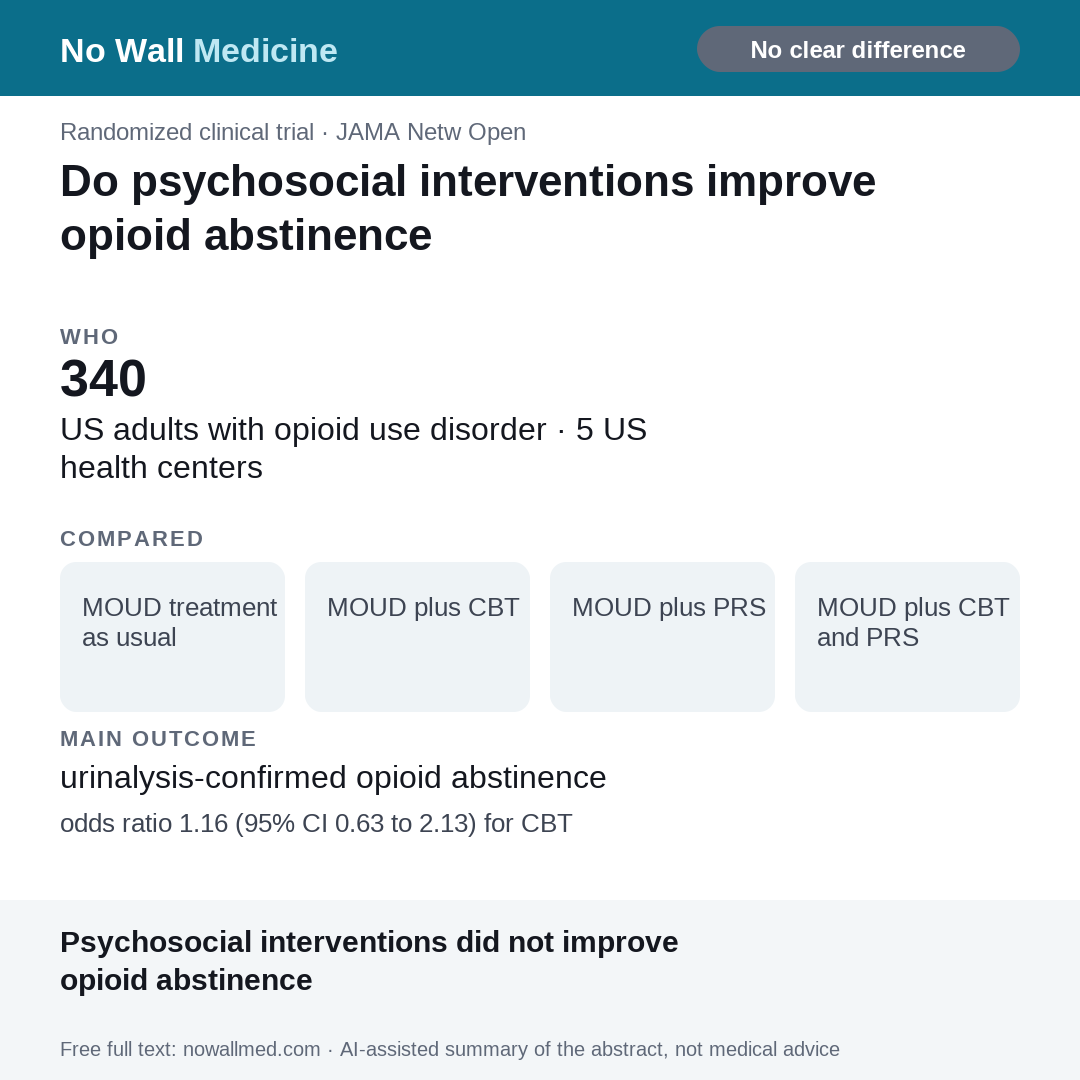
Result: odds ratio 1.16 (95% CI 0.63 to 2.13) for CBT
Bottom line: Psychosocial interventions did not improve opioid abstinence
JAMA Netw Open · 2026-06-01Download image
Why it matters: It is unclear which psychosocial approaches best enhance treatment outcomes for patients receiving medications for opioid use disorder.
Key points
- Researchers studied 340 US adults with opioid use disorder who were randomized to receive buprenorphine alone or with cognitive-behavioral therapy, peer recovery support, or both.
- Neither cognitive-behavioral therapy (odds ratio, 1.16; 95% CI, 0.63-2.13) nor peer recovery support (odds ratio, 0.87; 95% CI, 0.48-1.59) was associated with confirmed opioid abstinence.
- The combination of both therapies also showed no significant effect on opioid abstinence (odds ratio, 0.99; 95% CI, 0.30-3.27).
Headline and key points written with AI from the paper’s abstract, with every number checked against it. Read the paper before relying on them.
Topics
Spotted a mistake? Suggest a correction