Adding clot-dissolving drugs after mechanical stroke procedures increases chances of excellent functional outcomes
Adjunctive Thrombolytics After Successful Endovascular Reperfusion: A Systematic Review and Meta-Analysis of Randomized Controlled Trials
Meta-analysis of 6 randomized controlled trialsBenefit found
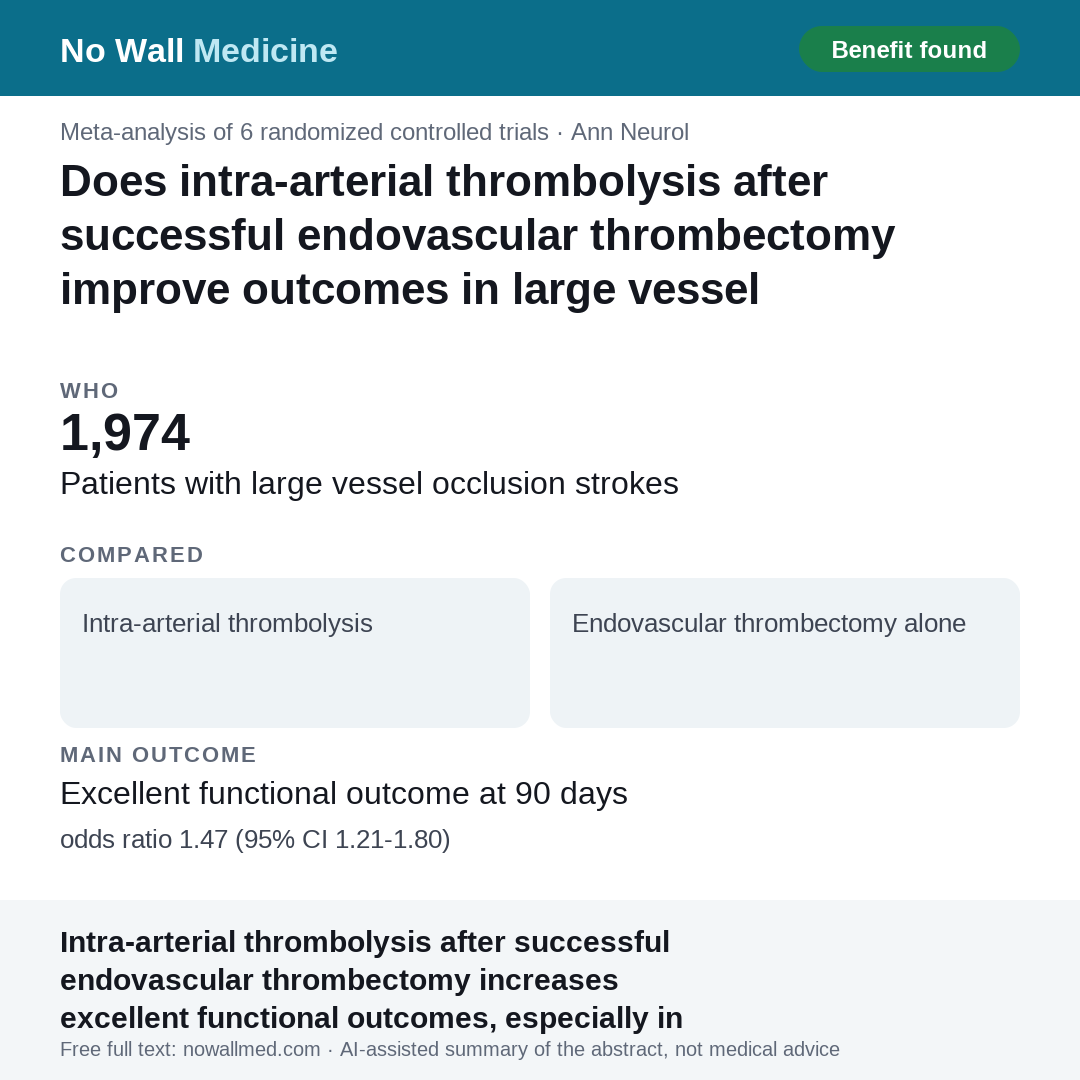
Does intra-arterial thrombolysis after successful endovascular thrombectomy improve outcomes in large vessel occlusion strokes?
Who
1,974
Patients with large vessel occlusion strokes
Compared
Intra-arterial thrombolysis
Endovascular thrombectomy alone
Main outcome
Excellent functional outcome at 90 days
Result: odds ratio 1.47 (95% CI 1.21-1.80)
Bottom line: Intra-arterial thrombolysis after successful endovascular thrombectomy increases excellent functional outcomes, especially in anterior circulation strokes.
Ann Neurol · 2025-08-13Download image
Clinical question: Does intra-arterial thrombolysis after successful endovascular thrombectomy improve outcomes in large vessel occlusion strokes?
Why it matters: Recent randomized controlled trials have yielded conflicting results regarding whether adding clot-dissolving drugs after mechanical clot removal improves outcomes for large vessel occlusion stroke patients.
Key points
- Researchers analyzed 6 randomized controlled trials involving 1,974 patients to see if adding intra-arterial thrombolysis after successful endovascular thrombectomy improved stroke recovery.
- The addition of clot-dissolving drugs increased the odds of an excellent functional outcome at 90 days (mRS 0-1) with an odds ratio of 1.47.
- The benefit was seen in anterior circulation strokes (OR 1.48) but was not statistically significant for posterior circulation strokes (OR 1.51, p=0.18).
Headline and key points written with AI from the paper’s abstract, with every number checked against it. Read the paper before relying on them.
Was this summary helpful?
Subject terms
Cite this article
Doheim MF, Mohammaden MH, Jumah A, Yang Q, Zi W, Chen Y. Adjunctive Thrombolytics After Successful Endovascular Reperfusion: A Systematic Review and Meta-Analysis of Randomized Controlled Trials. Ann Neurol. 2025. doi:10.1002/ana.70021
Spotted a mistake? Suggest a correction
Top studies every Monday
The week’s key trials and guidelines in your specialties, plus any topics you follow. By email, free.
Get the weekly digest