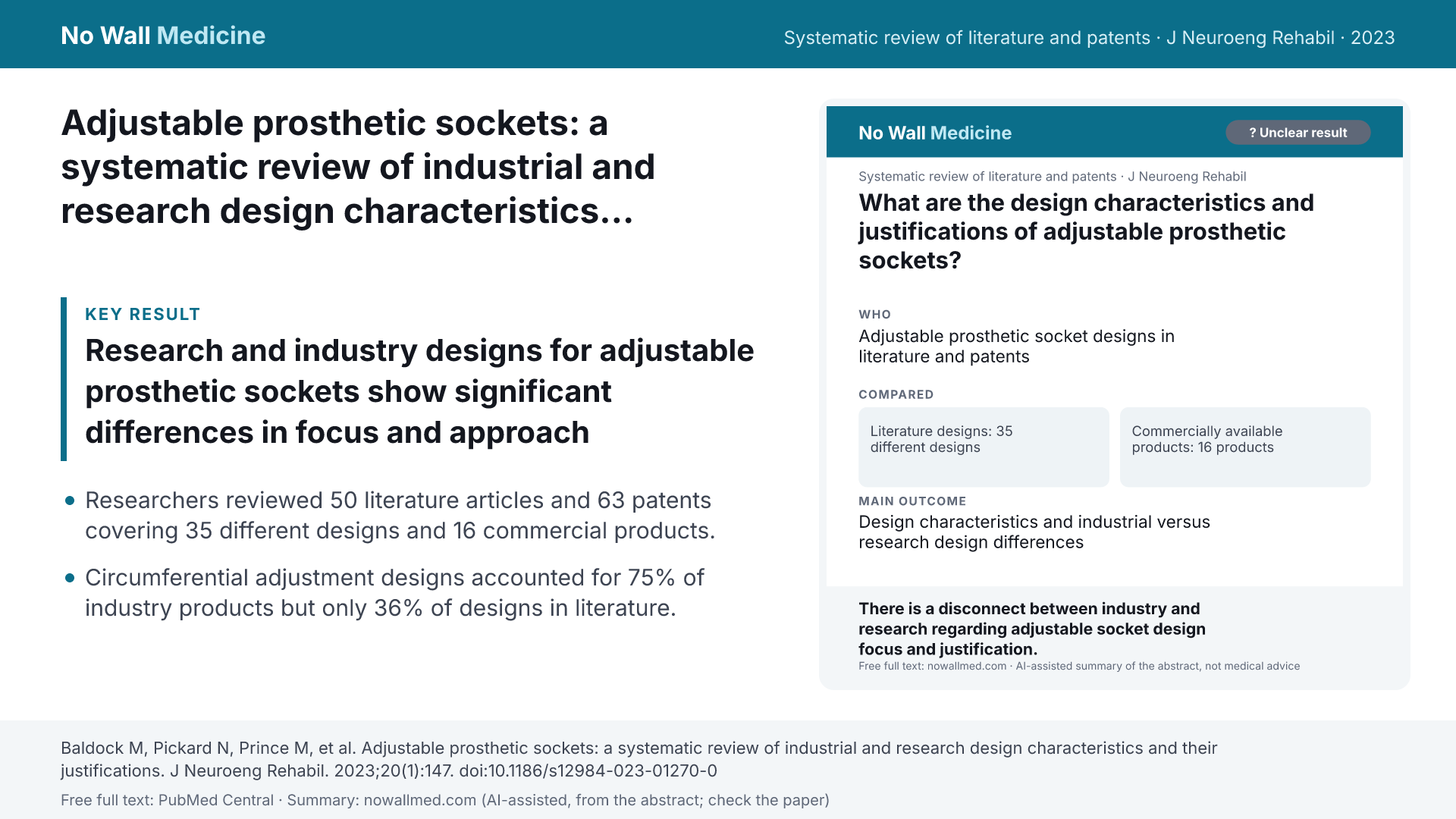
Research and industry designs for adjustable prosthetic sockets show significant differences in focus and approach
Adjustable prosthetic sockets: a systematic review of industrial and research design characteristics and their justifications
Systematic review of literature and patentsUnclear result
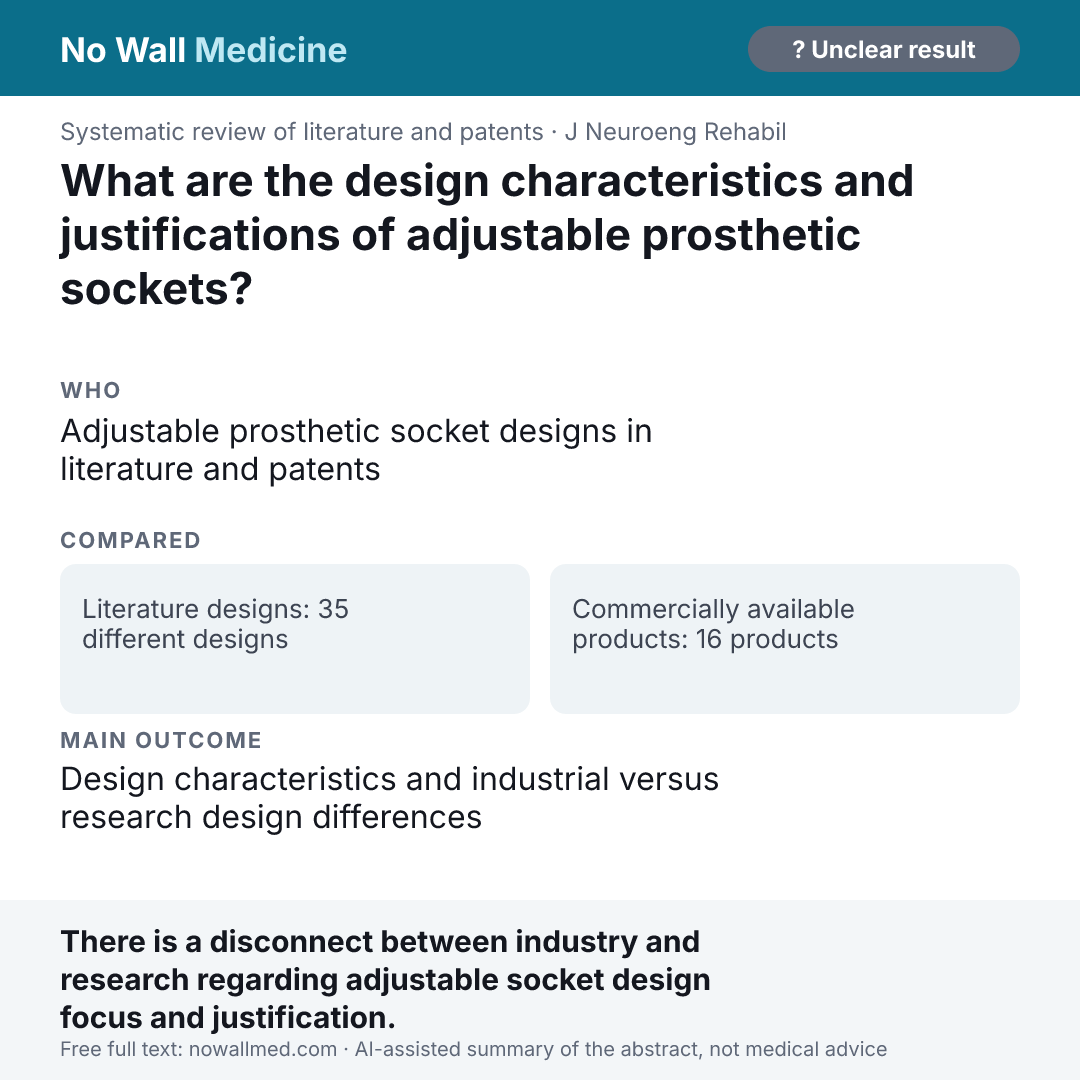
What are the design characteristics and justifications of adjustable prosthetic sockets?
Who
Adjustable prosthetic socket designs in literature and patents
Compared
Literature designs: 35 different designs
Commercially available products: 16 products
Main outcome
Design characteristics and industrial versus research design differences
Bottom line: There is a disconnect between industry and research regarding adjustable socket design focus and justification.
J Neuroeng Rehabil · 2023-11-06 · Save PNG
Clinical question: What are the design characteristics and justifications of adjustable prosthetic sockets?
Why it matters: The relationship between adjustable socket design and patient comfort or function is rarely investigated, and the rationale for specific design choices is often unclear.
Key points
- Researchers reviewed 50 literature articles and 63 patents covering 35 different designs and 16 commercial products.
- Circumferential adjustment designs accounted for 75% of industry products but only 36% of designs in literature.
- Only 17.6% of clinical studies assessed a commercially available socket, and many studies were small in size.
Limitation the authors note: Clinical studies were generally small in size and many lacked appropriate safety features to prevent tissue damage or inadequate coupling.
Headline and key points written with AI from the paper’s abstract, with every number checked against it. Read the paper before relying on them.
Was this summary helpful?
Subject terms
Headline, design, result, key points, caveat and citation as plain text.
Cite this article
Baldock M, Pickard N, Prince M, et al. Adjustable prosthetic sockets: a systematic review of industrial and research design characteristics and their justifications. J Neuroeng Rehabil. 2023;20(1):147. doi:10.1186/s12984-023-01270-0
Spotted a mistake? Suggest a correction