Adjusting for subsequent therapies shows improved survival with ixazomib in multiple myeloma patients
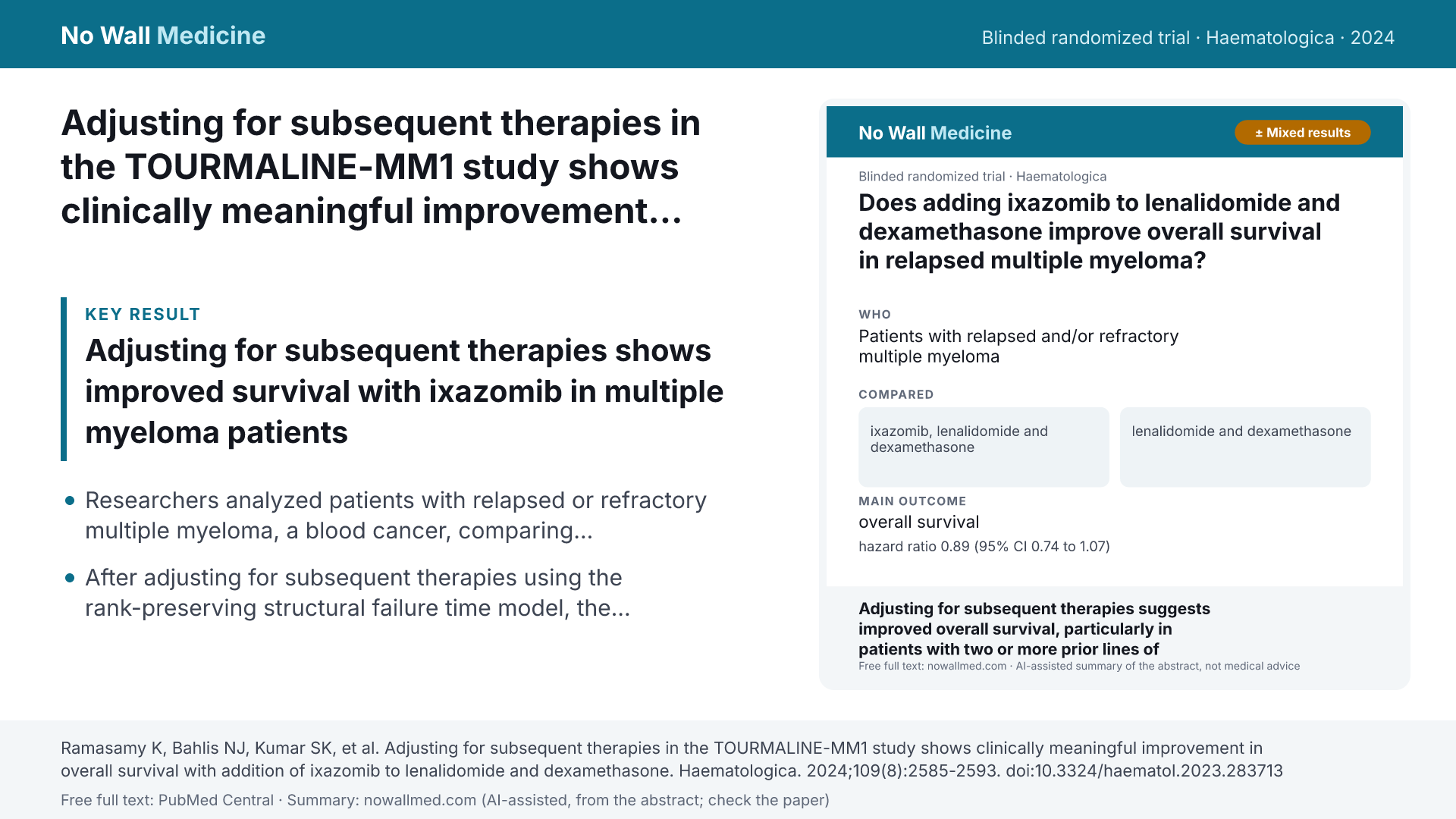
Adjusting for subsequent therapies in the TOURMALINE-MM1 study shows clinically meaningful improvement in overall survival with addition of ixazomib to lenalidomide and dexamethasone
Blinded randomized trialMixed results
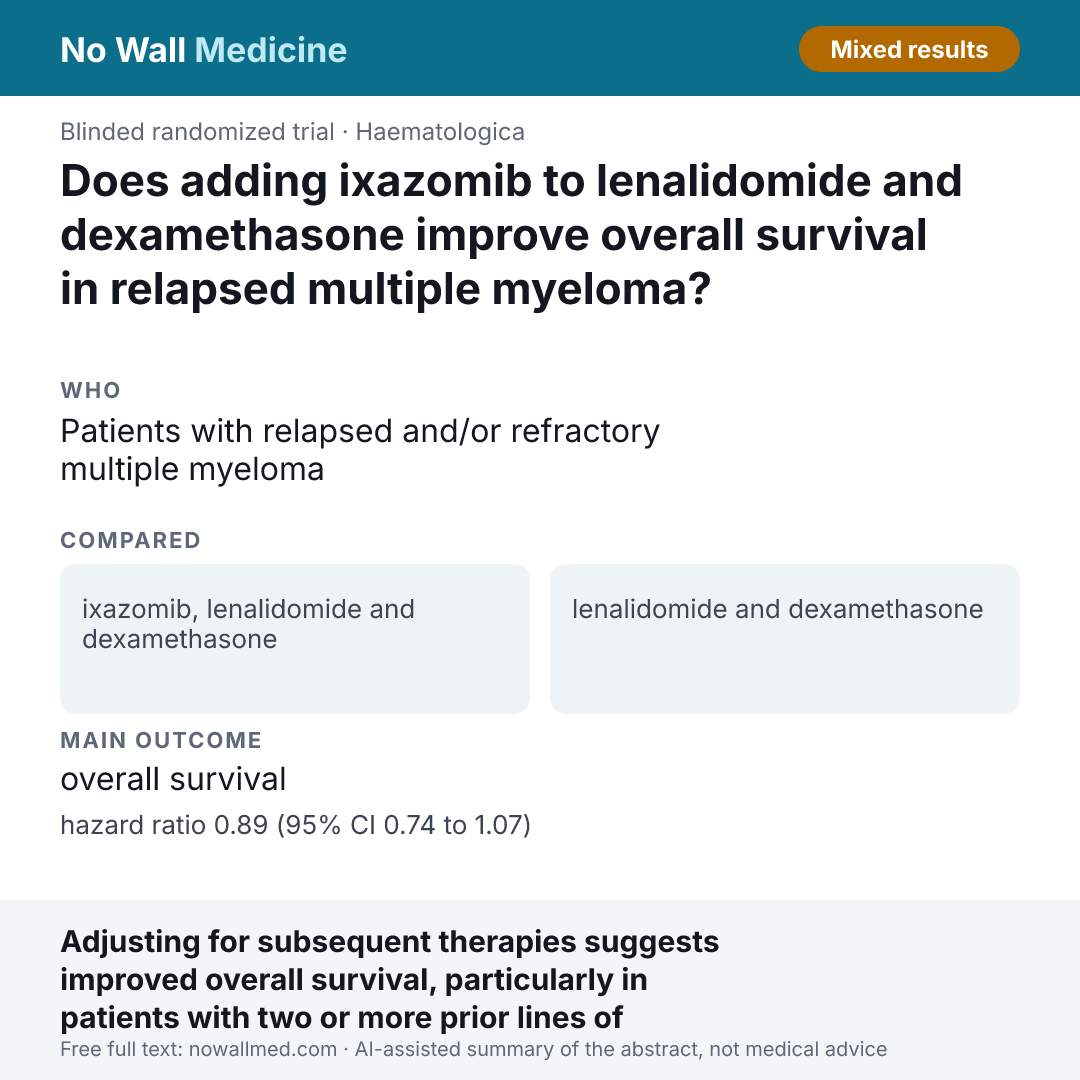
Does adding ixazomib to lenalidomide and dexamethasone improve overall survival in relapsed multiple myeloma?
Who
Patients with relapsed and/or refractory multiple myeloma
Compared
ixazomib, lenalidomide and dexamethasone
lenalidomide and dexamethasone
Main outcome
overall survival
Result: hazard ratio 0.89 (95% CI 0.74 to 1.07)
Bottom line: Adjusting for subsequent therapies suggests improved overall survival, particularly in patients with two or more prior lines of therapy.
Limitation: Subsequent therapies and newer modes of therapy can complicate the interpretation of overall survival.
Haematologica · 2024-08-01 · Save PNG
Clinical question: Does adding ixazomib to lenalidomide and dexamethasone improve overall survival in relapsed multiple myeloma?
Why it matters: Subsequent therapies received after a clinical trial can complicate the interpretation of overall survival outcomes in patients with relapsed or refractory multiple myeloma.
Key points
- Researchers analyzed patients with relapsed or refractory multiple myeloma, a blood cancer, comparing ixazomib, lenalidomide, and dexamethasone to lenalidomide and dexamethasone alone.
- After adjusting for subsequent therapies using the rank-preserving structural failure time model, the estimated hazard ratio for the three-drug group was 0.89 (95% CI: 0.74-1.07).
- In patients with 2 or more prior lines of therapy, adjusted hazard ratios were 0.52 (95% CI: 0.30-0.88) using IPCW and MSM methods and 0.68 (95% CI: 0.51-0.91) using RPSFTM.
Headline and key points written with AI from the paper’s abstract, with every number checked against it. Read the paper before relying on them.
Was this summary helpful?
Subject terms
Headline, design, result, key points, caveat and citation as plain text.
Cite this article
Ramasamy K, Bahlis NJ, Kumar SK, et al. Adjusting for subsequent therapies in the TOURMALINE-MM1 study shows clinically meaningful improvement in overall survival with addition of ixazomib to lenalidomide and dexamethasone. Haematologica. 2024;109(8):2585-2593. doi:10.3324/haematol.2023.283713
Spotted a mistake? Suggest a correction