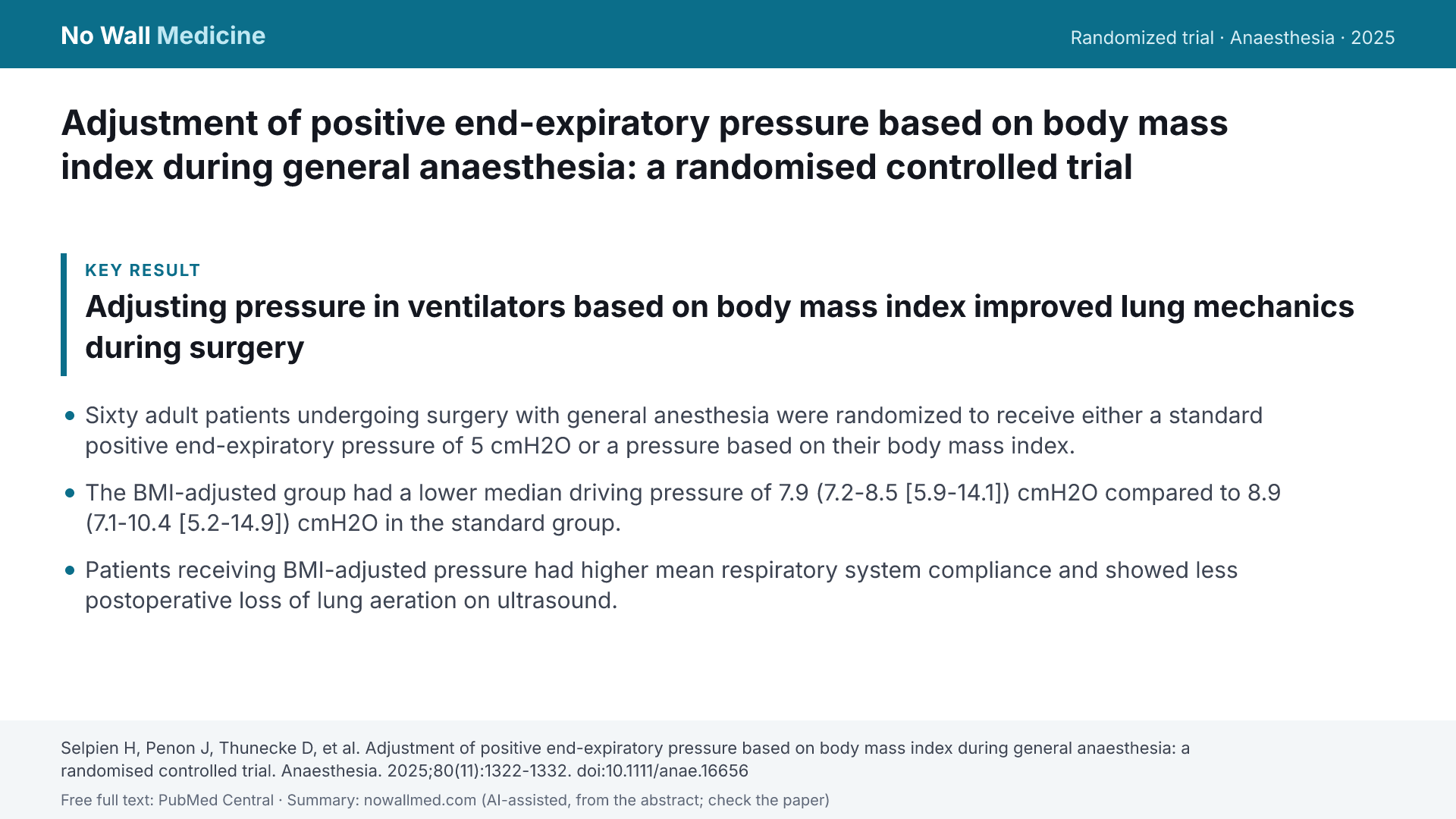
Adjusting pressure in ventilators based on body mass index improved lung mechanics during surgery
Adjustment of positive end-expiratory pressure based on body mass index during general anaesthesia: a randomised controlled trial
Why it matters: The ideal strategy for optimizing positive end-expiratory pressure to prevent postoperative pulmonary complications remains contentious.
Key points
- Sixty adult patients undergoing surgery with general anesthesia were randomized to receive either a standard positive end-expiratory pressure of 5 cmH2O or a pressure based on their body mass index.
- The BMI-adjusted group had a lower median driving pressure of 7.9 (7.2-8.5 [5.9-14.1]) cmH2O compared to 8.9 (7.1-10.4 [5.2-14.9]) cmH2O in the standard group.
- Patients receiving BMI-adjusted pressure had higher mean respiratory system compliance and showed less postoperative loss of lung aeration on ultrasound.
Headline and key points written with AI from the paper’s abstract, with every number checked against it. Read the paper before relying on them.
Was this summary helpful?
Subject terms
Headline, design, result, key points, caveat and citation as plain text.
Cite this article
Selpien H, Penon J, Thunecke D, et al. Adjustment of positive end-expiratory pressure based on body mass index during general anaesthesia: a randomised controlled trial. Anaesthesia. 2025;80(11):1322-1332. doi:10.1111/anae.16656
Spotted a mistake? Suggest a correction