Alectinib showed manageable safety and improved quality of life compared to chemotherapy in lung cancer
Adjuvant alectinib versus chemotherapy in resected ALK-positive non-small-cell lung cancer (ALINA): health-related quality-of-life and safety outcomes from a randomised, open-label, phase 3 trial
Randomised, open-label, phase 3 trialBenefit found
Are adjuvant alectinib and chemotherapy safe and effective for health-related quality-of-life in resected ALK-positive NSCLC?
Who
257
Patients with resected, ALK-positive, stage IB to IIIA non-small-cell lung cancer · Global
Compared
Alectinib: 7% serious treatment-related adverse events
Chemotherapy: 7% serious treatment-related adverse events
Main outcome
Safety and health-related quality-of-life
Bottom line: Adjuvant alectinib showed a manageable safety profile and maintained improved health-related quality-of-life over 2 years of treatment.
Funded by: F Hoffmann-La Roche
Lancet Oncol · 2026-08-24Download image
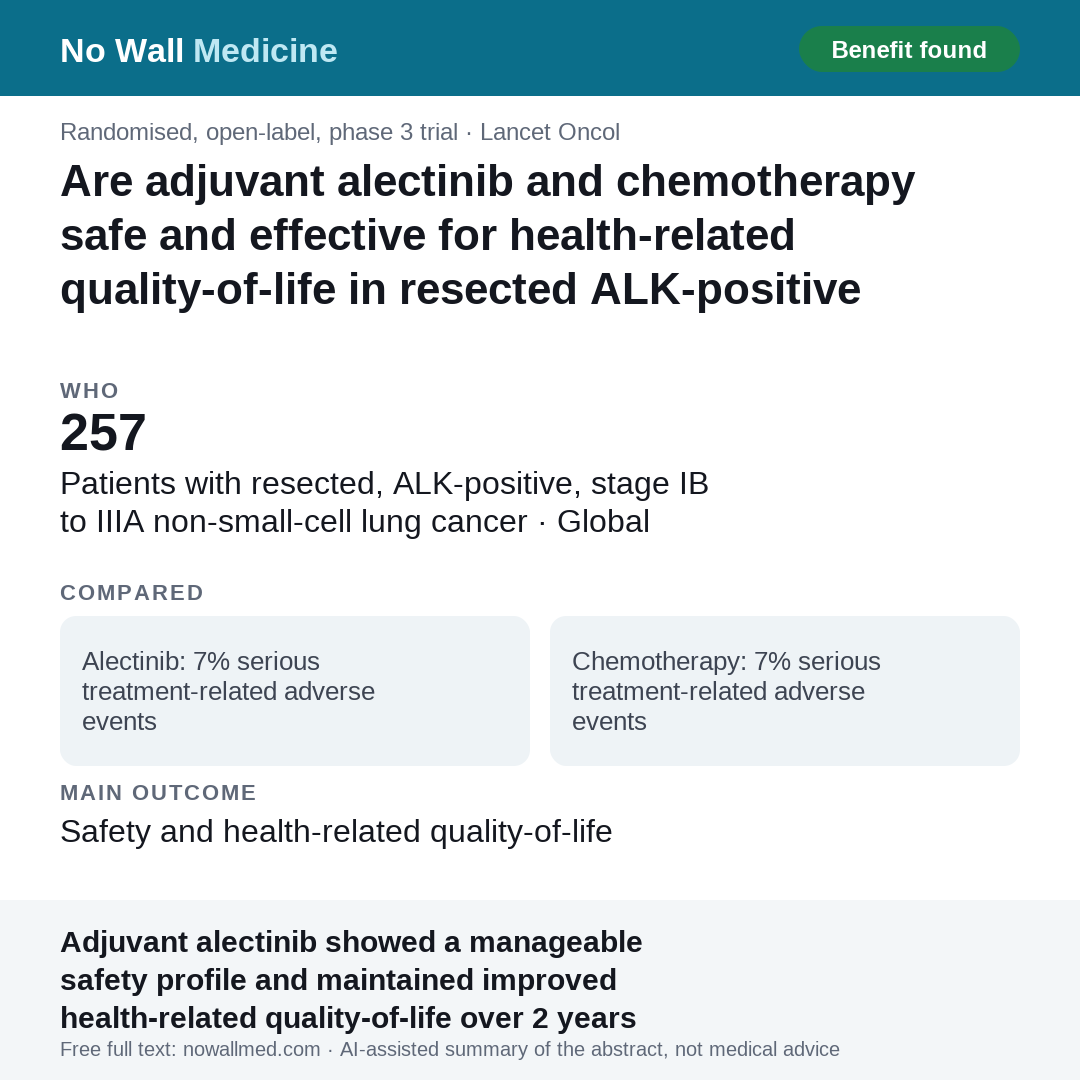
Clinical question: Are adjuvant alectinib and chemotherapy safe and effective for health-related quality-of-life in resected ALK-positive NSCLC?
Why it matters: Researchers needed to understand the safety and health-related quality-of-life outcomes for patients receiving alectinib after surgery for ALK-positive lung cancer.
Key points
- Researchers studied 257 patients with resected, ALK-positive non-small-cell lung cancer assigned to receive either alectinib or platinum-based chemotherapy.
- Serious treatment-related adverse events occurred in 2% of the alectinib group and 7% of the chemotherapy group, with no deaths reported due to adverse events.
- Patients receiving alectinib showed clinically meaningful improvements in several health-related quality-of-life domains that were maintained over 2 years of treatment.
Headline and key points written with AI from the paper’s abstract, with every number checked against it. Read the paper before relying on them.
Abstract
Background
For patients with resected, ALK-positive non-small-cell lung cancer (NSCLC), adjuvant alectinib significantly improved disease-free survival versus platinum-based chemotherapy in the global, phase 3, open-label, randomised ALINA trial. We report safety and health-related quality-of-life (HRQoL) outcomes from the ALINA trial. Methods
Eligible patients aged 18 years or older with resected, ALK-positive, stage IB (≥4 cm)-IIIA NSCLC (per the American Joint Committee on Cancer and the Union for International Cancer Control Cancer Staging Manual 7th edition) and an Eastern Cooperative Oncology Group performance status of 0-1 were randomly assigned (1:1) via a block-stratified randomisation method to receive oral alectinib (600 mg twice daily) for 24 months or intravenous platinum-based chemotherapy for four 3-week cycles. Randomisation was stratified according to disease stage and race. The primary endpoint, previously reported, was disease-free survival. Safety was a secondary endpoint and HRQoL was an exploratory endpoint. Safety was assessed by the investigator as per the National Cancer Institute Common Terminology Criteria for Adverse Events version 5·0 until 28 days after the last alectinib dose or chemotherapy cycle. HRQoL was assessed via the Short-Form 36-item health survey version 2 (SF-36v2) questionnaire at baseline, every 3 weeks to week 12, then every 12 weeks until disease recurrence, consent withdrawal, death, or week 96. Norm-based scoring was applied; clinically meaningful changes were defined using the SF-36v2 manual. Safety was assessed in the safety-evaluable population and HRQoL in the intention-to-treat population. This study is registered with ClinicalTrials.gov (NCT03456076) and is ongoing. Findings
Between Aug 16, 2018, and Dec 8, 2021, 257 patients were assigned to receive alectinib (n=130) or chemotherapy (n=127). 123 (48%) patients were male and 134 (52%) were female; 143 (56%) were Asian. The safety-evaluable population comprised 128 patients who received alectinib and 120 patients who received chemotherapy; median duration of safety follow-up was 24·8 months (IQR 22·0-24·9) in the alectinib group and 3·7 months (IQR 3·7-3·8) in the chemotherapy group. The safety of adjuvant alectinib was generally consistent with its known profile. The most common grade 3-4 adverse events were blood creatine phosphokinase increased (eight [6%] of 128), alanine aminotransferase increased (two [2%] of 128), and blood bilirubin increased (two [2%] of 128) in the alectinib group, and neutrophil count decreased (12 [10%] of 120), neutropenia (ten [8%] of 120), and nausea (five [4%] of 120) in the chemotherapy group. Serious treatment-related adverse events occurred in two (2%; one each with appendicitis and pneumonitis) of 128 patients in the alectinib group and eight (7%) of 120 patients in the chemotherapy group ( most common were gastrointestinal disorders in three [3%] patients). No deaths due to adverse events were reported in either group. There were fewer discontinuations due to adverse events with alectinib (seven [5%]) versus chemotherapy (15 [13%]). A clinically meaningful difference in improvement from baseline was seen at week 12 for bodily pain, role physical, mental health, social functioning, and vitality SF-36v2 domains with alectinib; improvements in physical and mental HRQoL were maintained over 2 years of active treatment (at week 96, mean Mental Component Summary score: 49·9 [SD 10·4]; mean Physical Component Summary score: 48·8 [SD 7·2]) and reached levels similar to the general population (population norm: 50). Interpretation
For patients with resected ALK-positive NSCLC, adjuvant alectinib had a manageable safety profile; HRQoL improved and was maintained over 2 years of active treatment. Together with the disease-free survival benefit seen in ALINA, these data support adjuvant alectinib as an important new standard-of-care for patients with resected ALK-positive NSCLC. Funding
F Hoffmann-La Roche.
Abstract reproduced under the article’s CC BY licence.
Topics
Cite this article
Dziadziuszko R, Ahn JS, Barlesi F, Solomon BJ, Wu YL, Bondarenko I. Adjuvant alectinib versus chemotherapy in resected ALK-positive non-small-cell lung cancer (ALINA): health-related quality-of-life and safety outcomes from a randomised, open-label, phase 3 trial. Lancet Oncol. 2026. doi:10.1016/S1470-2045(26)00283-4
Spotted a mistake? Suggest a correction