Chemoradiotherapy improved 10-year survival for women with high-risk endometrial cancer compared to radiotherapy alone
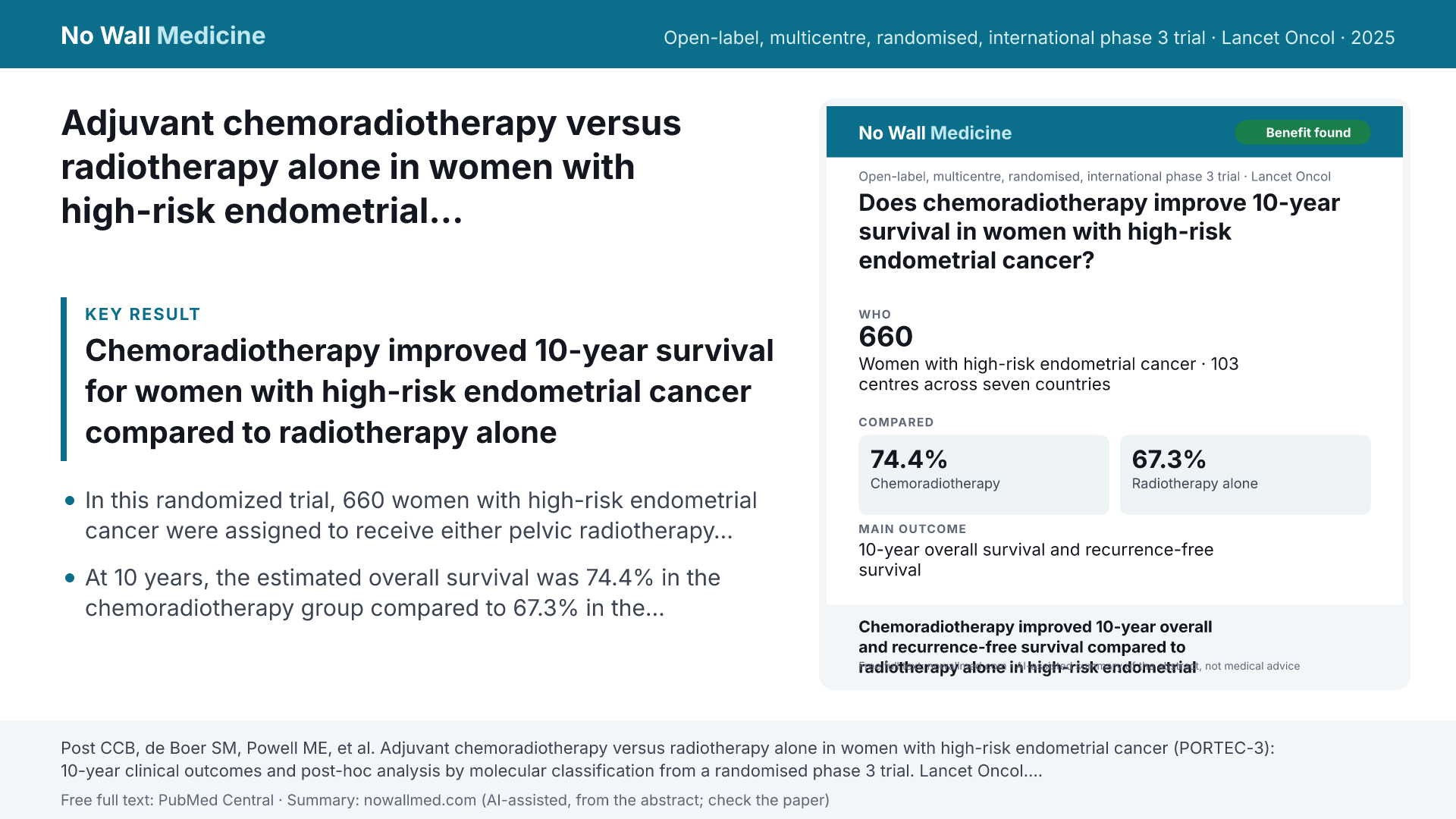
Adjuvant chemoradiotherapy versus radiotherapy alone in women with high-risk endometrial cancer (PORTEC-3): 10-year clinical outcomes and post-hoc analysis by molecular classification from a randomised phase 3 trial
Secondary analysis of a trialBenefit found
Does chemoradiotherapy improve 10-year survival in women with high-risk endometrial cancer?
Who
660
Women with high-risk endometrial cancer · 103 centres across seven countries
Compared
74.4%Chemoradiotherapy (95% CI 69.8-79.4)
67.3%Radiotherapy alone (62.3-72.7%)
Main outcome
10-year overall survival and recurrence-free survival
Result: adjusted hazard ratio 0.73 (95% CI 0.54-0.97)
Bottom line: Chemoradiotherapy improved 10-year overall and recurrence-free survival compared to radiotherapy alone in high-risk endometrial cancer.
Limitation: Post-hoc molecular analysis was only available for 411 (62%) patients.
Funded by: Dutch Cancer Society, Cancer Research UK, and others
Lancet Oncol · 2025-09-05 · Save PNG
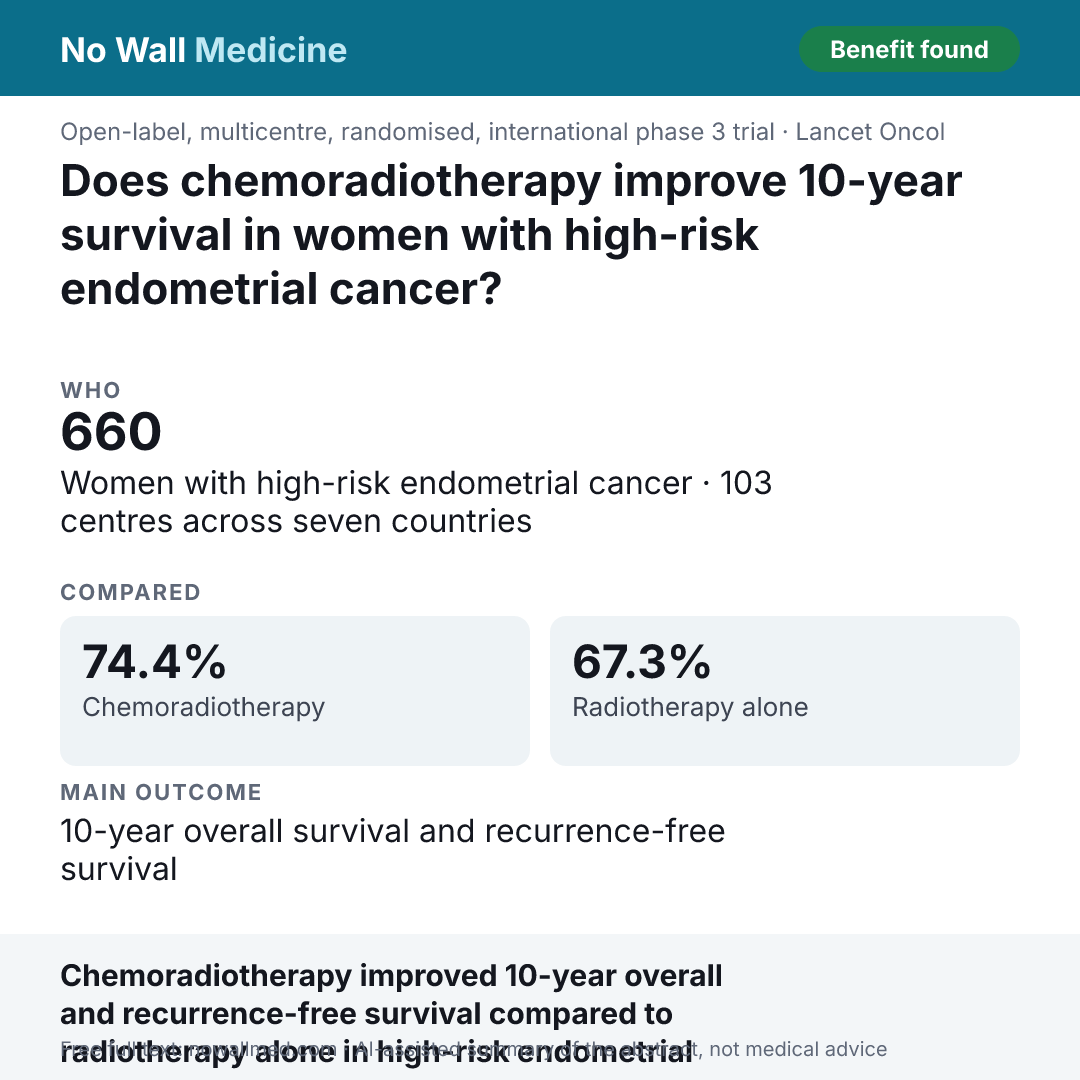
Clinical question: Does chemoradiotherapy improve 10-year survival in women with high-risk endometrial cancer?
Key points
- In this randomized trial, 660 women with high-risk endometrial cancer were assigned to receive either pelvic radiotherapy or chemoradiotherapy, which combines radiation with cisplatin and carboplatin/paclitaxel.
- At 10 years, the estimated overall survival was 74.4% in the chemoradiotherapy group compared to 67.3% in the radiotherapy group, and recurrence-free survival was 72.8% versus 67.4%.
- For patients with p53 abnormal tumors, 10-year overall survival was 52.7% with chemoradiotherapy versus 36.6% with radiotherapy alone, while MMRd and POLEmut cancers did not seem to benefit.
Headline and key points written with AI from the paper’s abstract, with every number checked against it. Read the paper before relying on them.
Was this summary helpful?
Abstract
Background
The PORTEC-3 trial investigated the benefit of chemoradiotherapy versus pelvic radiotherapy alone for women with high-risk endometrial cancer. We present the preplanned long-term analysis of the randomised PORTEC-3 trial with a post-hoc analysis including molecular classification of the tumours. Methods
PORTEC-3 was an open-label, multicentre, randomised, international phase 3 trial. Women were eligible if they had high-risk endometrial cancer (either International Federation of Gynecology and Obstetrics 2009 stage I, grade 3, with deep myometrial invasion and/or lymphovascular space invasion; stage II-III; or stage I-III with serous or clear-cell histology), were aged 18 years or older, and had a WHO performance score of 0-2. Participants were randomly assigned (1:1) to receive pelvic radiotherapy (48·6 Gy in 1·8 Gy fractions) or chemoradiotherapy (radiotherapy combined with two cycles of cisplatin 50 mg/m2 intravenously in weeks one and four, followed by four cycles of carboplatin area-under-the-curve 5 and paclitaxel 175 mg/m2 intravenously at 3-week intervals). Randomisation was done by use of biased-coin minimisation with stratification for participating centre, lymphadenectomy, stage, and histological type. We report the primary outcomes of overall survival and recurrence-free survival at 10 years. We also report primary outcomes by molecular subgroup in a post-hoc analysis. Survival was analysed in the intention-to-treat population. The study is registered with ClinicalTrials.gov (NCT00411138) and is now complete. Findings
Between Nov 23, 2006, and Dec 20, 2013, 660 eligible and evaluable patients recruited at 103 centres in six clinical trial groups across seven countries were randomly assigned to chemoradiotherapy (n=330) or radiotherapy alone (n=330). Median follow-up was 10·1 years (IQR 9·8-11·0). Estimated 10-year overall survival was 74·4% (95% CI 69·8-79·4) in the chemoradiotherapy group and 67·3% (62·3-72·7) in the radiotherapy group (adjusted hazard ratio [HR] 0·73 [95% CI 0·54-0·97], p=0·032), and 10-year recurrence-free survival was 72·8% (67·2-77·6) versus 67·4% (61·7-72·4; adjusted HR 0·74 [95% CI 0·56-0·98], p=0·034). Molecular analysis was available for 411 (62%) patients (210 [64%] of 330 patients in the chemoradiotherapy group and 201 [61%] of 330 patients in the radiotherapy group), whose characteristics were similar to the overall trial population. Post-hoc analysis by molecular class showed that, for women with p53 abnormal tumours, 10-year overall survival was 52·7% (95% CI 40·8-68·1) with chemoradiotherapy versus 36·6% (25·0 to 53·7) with radiotherapy alone (adjusted HR 0·52 [95% CI 0·30-0·91], p=0·021); 10-year recurrence-free survival was 52·6% (95% CI 38·3 to 65·0) versus 37·0% (95% CI 23·7 to 50·2; HR 0·42 [95% CI 0·24 to 0·74], p=0·0027). MMRd and POLEmut cancers did not seem to benefit from chemoradiotherapy over radiotherapy alone, whereas the effects for NSMP cancers were modulated by oestrogen-receptor status. Interpretation
10-year overall survival and recurrence-free survival were improved for patients with high-risk endometrial cancer treated with adjuvant chemoradiotherapy versus radiotherapy alone, with most clinically relevant benefit suggested for p53 abnormal cancers. Funding
Dutch Cancer Society, Cancer Research UK, National Health and Medical Research Council Australia, Cancer Australia, Italian Medicines Agency, and the Canadian Cancer Society Research Institute.
Abstract reproduced under the article’s CC BY licence.
Subject terms
Headline, design, result, key points, caveat and citation as plain text.
Cite this article
Post CCB, de Boer SM, Powell ME, et al. Adjuvant chemoradiotherapy versus radiotherapy alone in women with high-risk endometrial cancer (PORTEC-3): 10-year clinical outcomes and post-hoc analysis by molecular classification from a randomised phase 3 trial. Lancet Oncol. 2025;26(10):1370-1381. doi:10.1016/S1470-2045(25)00379-1
Spotted a mistake? Suggest a correction