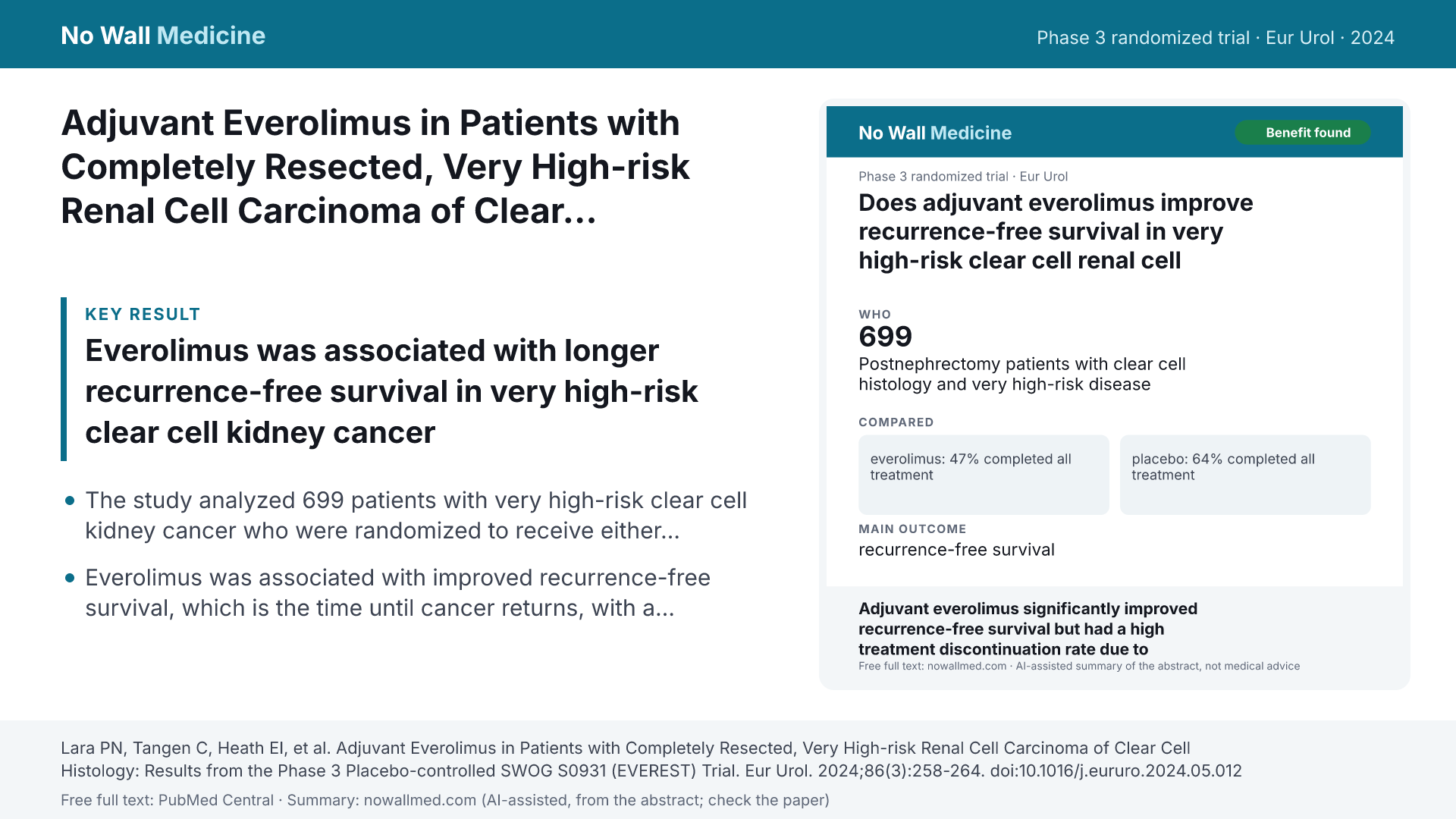
Everolimus was associated with longer recurrence-free survival in very high-risk clear cell kidney cancer
Adjuvant Everolimus in Patients with Completely Resected, Very High-risk Renal Cell Carcinoma of Clear Cell Histology: Results from the Phase 3 Placebo-controlled SWOG S0931 (EVEREST) Trial
Phase 3 randomized trialBenefit found
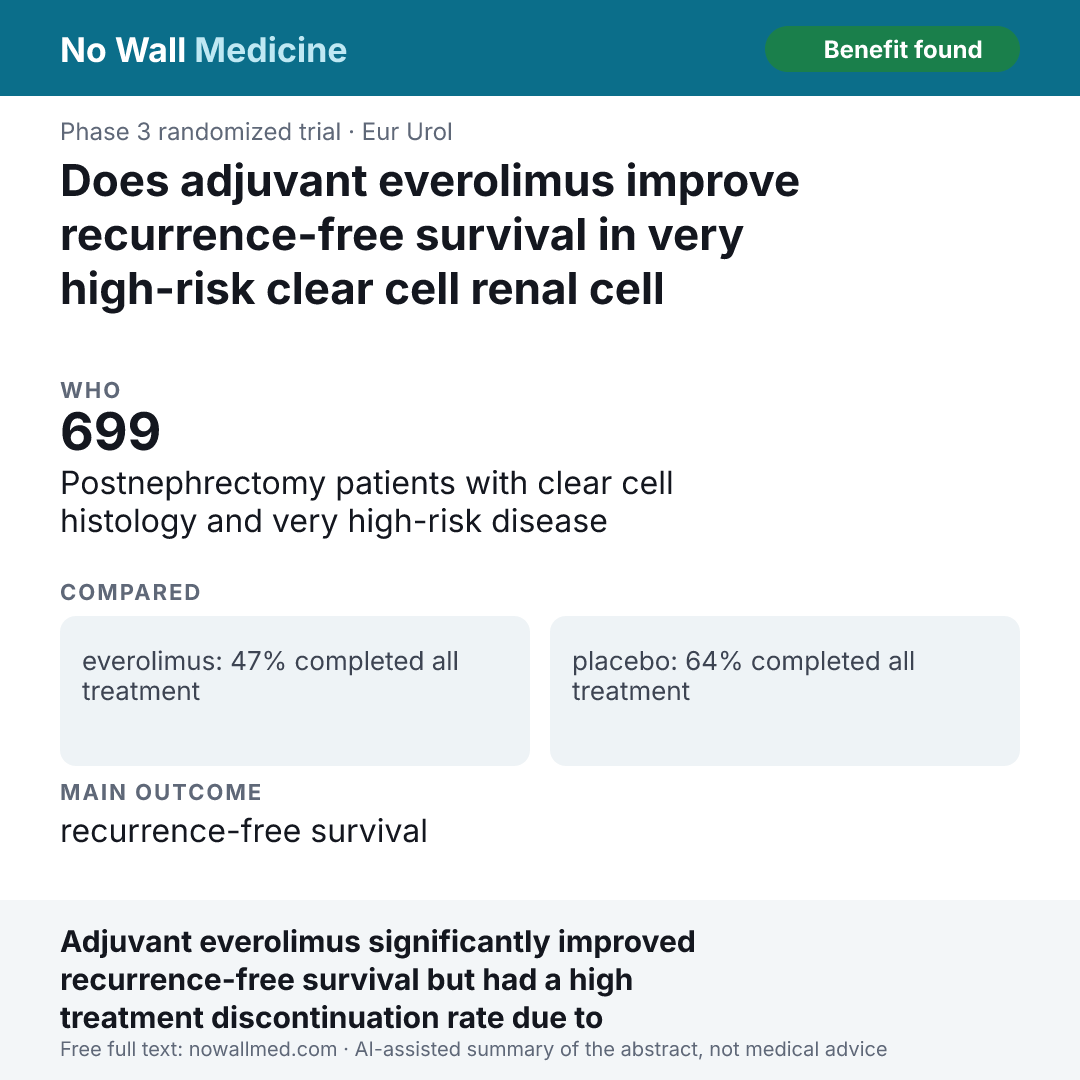
Does adjuvant everolimus improve recurrence-free survival in very high-risk clear cell renal cell carcinoma?
Who
699
Postnephrectomy patients with clear cell histology and very high-risk disease
Compared
everolimus: 47% completed all treatment
placebo: 64% completed all treatment
Main outcome
recurrence-free survival
Result: hazard ratio 0.80 (95% CI 0.65 to 0.99)
Bottom line: Adjuvant everolimus significantly improved recurrence-free survival but had a high treatment discontinuation rate due to adverse events.
Limitation: high discontinuation rate due to adverse events
Eur Urol · 2024-05-29 · Save PNG
Clinical question: Does adjuvant everolimus improve recurrence-free survival in very high-risk clear cell renal cell carcinoma?
In absolute numbers
everolimus: 47% · placebo: 64% → a difference of 17 percentage points, so about 6 people would need the treatment for 1 more to benefit (number needed to treat) over the trial’s follow-up.
Worked out by us from the two group results above, not reported by the authors. Check the paper for the exact outcome and timing.
Key points
- The study analyzed 699 patients with very high-risk clear cell kidney cancer who were randomized to receive either everolimus or a placebo.
- Everolimus was associated with improved recurrence-free survival, which is the time until cancer returns, with a hazard ratio of 0.80 (95% CI 0.65-0.99, p = 0.041).
- Only 47% of patients in the everolimus group completed all treatment compared to 64% in the placebo group due to side effects.
Headline and key points written with AI from the paper’s abstract, with every number checked against it. Read the paper before relying on them.
Was this summary helpful?
Subject terms
Headline, design, result, key points, caveat and citation as plain text.
Cite this article
Lara PN, Tangen C, Heath EI, et al. Adjuvant Everolimus in Patients with Completely Resected, Very High-risk Renal Cell Carcinoma of Clear Cell Histology: Results from the Phase 3 Placebo-controlled SWOG S0931 (EVEREST) Trial. Eur Urol. 2024;86(3):258-264. doi:10.1016/j.eururo.2024.05.012
Spotted a mistake? Suggest a correction