Olaparib was associated with longer invasive disease-free survival in high-risk BRCA-mutated breast cancer
Adjuvant Olaparib for Patients with BRCA1- or BRCA2-Mutated Breast Cancer
Phase 3, double-blind, randomized trialBenefit found
Does adjuvant olaparib improve invasive disease-free survival in high-risk BRCA-mutated early breast cancer?
Who
1836
HER2-negative early breast cancer with BRCA1 or BRCA2 germline variants
Compared
85.9%olaparib
77.1%placebo
Main outcome
invasive disease-free survival
Result: hazard ratio 0.58 (99.5% CI, 0.41 to 0.82)
Bottom line: Adjuvant olaparib significantly improves invasive disease-free survival in high-risk HER2-negative early breast cancer with BRCA1 or BRCA2 mutations.
Limitation: Olaparib had limited effects on global patient-reported quality of life.
Funded by: National Cancer Institute and AstraZeneca
NEJM · 2021-06-03Download image
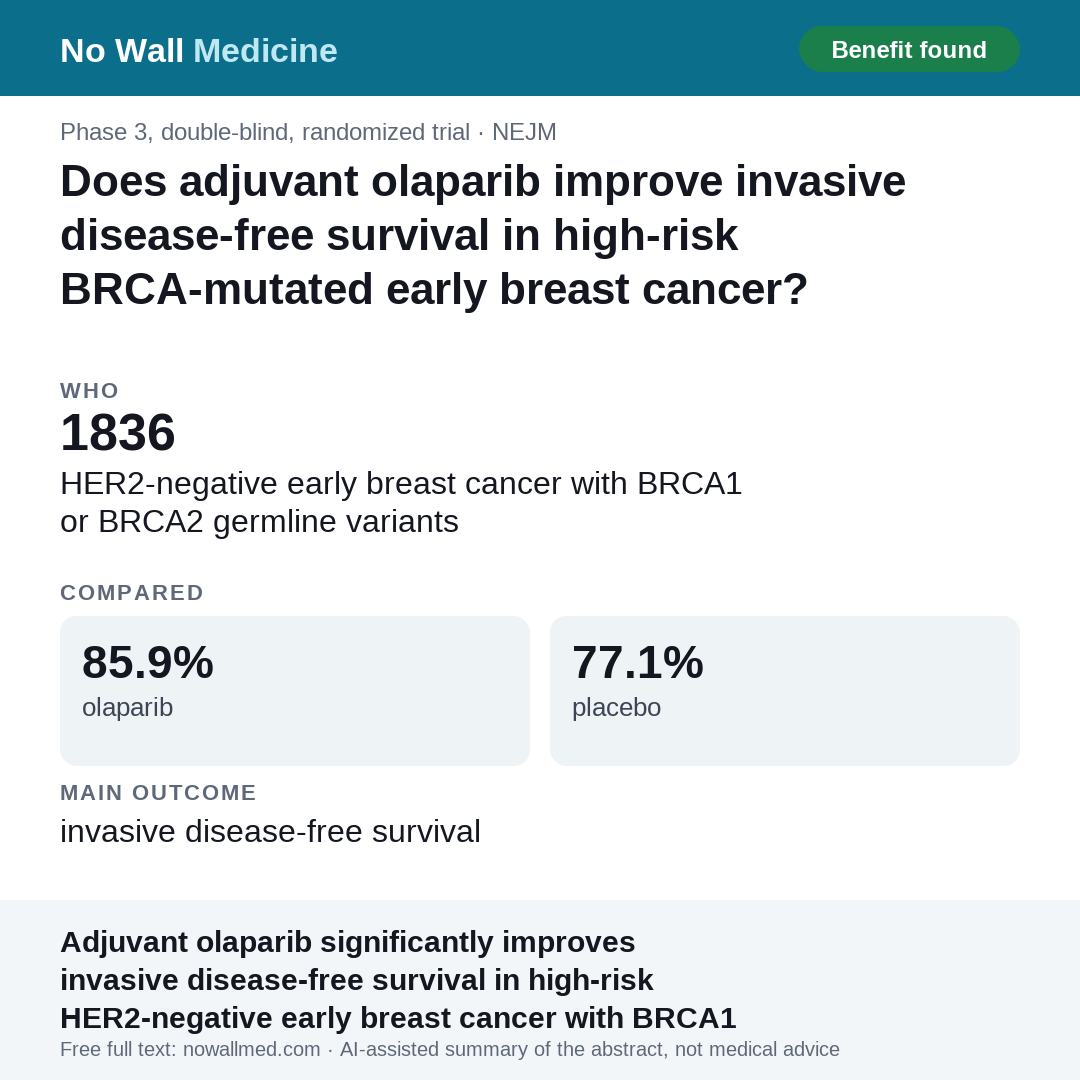
Clinical question: Does adjuvant olaparib improve invasive disease-free survival in high-risk BRCA-mutated early breast cancer?
Why it matters: New therapies are needed to reduce recurrence in patients with BRCA1 or BRCA2 germline mutation-associated early breast cancer.
In absolute numbers
olaparib: 85.9% · placebo: 77.1% → a difference of 8.8 percentage points, so about 12 people would need the treatment for 1 more to benefit (number needed to treat) over the trial’s follow-up.
Worked out by us from the two group results above, not reported by the authors. Check the paper for the exact outcome and timing.
Key points
- The trial randomized 1836 patients with HER2-negative early breast cancer and BRCA1 or BRCA2 mutations to receive either 1 year of oral olaparib or a placebo.
- At a median follow-up of 2.5 years, the 3-year invasive disease-free survival was 85.9% for olaparib compared to 77.1% for placebo.
- The 3-year distant disease-free survival was 87.5% in the olaparib group and 80.4% in the placebo group.
Headline and key points written with AI from the paper’s abstract, with every number checked against it. Read the paper before relying on them.
Was this summary helpful?
Subject terms
Cite this article
Tutt ANJ, Garber JE, Kaufman B, Viale G, Fumagalli D, Rastogi P. Adjuvant Olaparib for Patients with BRCA1- or BRCA2-Mutated Breast Cancer. NEJM. 2021. doi:10.1056/NEJMoa2105215
Spotted a mistake? Suggest a correction
Top studies every Monday
The week’s key trials and guidelines in your specialties, plus any topics you follow. By email, free.
Get the weekly digest