Osimertinib showed better disease-free survival than immunotherapy for patients with EGFR-mutant lung cancer
Adjuvant therapy in completely resected, EGFR-mutant non-small cell lung cancer: a comparative analysis of treatment efficacy between EGFR-TKI and anti-PD-1/PD-L1 immunotherapy
Meta-analysisBenefit found
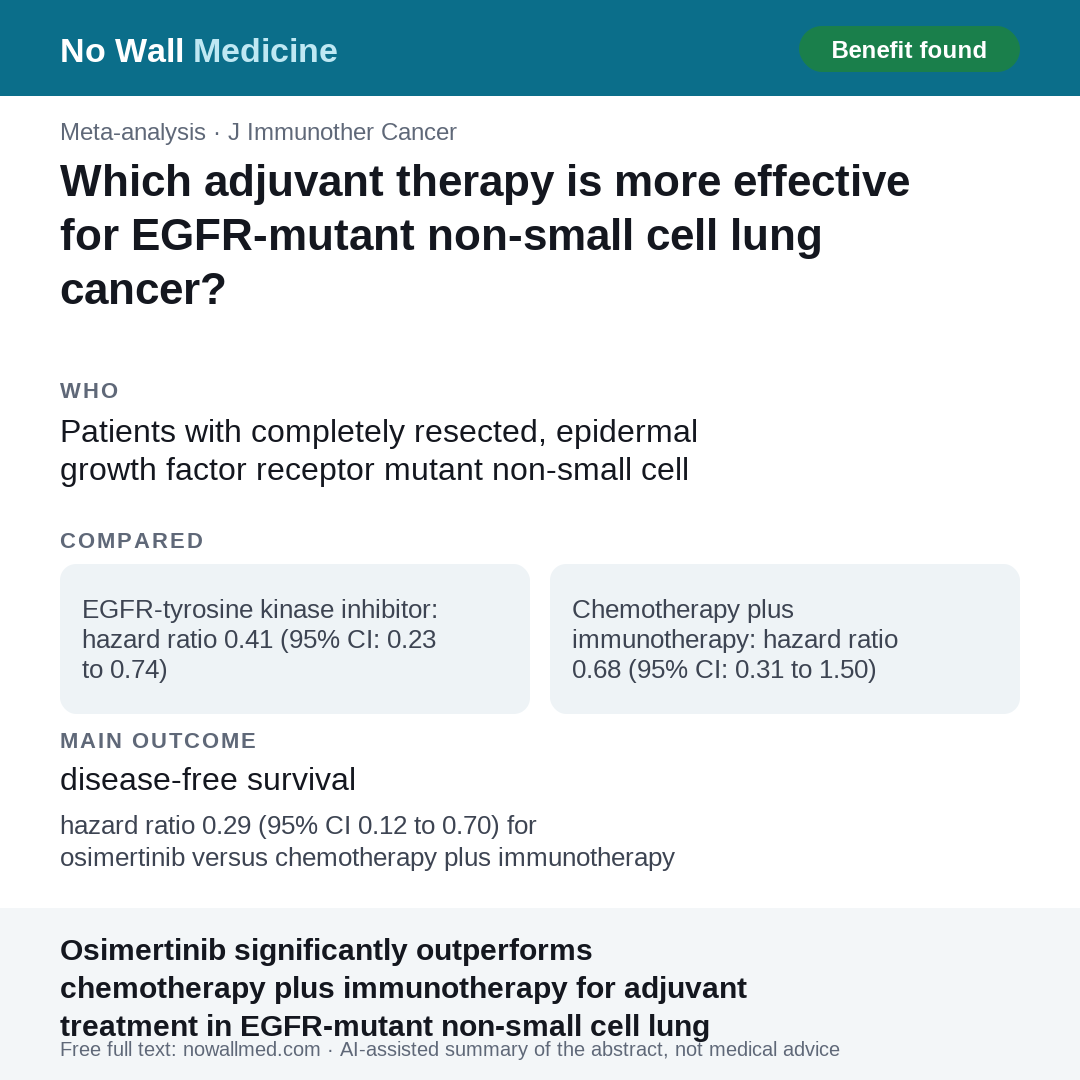
Which adjuvant therapy is more effective for EGFR-mutant non-small cell lung cancer?
Who
Patients with completely resected, epidermal growth factor receptor mutant non-small cell lung cancer
Compared
EGFR-tyrosine kinase inhibitor: hazard ratio 0.41 (95% CI: 0.23 to 0.74)
Chemotherapy plus immunotherapy: hazard ratio 0.68 (95% CI: 0.31 to 1.50)
Main outcome
disease-free survival
Result: hazard ratio 0.29 (95% CI 0.12 to 0.70) for osimertinib versus chemotherapy plus immunotherapy
Bottom line: Osimertinib significantly outperforms chemotherapy plus immunotherapy for adjuvant treatment in EGFR-mutant non-small cell lung cancer.
J Immunother Cancer · 2023-10-18Download image
Clinical question: Which adjuvant therapy is more effective for EGFR-mutant non-small cell lung cancer?
Why it matters: There is currently a lack of head-to-head comparison between EGFR-tyrosine kinase inhibitors and immunotherapy for patients with completely resected, EGFR-mutant non-small cell lung cancer.
Key points
- Researchers performed a meta-analysis comparing EGFR-tyrosine kinase inhibitors (drugs targeting specific genetic mutations) and immunotherapy after chemotherapy in patients with resected non-small cell lung cancer.
- EGFR-tyrosine kinase inhibitors were associated with a lower risk of recurrence or death (HR 0.41, 95% CI: 0.23 to 0.74, p=0.003) compared to chemotherapy alone.
- The third-generation drug osimertinib was associated with better disease-free survival than immunotherapy (HR 0.29, 95% CI: 0.12 to 0.70, p=0.006).
Headline and key points written with AI from the paper’s abstract, with every number checked against it. Read the paper before relying on them.
Was this summary helpful?
Abstract
The IMpower010 and KEYNOTE-091 trials have demonstrated the benefit of adjuvant immunotherapy (IO) after chemotherapy (C+IO) in resected non-small cell lung cancer (NSCLC), including those with epidermal growth factor receptor gene (EGFR) mutation. Meanwhile, several studies have reported that EGFR-tyrosine kinase inhibitor (EGFR-TKI) may prolong disease-free survival (DFS) in these patients. However, there is currently a lack of head-to-head comparison between these two adjuvant therapy strategies. Therefore, we designed a comparative analysis of their efficacy to inform clinical decision-making by assessing DFS as the primary outcome. The results of direct meta-analysis indicated that EGFR-TKI reduced the risk of recurrence and/or death in completely resected NSCLC (HREGFR-TKI/chemo = 0.41, 95% CI: 0.23 to 0.74, p=0.003), while C+IO did not significantly improve DFS compared with chemotherapy alone (HRC+IO/chemo=0.68, 95% CI: 0.31 to 1.50, p=0.338). Indirect comparison suggested that EGFR-TKI has a trend to prolong DFS compared with C+IO (HR EGFR-TKI/C+IO = 0.60, 95% CI: 0.23 to 1.61, p=0.312), while the third-generation TKI (3rd-TKI) osimertinib significantly outperformed C+IO (HR3rd-TKI/C+IO = 0.29, 95% CI: 0.12 to 0.70, p=0.006). In conclusion, osimertinib rather than immunotherapy should be regarded as the preferred adjuvant therapy in completely resected, EGFR-mutant NSCLC.
Abstract reproduced under the article’s CC BY NC licence.
Subject terms
Cite this article
Li Z, Zhang X, Wang Y, Yu Z, Yang C, Zhou Y. Adjuvant therapy in completely resected, EGFR-mutant non-small cell lung cancer: a comparative analysis of treatment efficacy between EGFR-TKI and anti-PD-1/PD-L1 immunotherapy. J Immunother Cancer. 2023. doi:10.1136/jitc-2023-007327
Spotted a mistake? Suggest a correction
Top studies every Monday
The week’s key trials and guidelines in your specialties, plus any topics you follow. By email, free.
Get the weekly digest