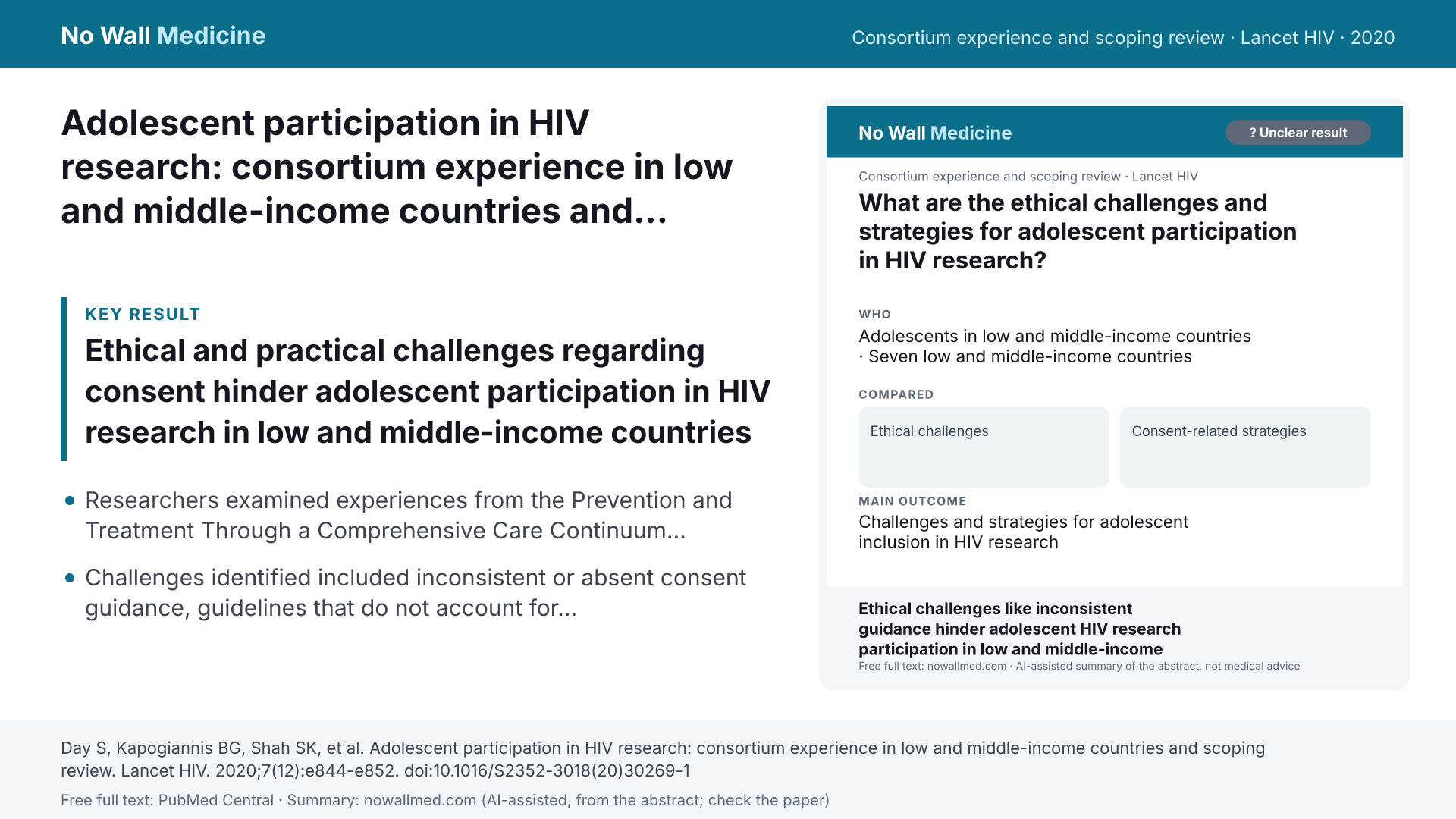
Ethical and practical challenges regarding consent hinder adolescent participation in HIV research in low and middle-income countries
Adolescent participation in HIV research: consortium experience in low and middle-income countries and scoping review
Consortium experience and scoping reviewUnclear result
What are the ethical challenges and strategies for adolescent participation in HIV research?
Who
Adolescents in low and middle-income countries · Seven low and middle-income countries
Compared
Ethical challenges
Consent-related strategies
Main outcome
Challenges and strategies for adolescent inclusion in HIV research
Bottom line: Ethical challenges like inconsistent guidance hinder adolescent HIV research participation in low and middle-income countries.
Lancet HIV · 2020-12-04Download image
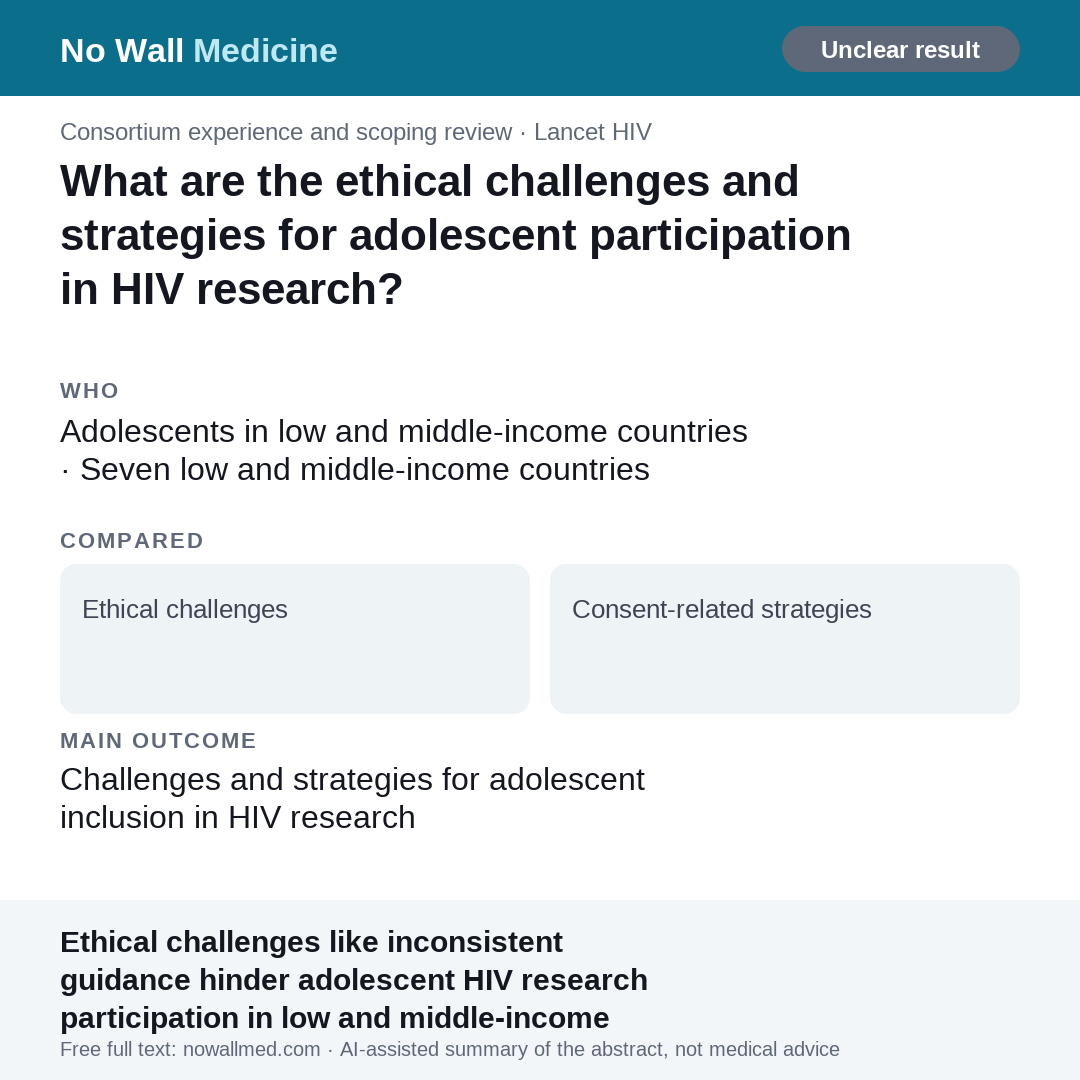
Clinical question: What are the ethical challenges and strategies for adolescent participation in HIV research?
Why it matters: Ethical challenges regarding consent can hinder the inclusion of adolescents in HIV research within low and middle-income countries.
Key points
- Researchers examined experiences from the Prevention and Treatment Through a Comprehensive Care Continuum for HIV-affected Adolescents in Resource Constrained Settings consortium across seven low and middle-income countries.
- Challenges identified included inconsistent or absent consent guidance, guidelines that do not account for adolescents' lives, and varying assessments by ethical review committees.
- Three strategies to expand inclusion were identified: waiving parental consent, allowing independent adolescent consent, and implementing surrogate decision making.
Headline and key points written with AI from the paper’s abstract, with every number checked against it. Read the paper before relying on them.
Was this summary helpful?
Subject terms
Cite this article
Day S, Kapogiannis BG, Shah SK, et al. Adolescent participation in HIV research: consortium experience in low and middle-income countries and scoping review. Lancet HIV. 2020. doi:10.1016/S2352-3018(20)30269-1
Spotted a mistake? Suggest a correction