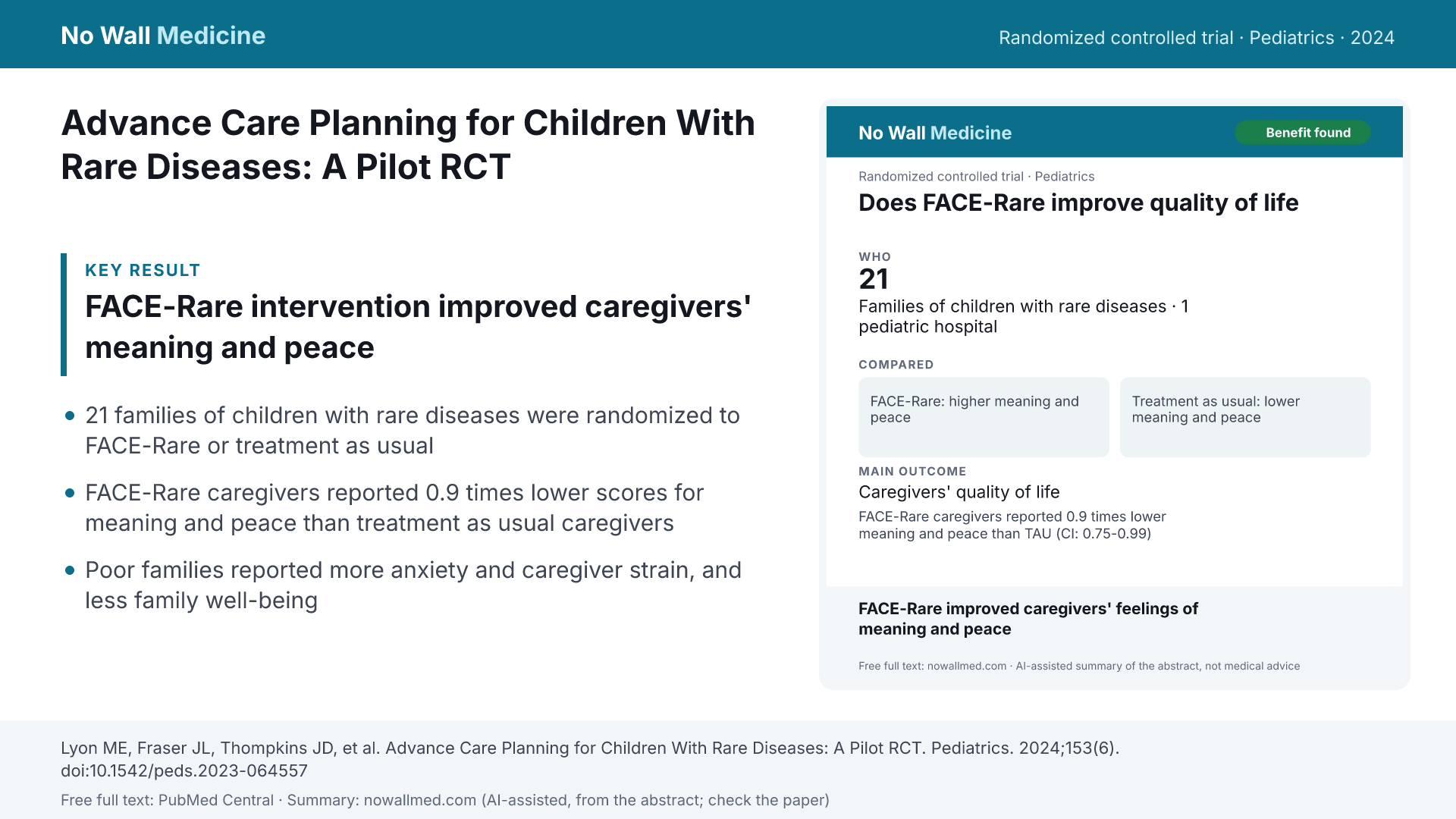
FACE-Rare intervention improved caregivers' meaning and peace
Advance Care Planning for Children With Rare Diseases: A Pilot RCT
Randomized controlled trialBenefit found
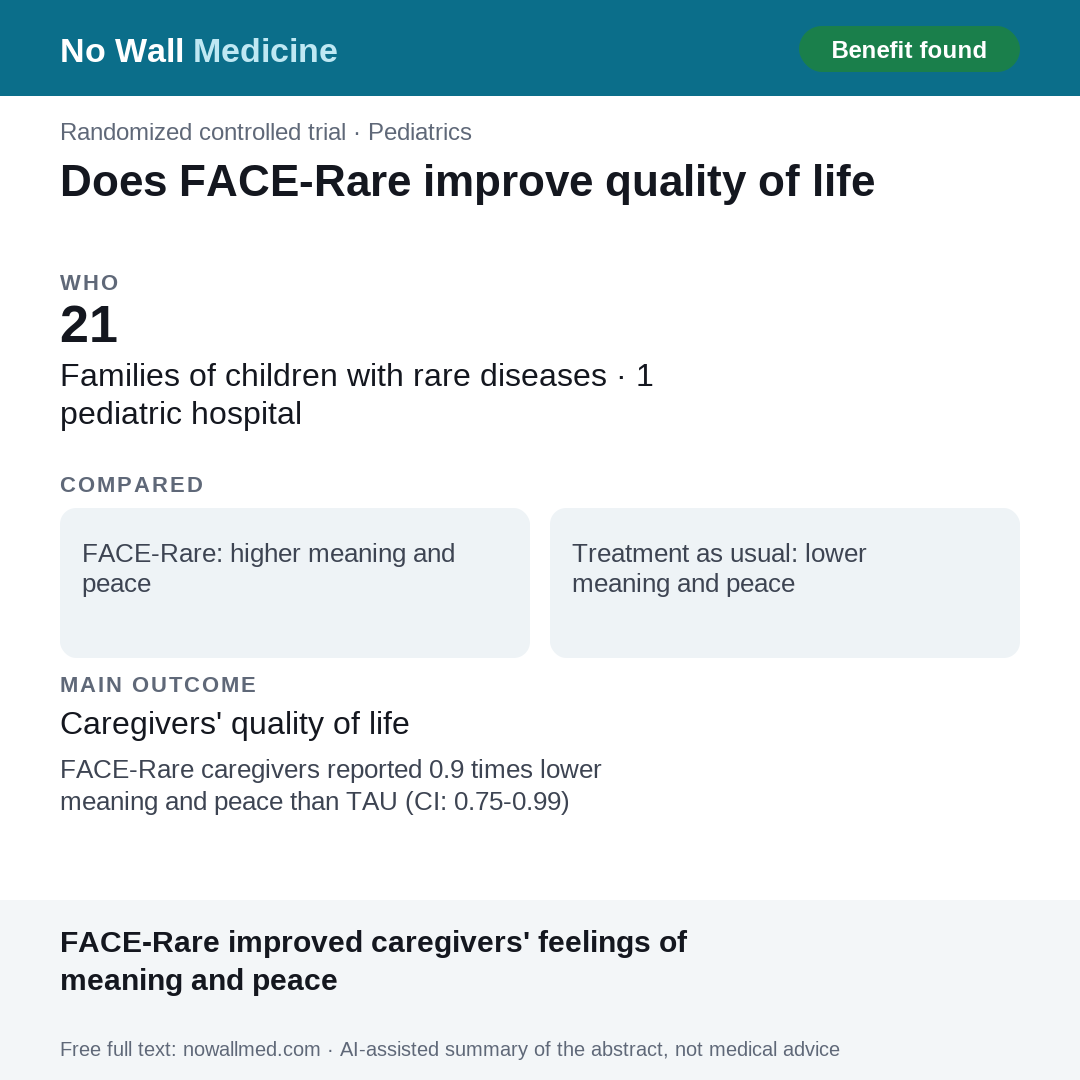
Does FACE-Rare improve quality of life
Who
21
Families of children with rare diseases · 1 pediatric hospital
Compared
FACE-Rare: higher meaning and peace
Treatment as usual: lower meaning and peace
Main outcome
Caregivers' quality of life
Result: FACE-Rare caregivers reported 0.9 times lower meaning and peace than TAU (CI: 0.75-0.99)
Bottom line: FACE-Rare improved caregivers' feelings of meaning and peace
Limitation: small sample size
Pediatrics · 2024-05-03Download image
Why it matters: The efficacy of pediatric advance care planning for children with rare diseases was unknown
Key points
- 21 families of children with rare diseases were randomized to FACE-Rare or treatment as usual.
- FACE-Rare caregivers reported 0.9 times lower scores for meaning and peace than treatment as usual caregivers.
- Poor families reported more anxiety and caregiver strain, and less family well-being.
Limitation the authors note: The study was a single-center pilot trial with a small sample size
Headline and key points written with AI from the paper’s abstract, with every number checked against it. Read the paper before relying on them.
Was this summary helpful?
Subject terms
Cite this article
Lyon ME, Fraser JL, Thompkins JD, et al. Advance Care Planning for Children With Rare Diseases: A Pilot RCT. Pediatrics. 2024. doi:10.1542/peds.2023-064557
Spotted a mistake? Suggest a correction