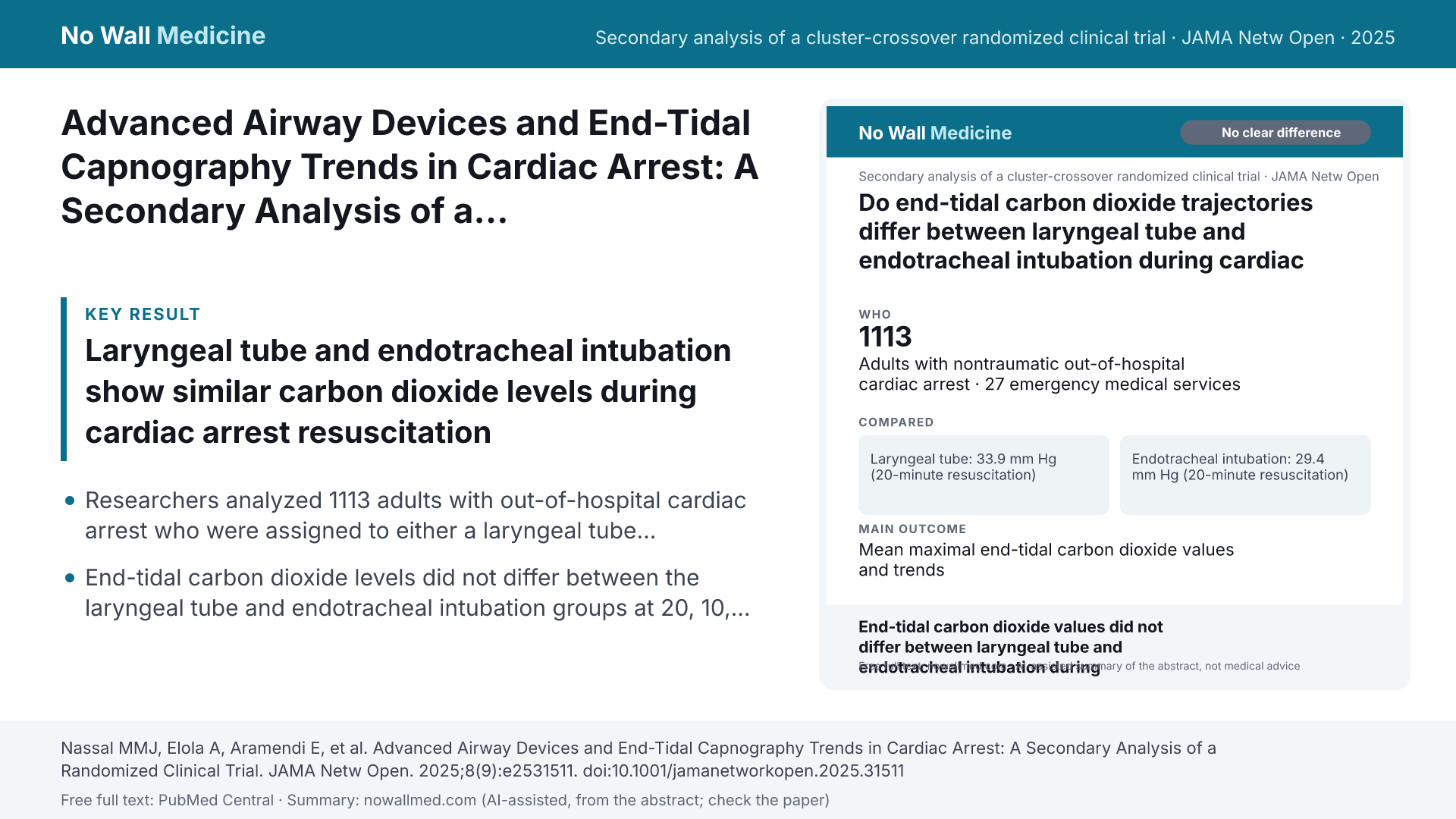
Laryngeal tube and endotracheal intubation show similar carbon dioxide levels during cardiac arrest resuscitation
Advanced Airway Devices and End-Tidal Capnography Trends in Cardiac Arrest: A Secondary Analysis of a Randomized Clinical Trial
Secondary analysis of a cluster-crossover randomized clinical trialNo clear difference
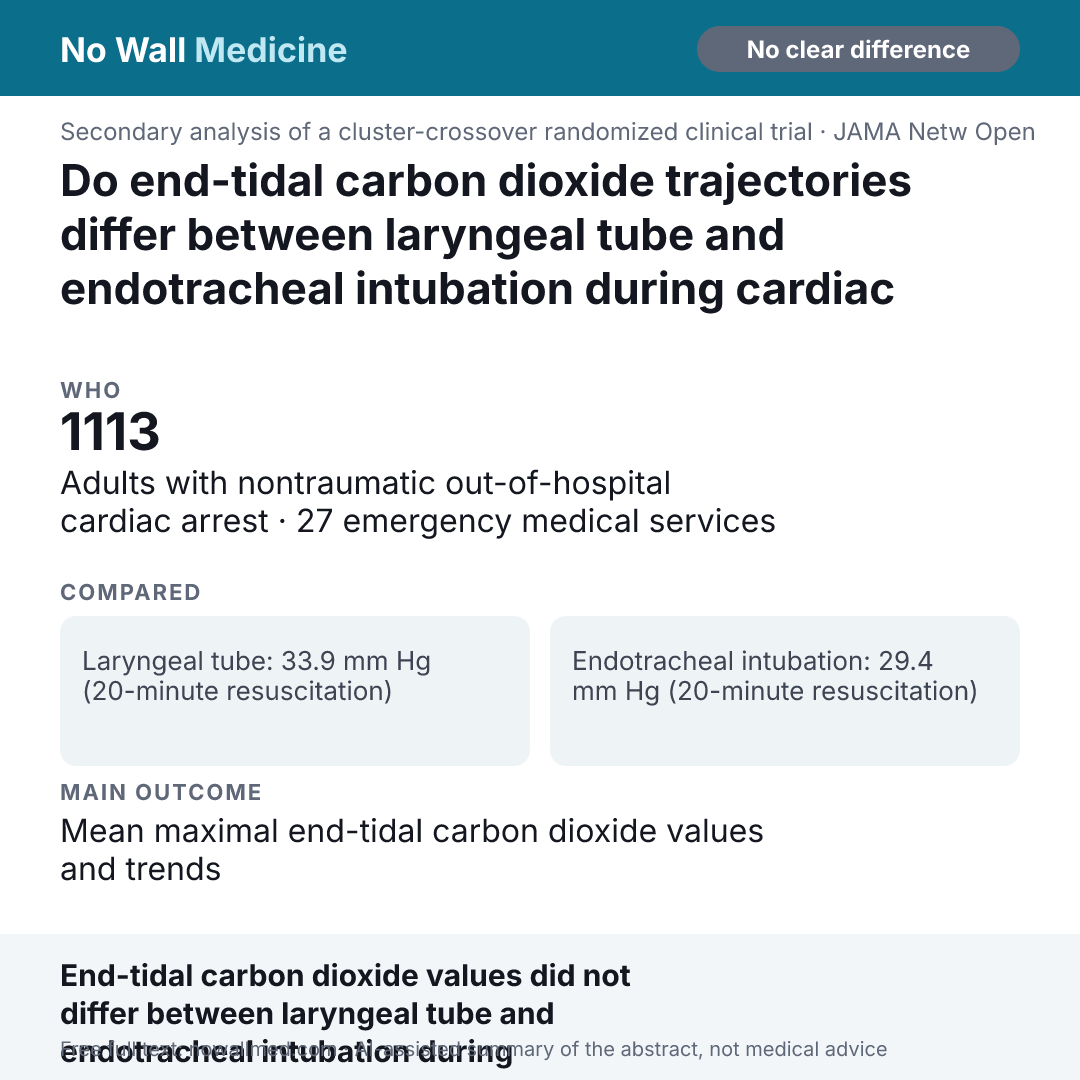
Do end-tidal carbon dioxide trajectories differ between laryngeal tube and endotracheal intubation during cardiac arrest?
Who
1113
Adults with nontraumatic out-of-hospital cardiac arrest · 27 emergency medical services agencies
Compared
Laryngeal tube: 33.9 mm Hg (20-minute resuscitation)
Endotracheal intubation: 29.4 mm Hg (20-minute resuscitation)
Main outcome
Mean maximal end-tidal carbon dioxide values and trends
Bottom line: End-tidal carbon dioxide values did not differ between laryngeal tube and endotracheal intubation during resuscitation.
Limitation: This was a secondary analysis of a randomized clinical trial.
JAMA Netw Open · 2025-09-02 · Save PNG
Clinical question: Do end-tidal carbon dioxide trajectories differ between laryngeal tube and endotracheal intubation during cardiac arrest?
Key points
- Researchers analyzed 1113 adults with out-of-hospital cardiac arrest who were assigned to either a laryngeal tube or endotracheal intubation.
- End-tidal carbon dioxide levels did not differ between the laryngeal tube and endotracheal intubation groups at 20, 10, or 1 minute of resuscitation.
- Increasing carbon dioxide trends were associated with sustained return of spontaneous circulation, which is the resumption of a heartbeat.
Headline and key points written with AI from the paper’s abstract, with every number checked against it. Read the paper before relying on them.
Was this summary helpful?
Subject terms
Headline, design, result, key points, caveat and citation as plain text.
Cite this article
Nassal MMJ, Elola A, Aramendi E, et al. Advanced Airway Devices and End-Tidal Capnography Trends in Cardiac Arrest: A Secondary Analysis of a Randomized Clinical Trial. JAMA Netw Open. 2025;8(9):e2531511. doi:10.1001/jamanetworkopen.2025.31511
Spotted a mistake? Suggest a correction