Smartphone-based tool improved jaundice screening and management in a resource-limited Mexican healthcare setting
Advancing neonatal jaundice screening with mHealth: a mixed-methods randomised controlled feasibility study in a resource-limited setting in Mexico
Mixed-methods randomized controlled feasibility studyBenefit found
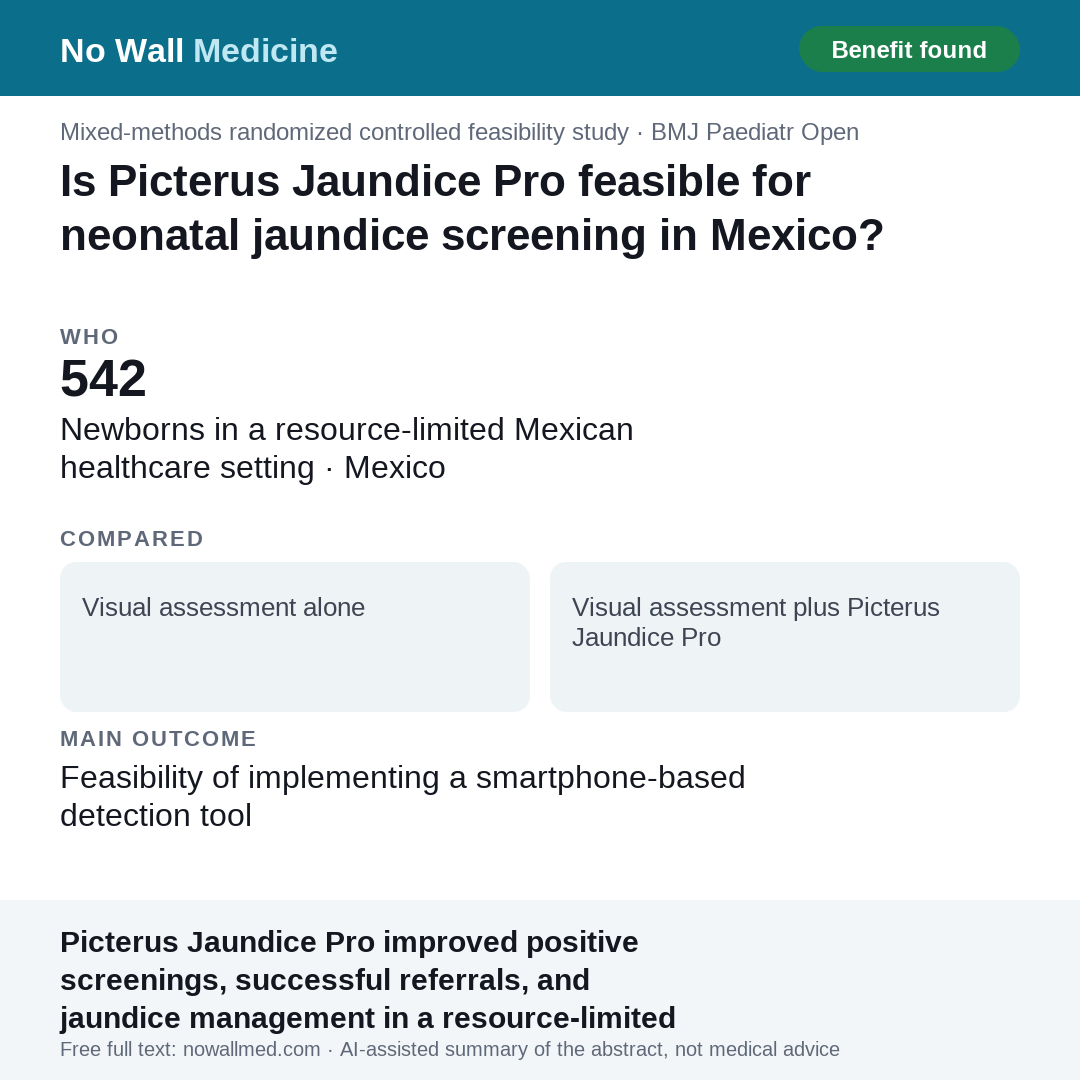
Is Picterus Jaundice Pro feasible for neonatal jaundice screening in Mexico?
Who
542
Newborns in a resource-limited Mexican healthcare setting · Mexico
Compared
Visual assessment alone
Visual assessment plus Picterus Jaundice Pro
Main outcome
Feasibility of implementing a smartphone-based detection tool
Result: proportional difference [95% CI 0.230 to 0.362] for positive screenings
Bottom line: Picterus Jaundice Pro improved positive screenings, successful referrals, and jaundice management in a resource-limited setting.
Limitation: Incomplete referrals occurred due to logistical barriers and low perceived risk by parents.
BMJ Paediatr Open · 2026-04-02Download image
Clinical question: Is Picterus Jaundice Pro feasible for neonatal jaundice screening in Mexico?
Why it matters: Severe neonatal jaundice can cause brain damage or death, but resource-limited settings often lack access to reliable detection methods.
Key points
- Researchers studied 542 newborns, comparing visual assessment alone to visual assessment plus the Picterus Jaundice Pro smartphone tool.
- The smartphone tool group showed higher proportions of positive screenings (0.299), successful referrals (0.112), and jaundice management needed (0.045) compared to the control.
- In 11% of cases, referrals were incomplete due to logistical barriers and parents perceiving a low risk of harm.
Limitation the authors note: Incomplete referrals occurred in 11% of cases due to logistical barriers and low perceived risk by parents.
Headline and key points written with AI from the paper’s abstract, with every number checked against it. Read the paper before relying on them.
Abstract
Background
Neonatal jaundice is a common and usually harmless condition, but 10% of cases can progress to severe forms that can cause irreversible brain damage or death if undetected and untreated. The prevalence of severe cases is higher in resource-limited settings due to limited access to reliable detection methods among other contributing factors. Objective
To assess the feasibility of implementing Picterus Jaundice Pro, a smartphone-based detection tool for neonatal jaundice, in a resource-limited Mexican healthcare setting. Methods
A mixed-methods approach was employed, integrating a pragmatic randomised controlled trial (RCT) with qualitative insights from semi-structured interviews, all conducted within a feasibility framework. In the RCT, newborns were randomly assigned to screening by visual assessment alone (control) or visual assessment plus Picterus Jaundice Pro (intervention). Feasibility outcomes included RCT-derived measures - the proportion of positive screenings, successful referrals to emergency room (bilirubin ≥14.6 mg/dL [250 µmol/L]), jaundice management needed and jaundice management received. Recruitment capability, device practicality, integration, acceptability and protocol adherence were also assessed. Results
From January to June 2024, 542 newborns were included (273 control, 269 intervention). Compared with control, the intervention arm showed higher proportions (proportional difference [95% CI]) in positive screenings (0.299 [0.230 to 0.362]), successful referrals (0.112 [0.058 to 0.166]), jaundice management needed (0.045 [0.008 to 0.082]), and jaundice management received (0.038 [0.003 to 0.072]).Interviewed participants considered Picterus Jaundice Pro user-friendly and well-integrated into workflows. Despite high protocol adherence, incomplete referrals due to logistical barriers and low perceived risk by parents occurred in 11% of cases. Conclusions
Implementing Picterus Jaundice Pro yielded encouraging improvements in screening practices, underscoring its potential to advance neonatal care. Addressing systemic barriers and raising awareness among parents and healthcare workers is crucial for maximizing impact. Trial registration number
NCT06073444.
Abstract reproduced under the article’s CC BY NC licence.
Topics
Cite this article
Jiménez-Díaz G, Elizarrarás-Rivas J, Keitsch M, Gierman LM, Marcuzzi A, Infanti JJ. Advancing neonatal jaundice screening with mHealth: a mixed-methods randomised controlled feasibility study in a resource-limited setting in Mexico. BMJ Paediatr Open. 2026. doi:10.1136/bmjpo-2025-003624
Spotted a mistake? Suggest a correction