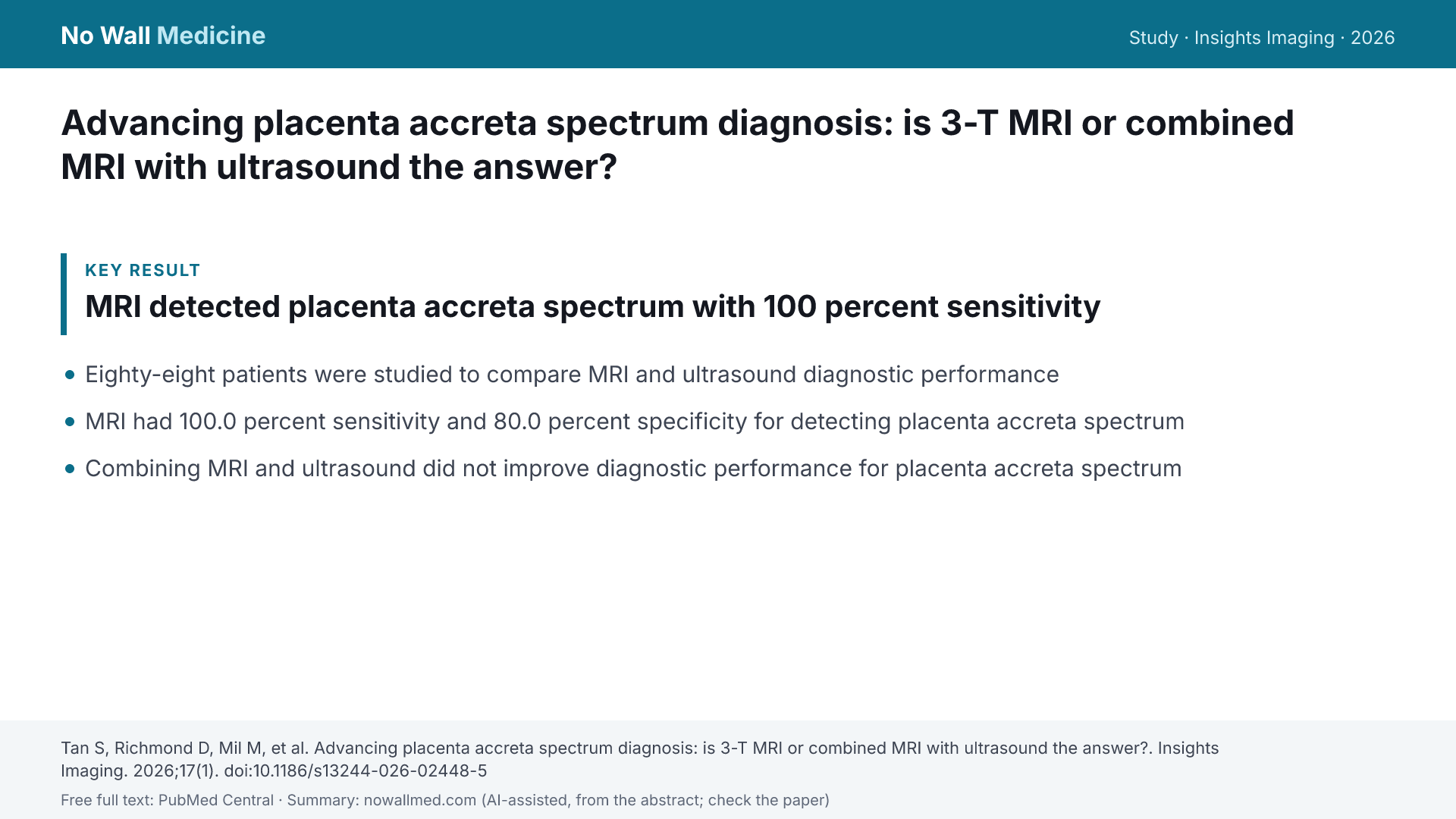
MRI detected placenta accreta spectrum with 100 percent sensitivity
Advancing placenta accreta spectrum diagnosis: is 3-T MRI or combined MRI with ultrasound the answer?
Why it matters: Doctors have had no dedicated study on using 3-T MRI or combined MRI with ultrasound for diagnosing placenta accreta spectrum
Key points
- Eighty-eight patients were studied to compare MRI and ultrasound diagnostic performance.
- MRI had 100.0 percent sensitivity and 80.0 percent specificity for detecting placenta accreta spectrum.
- Combining MRI and ultrasound did not improve diagnostic performance for placenta accreta spectrum.
Study type: Observational study: it can show a link, but not prove that one thing causes another.
Headline and key points written with AI from the paper’s abstract, with every number checked against it. Read the paper before relying on them.
Was this summary helpful?
Headline, design, result, key points, caveat and citation as plain text.
Cite this article
Tan S, Richmond D, Mil M, et al. Advancing placenta accreta spectrum diagnosis: is 3-T MRI or combined MRI with ultrasound the answer?. Insights Imaging. 2026;17(1). doi:10.1186/s13244-026-02448-5
Spotted a mistake? Suggest a correction