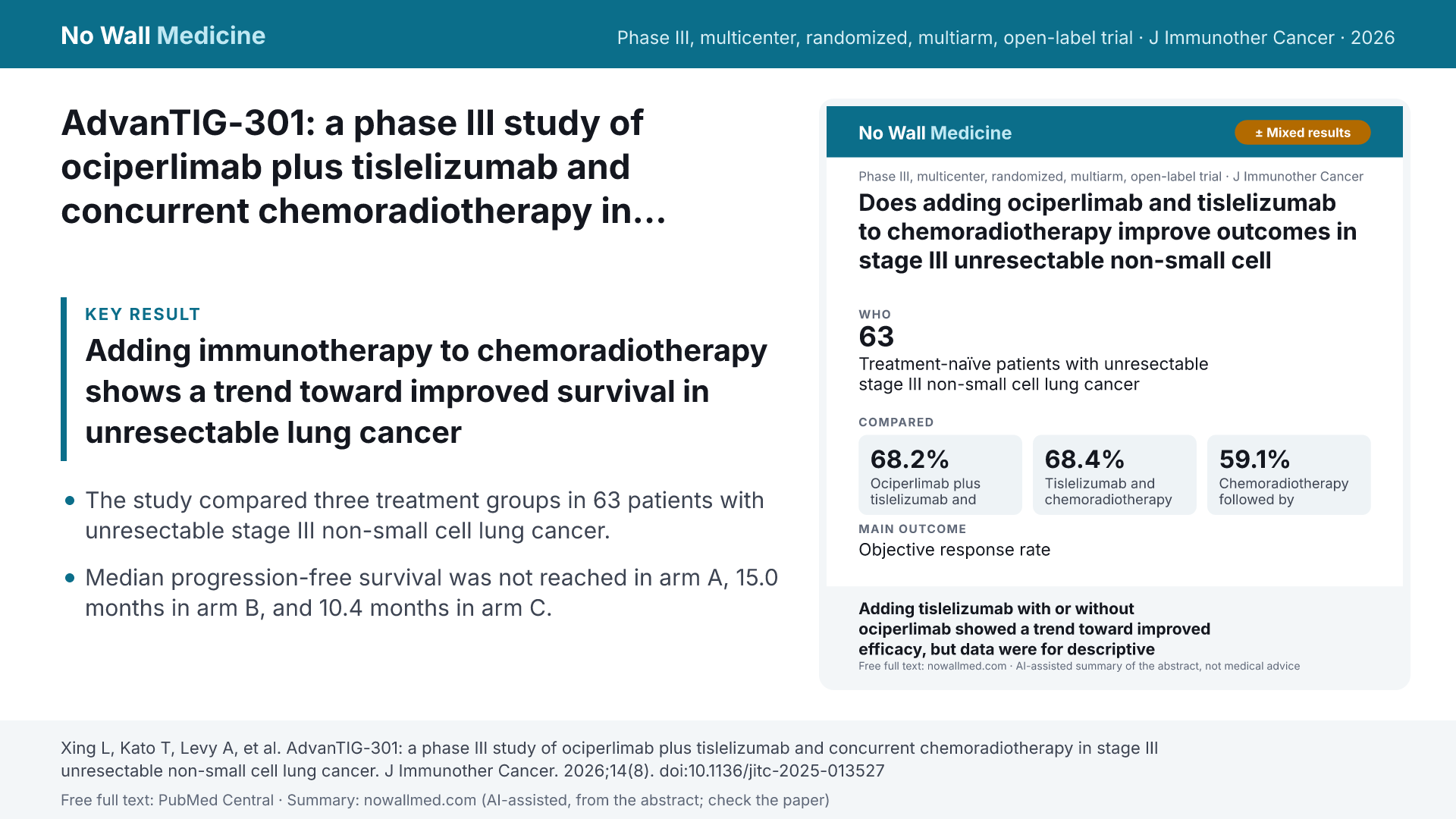
Adding immunotherapy to chemoradiotherapy shows a trend toward improved survival in unresectable lung cancer
AdvanTIG-301: a phase III study of ociperlimab plus tislelizumab and concurrent chemoradiotherapy in stage III unresectable non-small cell lung cancer
Phase III, multicenter, randomized, multiarm, open-label trialMixed results
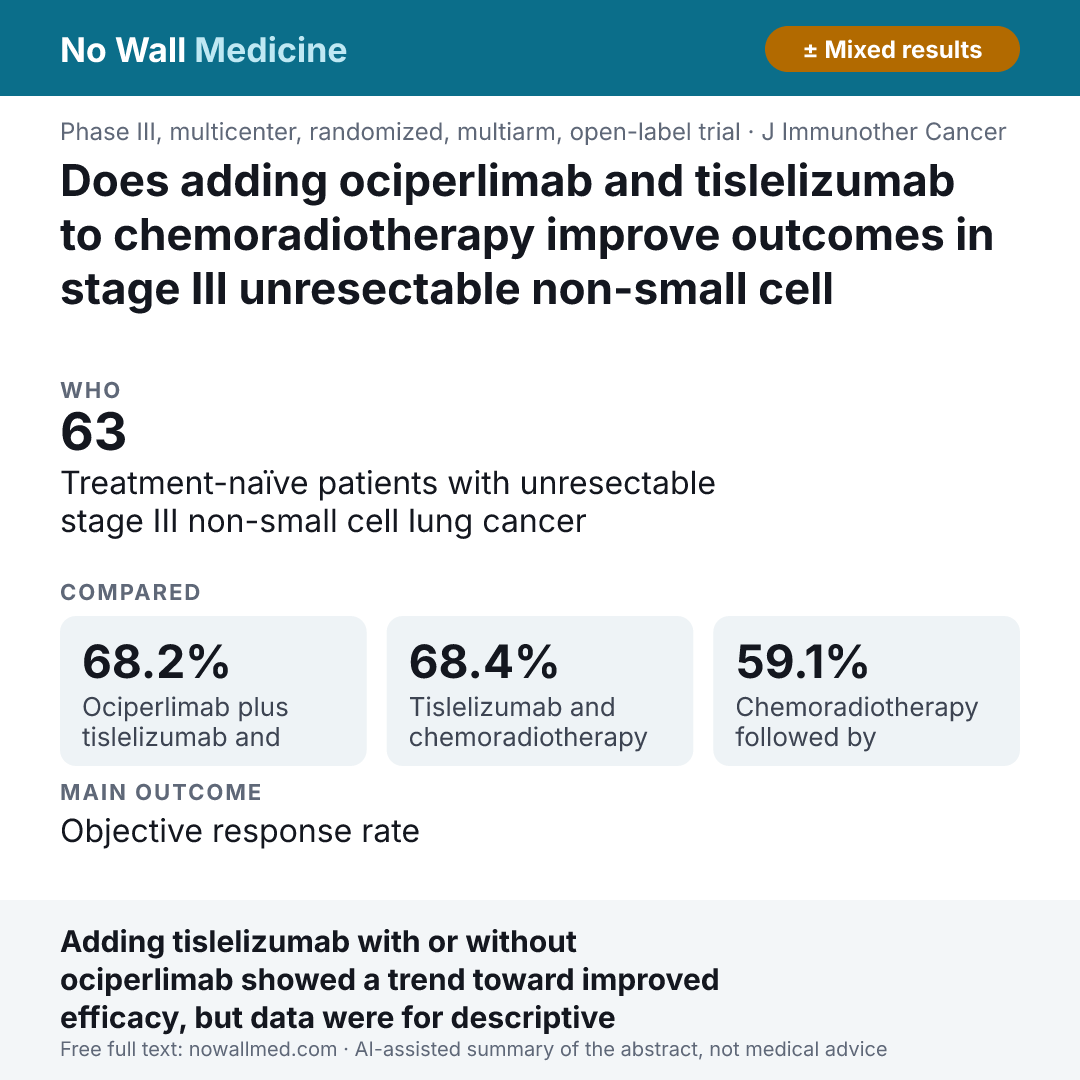
Does adding ociperlimab and tislelizumab to chemoradiotherapy improve outcomes in stage III unresectable non-small cell lung cancer?
Who
63
Treatment-naïve patients with unresectable stage III non-small cell lung cancer
Compared
68.2%Ociperlimab plus tislelizumab and chemoradiotherapy (45.1%-86.1%)
68.4%Tislelizumab and chemoradiotherapy (43.4%-87.4%)
59.1%Chemoradiotherapy followed by durvalumab (36.4%-79.3%)
Main outcome
Objective response rate
Bottom line: Adding tislelizumab with or without ociperlimab showed a trend toward improved efficacy, but data were for descriptive purposes only.
Limitation: Early trial termination
J Immunother Cancer · 2026-08-26 · Save PNG
Clinical question: Does adding ociperlimab and tislelizumab to chemoradiotherapy improve outcomes in stage III unresectable non-small cell lung cancer?
Why it matters: Patients with unresectable stage III non-small cell lung cancer have an unmet need for new therapies that improve survival.
Key points
- The study compared three treatment groups in 63 patients with unresectable stage III non-small cell lung cancer.
- Median progression-free survival was not reached in arm A, 15.0 months in arm B, and 10.4 months in arm C.
- Grade 3 or higher treatment-related adverse events occurred in 68.2% of patients in arm A, 66.7% in arm B, and 68.2% in arm C.
Limitation the authors note: The trial was subject to early termination.
Headline and key points written with AI from the paper’s abstract, with every number checked against it. Read the paper before relying on them.
Was this summary helpful?
Abstract
Background
Patients with unresectable stage III non-small cell lung cancer (NSCLC) have an unmet need for new therapies that improve survival. This phase III trial investigated the safety and efficacy of concurrent ociperlimab and tislelizumab plus concurrent chemoradiotherapy (cCRT) in treatment-naïve patients with stage III NSCLC. Methods
In this phase III, multicenter, randomized, multiarm, open-label trial, patients with unresectable stage III NSCLC received concurrent ociperlimab plus tislelizumab and cCRT, followed by ociperlimab plus tislelizumab (arm A), tislelizumab and cCRT, followed by tislelizumab (arm B), or cCRT, followed by durvalumab (arm C) (NCT04866017). Objectives were to compare progression-free survival (PFS), overall survival (OS), objective response rate (ORR), duration of response, disease control rate, clinical benefit rate, time to death or distant metastasis (TTDM), and safety and tolerability for arms A versus C, B versus C, and A versus B. Results
63 patients were randomized to arms A (N=22), B (N=19), and C (N=22) prior to early trial termination. In A, B, and C, respectively, 95.5% (21/22), 84.2% (16/19), and 95.5% (21/22) were current or former smokers, and 68.2% (15/22), 73.7% (14/19), and 68.2% (15/22) had PD-L1 expression in tumor cells of ≥1%. Median PFS (95% CI) was not reached (NR) (6.3-not estimable (NE)) in A, 15.0 months (7.4 to NE) in B, and 10.4 months (5.7 to NE) in C. Median OS and TTDM were NR in any arm. ORR (95% CI) was 68.2% (45.1%-86.1%) in A, 68.4% (43.4%-87.4%) in B, and 59.1% (36.4%-79.3%) in C; all responses were partial responses. Treatment-emergent adverse events (TEAEs) occurred in all patients; in arms A, B, and C, respectively, pneumonitis occurred in 18.2% (4/22), 5.6% (1/18), and 9.1% (2/22) of patients, and interstitial lung disease occurred in 13.6% (3/22), 11.1% (2/18), and 0% of patients, of which the majority of events for each were grade 1/2. Grade ≥3 treatment-related TEAEs occurred in 68.2% (15/22), 66.7% (12/18), and 68.2% (15/22) of patients in arms A, B, and C, respectively. Conclusions
There was a trend toward improved efficacy when adding tislelizumab with or without ociperlimab to cCRT followed by tislelizumab with or without ociperlimab compared with cCRT followed by durvalumab; however, efficacy data were for descriptive purposes only. No unexpected or new safety signals were identified.
Abstract reproduced under the article’s CC BY NC licence.
Subject terms
Headline, design, result, key points, caveat and citation as plain text.
Cite this article
Xing L, Kato T, Levy A, et al. AdvanTIG-301: a phase III study of ociperlimab plus tislelizumab and concurrent chemoradiotherapy in stage III unresectable non-small cell lung cancer. J Immunother Cancer. 2026;14(8). doi:10.1136/jitc-2025-013527
Spotted a mistake? Suggest a correction