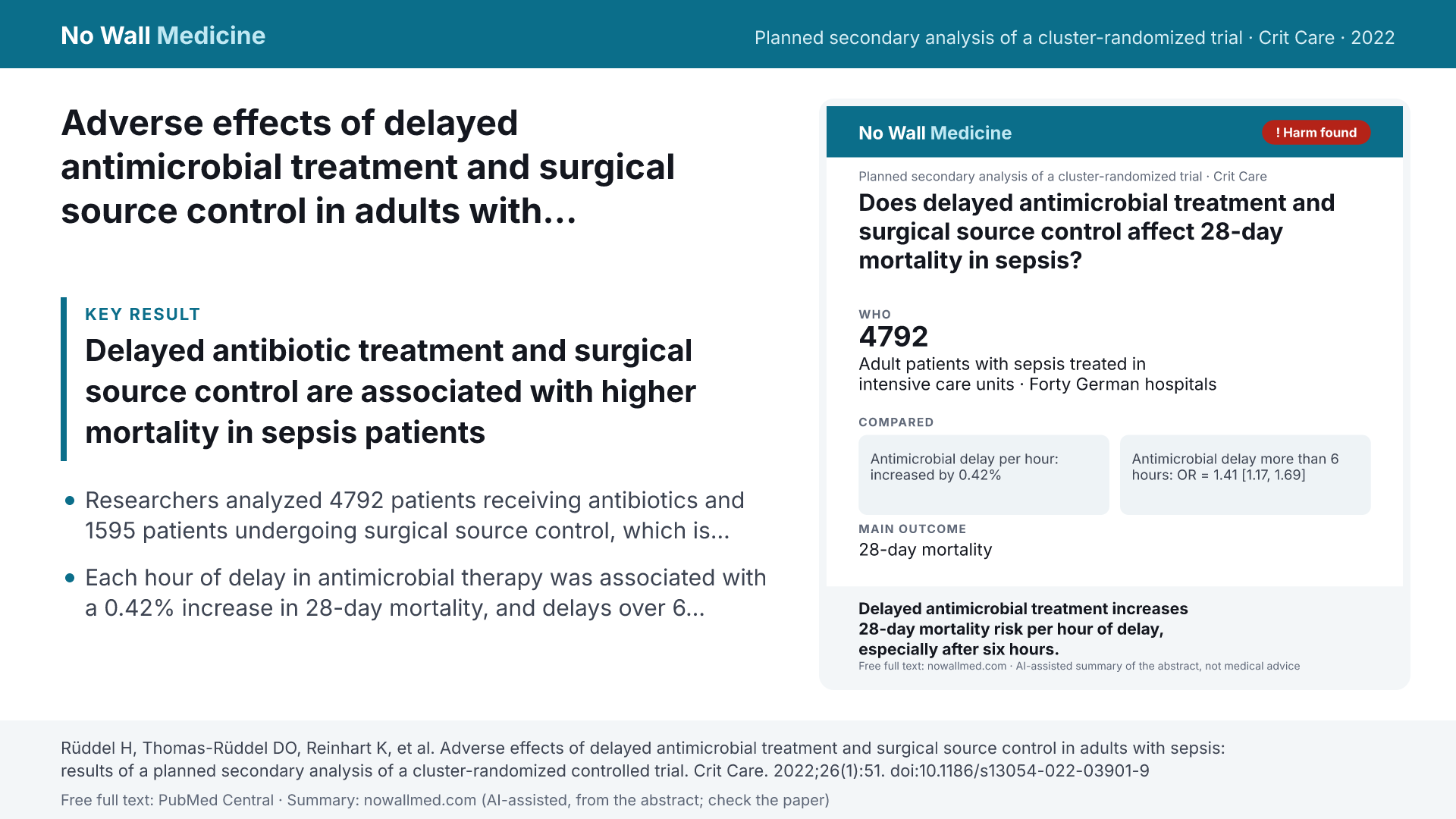
Delayed antibiotic treatment and surgical source control are associated with higher mortality in sepsis patients
Adverse effects of delayed antimicrobial treatment and surgical source control in adults with sepsis: results of a planned secondary analysis of a cluster-randomized controlled trial
Planned secondary analysis of a cluster-randomized trialHarm found
Does delayed antimicrobial treatment and surgical source control affect 28-day mortality in sepsis?
Who
4792
Adult patients with sepsis treated in intensive care units · Forty German hospitals
Compared
Antimicrobial delay per hour: increased by 0.42%
Antimicrobial delay more than 6 hours: OR = 1.41 [1.17, 1.69]
Main outcome
28-day mortality
Result: OR 1.019 (95% CI 1.01 to 1.028)
Bottom line: Delayed antimicrobial treatment increases 28-day mortality risk per hour of delay, especially after six hours.
Limitation: The analysis of surgical source control was not significant when adjusted for confounders.
Crit Care · 2022-02-28 · Save PNG
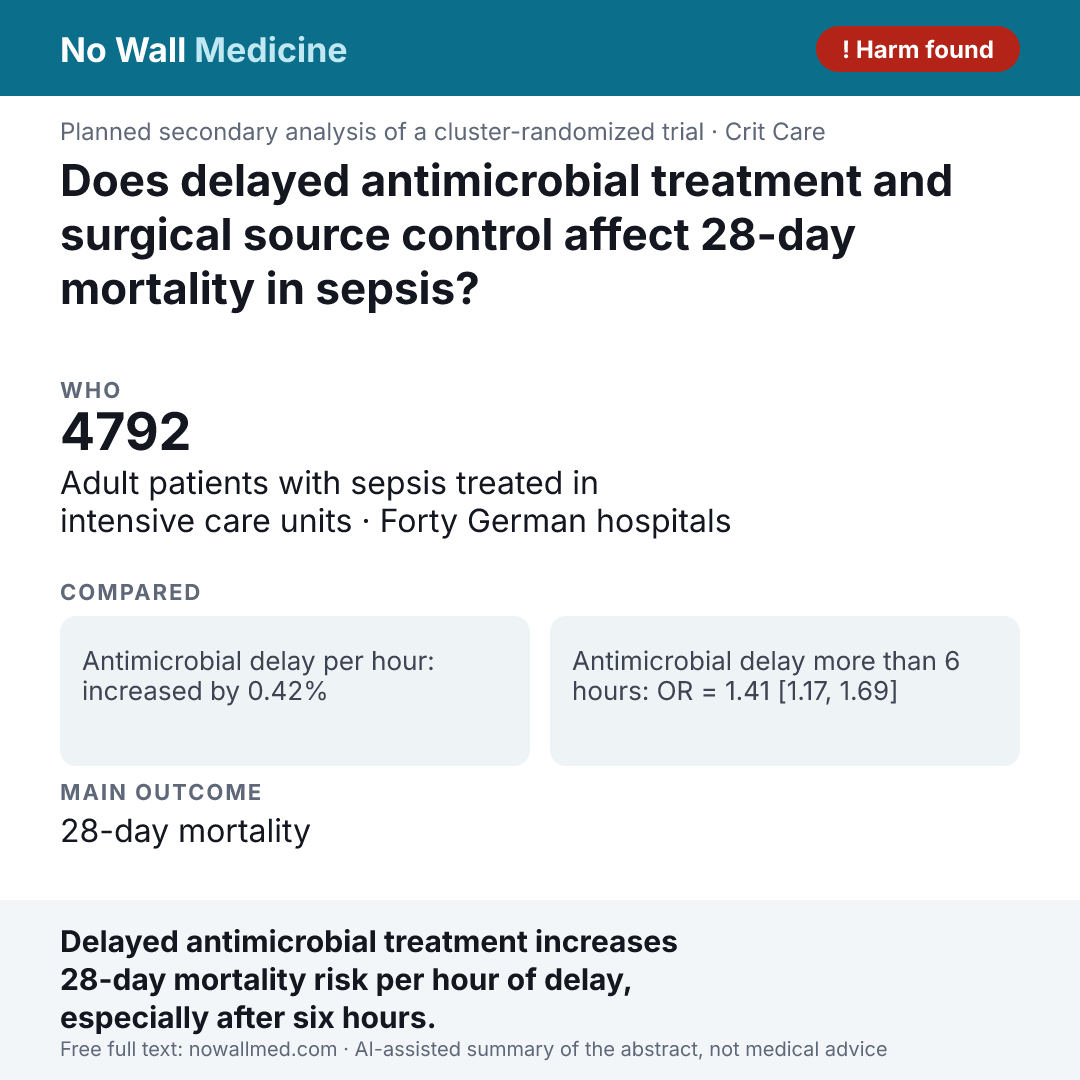
Clinical question: Does delayed antimicrobial treatment and surgical source control affect 28-day mortality in sepsis?
Key points
- Researchers analyzed 4792 patients receiving antibiotics and 1595 patients undergoing surgical source control, which is the physical removal of an infection source, in forty German hospitals.
- Each hour of delay in antimicrobial therapy was associated with a 0.42% increase in 28-day mortality, and delays over 6 hours were associated with an odds ratio of 1.41.
- Delayed antibiotics were associated with an increased risk of progressing from severe sepsis to septic shock, with an odds ratio of 1.051 per hour.
Headline and key points written with AI from the paper’s abstract, with every number checked against it. Read the paper before relying on them.
Was this summary helpful?
Subject terms
Headline, design, result, key points, caveat and citation as plain text.
Cite this article
Rüddel H, Thomas-Rüddel DO, Reinhart K, et al. Adverse effects of delayed antimicrobial treatment and surgical source control in adults with sepsis: results of a planned secondary analysis of a cluster-randomized controlled trial. Crit Care. 2022;26(1):51. doi:10.1186/s13054-022-03901-9
Spotted a mistake? Suggest a correction