Meta-analysis shows common complications following endoscopic retrograde cholangiopancreatography procedures
Adverse Events Associated With Endoscopic Retrograde Cholangiopancreatography: Systematic Review and Meta-Analysis
Systematic review and meta-analysisMixed results
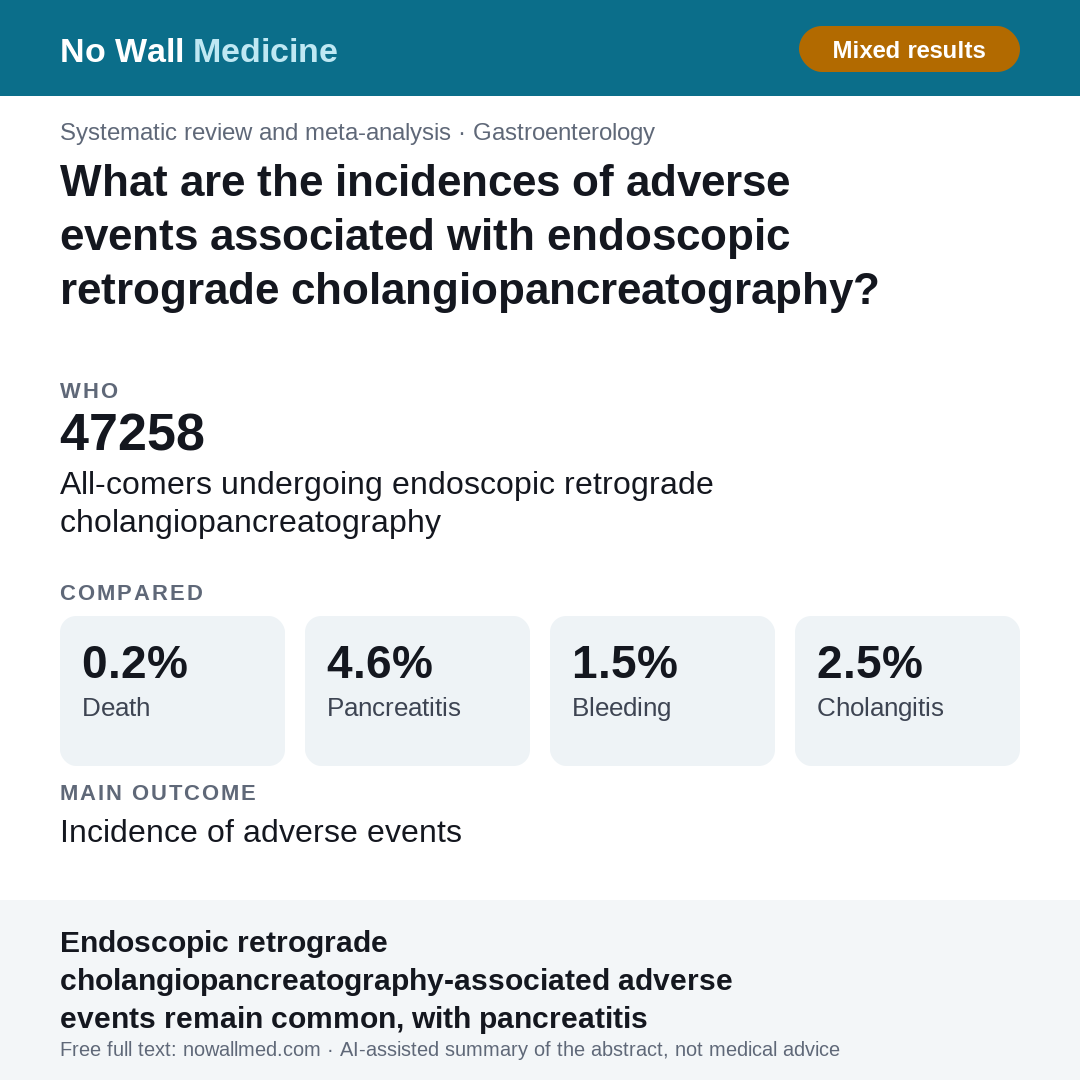
What are the incidences of adverse events associated with endoscopic retrograde cholangiopancreatography?
Who
47258
All-comers undergoing endoscopic retrograde cholangiopancreatography
Compared
0.2%Death (95% confidence interval 0.1%-0.3%)
4.6%Pancreatitis (95% CI, 4.0%-5.1%)
1.5%Bleeding (95% CI, 1.2%-1.7%)
2.5%Cholangitis (95% CI, 1.9%-3.3%)
Main outcome
Incidence of adverse events
Bottom line: Endoscopic retrograde cholangiopancreatography-associated adverse events remain common, with pancreatitis incidence remaining stable over time.
Gastroenterology · 2024-11-07Download image
Clinical question: What are the incidences of adverse events associated with endoscopic retrograde cholangiopancreatography?
Why it matters: The specific rates and temporal trends of complications following endoscopic retrograde cholangiopancreatography were not clearly established.
Key points
- Researchers analyzed 380 studies involving 47,258 patients to determine the incidence of complications from endoscopic retrograde cholangiopancreatography, a procedure used to examine bile and pancreatic ducts.
- The overall incidence of pancreatitis was 4.6% among all patients and 6.5% among first-time patients, while the death rate was 0.2%.
- Other reported complications included cholangitis at 2.5%, bleeding at 1.5%, cholecystitis at 0.8%, and perforation at 0.5%.
Headline and key points written with AI from the paper’s abstract, with every number checked against it. Read the paper before relying on them.
Topics
Cite this article
Bishay K, Meng ZW, Khan R, Gupta M, Ruan Y, Vaska M. Adverse Events Associated With Endoscopic Retrograde Cholangiopancreatography: Systematic Review and Meta-Analysis. Gastroenterology. 2024. doi:10.1053/j.gastro.2024.10.033
Spotted a mistake? Suggest a correction
Top studies every Monday
The week’s key trials and guidelines in your specialties, plus any topics you follow. By email, free.
Get the weekly digest