Experts cannot recommend for or against computer-aided detection during colonoscopy due to low certainty evidence
AGA Living Clinical Practice Guideline on Computer-Aided Detection-Assisted Colonoscopy
AGA clinical practice guidelineUnclear result
Should computer-aided detection systems be used during colonoscopy for colorectal polyp detection?
Who
Patients undergoing colonoscopy
Compared
Computer-aided detection assisted colonoscopy: 8% (95% CI, 6%-10%) increase in adenoma detection rate
Standard colonoscopy
Main outcome
Colorectal cancer, cancer deaths, and adenoma detection rates
Bottom line: No recommendation can be made due to very low certainty of evidence regarding benefits and harms.
Limitation: Very low certainty of evidence for critical outcomes and close tradeoff between effects.
Gastroenterology · 2025-03-23Download image
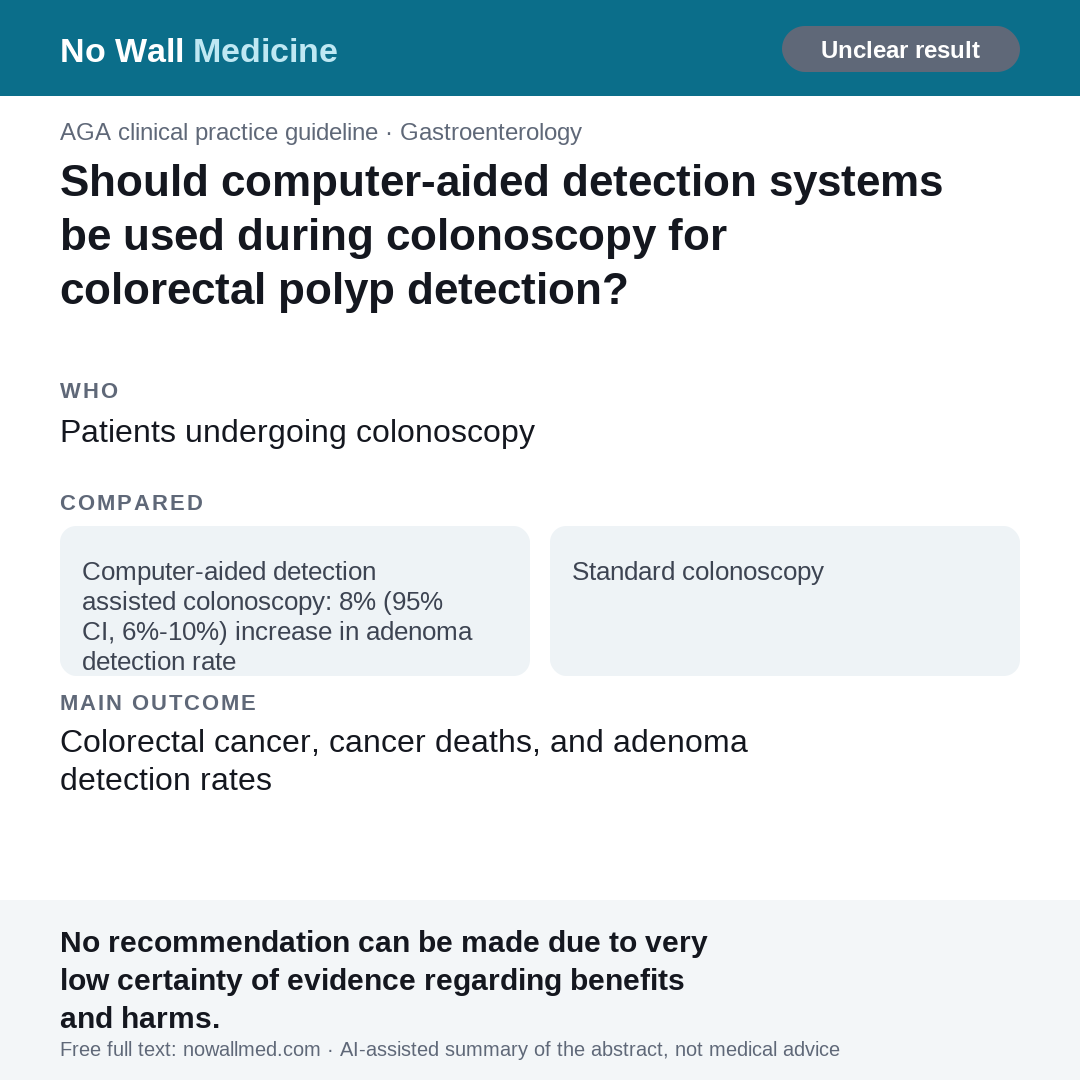
Clinical question: Should computer-aided detection systems be used during colonoscopy for colorectal polyp detection?
Why it matters: It is unknown if the benefits of computer-aided detection for polyp detection outweigh the increased burden of surveillance colonoscopies and resource implications.
Key points
- A multidisciplinary panel reviewed systematic reviews and microsimulation studies regarding computer-aided detection (CADe) systems used to find polyps during colonoscopies.
- The panel noted an 8% (95% CI, 6%-10%) increase in adenoma detection rate and a 2% (95% CI, 0%-4%) increase in advanced adenoma or sessile serrated lesion detection.
- Potential benefits of 11 fewer colorectal cancers and 2 fewer deaths per 10,000 individuals were balanced against 635 more intensive surveillance colonoscopies per 10,000 individuals.
Headline and key points written with AI from the paper’s abstract, with every number checked against it. Read the paper before relying on them.
Topics
Cite this article
Sultan S, Shung DL, Kolb JM, Foroutan F, Hassan C, Kahi CJ. AGA Living Clinical Practice Guideline on Computer-Aided Detection-Assisted Colonoscopy. Gastroenterology. 2025. doi:10.1053/j.gastro.2025.01.002
Spotted a mistake? Suggest a correction
Top studies every Monday
The week’s key trials and guidelines in your specialties, plus any topics you follow. By email, free.
Get the weekly digest