Age affects the benefit of mechanical clot removal for stroke patients in Brazil
Age Is an Effect Modifier of Thrombectomy Benefit in a Socioeconomically Vulnerable Stroke Population
Randomized, controlled trial subgroup analysisMixed results
Does age modify the benefit of endovascular treatment in large vessel occlusion stroke?
Who
221
Patients with anterior circulation large vessel occlusion stroke in Brazil · Multicenter, public healthcare system in Brazil
Compared
Non-elderly patients (<70 years): OR: 4.08 (95% CI: 1.71-9.76)
Elderly patients (≥70 years): OR: 0.90 (95% CI: 0.17-5.42)
Very elderly patients (≥80 years): OR: 0.36 (95% CI: 0.11-3.21)
Main outcome
Functional independence at 90 days
Result: pinteraction = 0.03
Bottom line: Endovascular treatment benefit is substantial in non-elderly patients but significantly diminished in elderly and very elderly patients.
Limitation: Further studies are needed to understand the mechanism underlying these findings.
Ann Neurol · 2026-07-24Download image
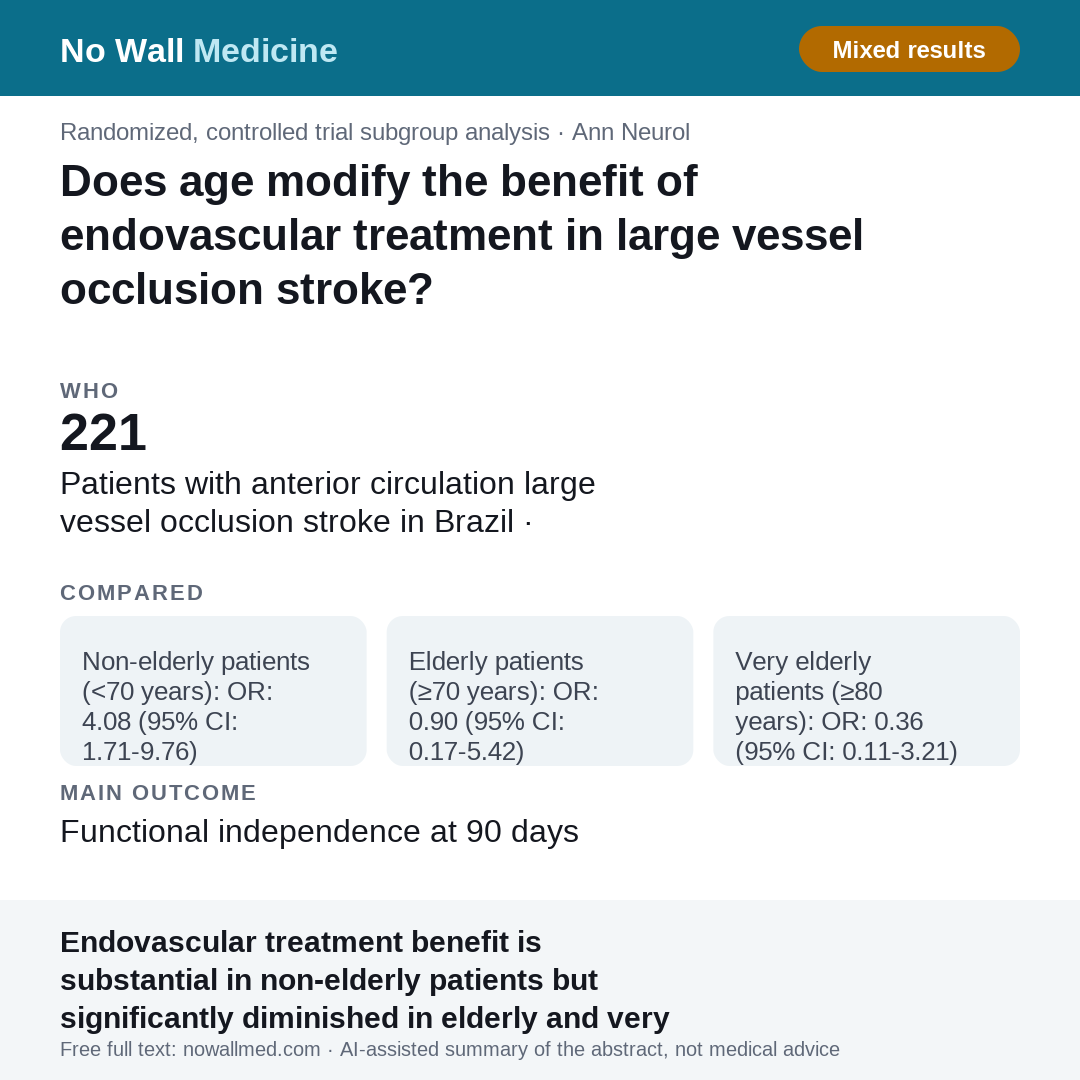
Clinical question: Does age modify the benefit of endovascular treatment in large vessel occlusion stroke?
Why it matters: Evidence is scarce regarding how age affects the benefits of mechanical clot removal in low and middle-income countries.
Key points
- Researchers analyzed 221 patients with large vessel occlusion stroke to compare mechanical clot removal against medical treatment alone.
- Non-elderly patients saw a benefit with mechanical clot removal (odds ratio: 4.08), but the benefit was smaller in elderly (odds ratio: 0.90) and very elderly (odds ratio: 0.36) groups.
- Increasing age was independently associated with lower odds of functional independence in the entire study population (odds ratio: 0.97).
Headline and key points written with AI from the paper’s abstract, with every number checked against it. Read the paper before relying on them.
Topics
Cite this article
Lima FO, Mont'Alverne FJA, Rebello LC, Abud DG, Silva GS, Frudit ME. Age Is an Effect Modifier of Thrombectomy Benefit in a Socioeconomically Vulnerable Stroke Population. Ann Neurol. 2026. doi:10.1002/ana.78281
Spotted a mistake? Suggest a correction