Molecular imaging agrees moderately with adrenal vein sampling for localization
Agreement Between Molecular Imaging and Adrenal Vein Sampling for Localization in Primary Aldosteronism: A Systematic Review
Systematic reviewMixed results
How well does molecular imaging agree with adrenal vein sampling for localization?
Who
Patients with primary aldosteronism
Compared
Molecular imaging
Adrenal vein sampling
Main outcome
Agreement for localization in primary aldosteronism
Result: positive percent agreement 0.6 to 0.9, negative percent agreement 0.5 to 0.9
Bottom line: Molecular imaging shows moderate and variable agreement with adrenal vein sampling for localization in primary aldosteronism.
Limitation: Heterogeneity in tracer protocols, patient preparation, and test interpretation prevented quantitative pooling.
J Am Heart Assoc · 2026-05-29Download image
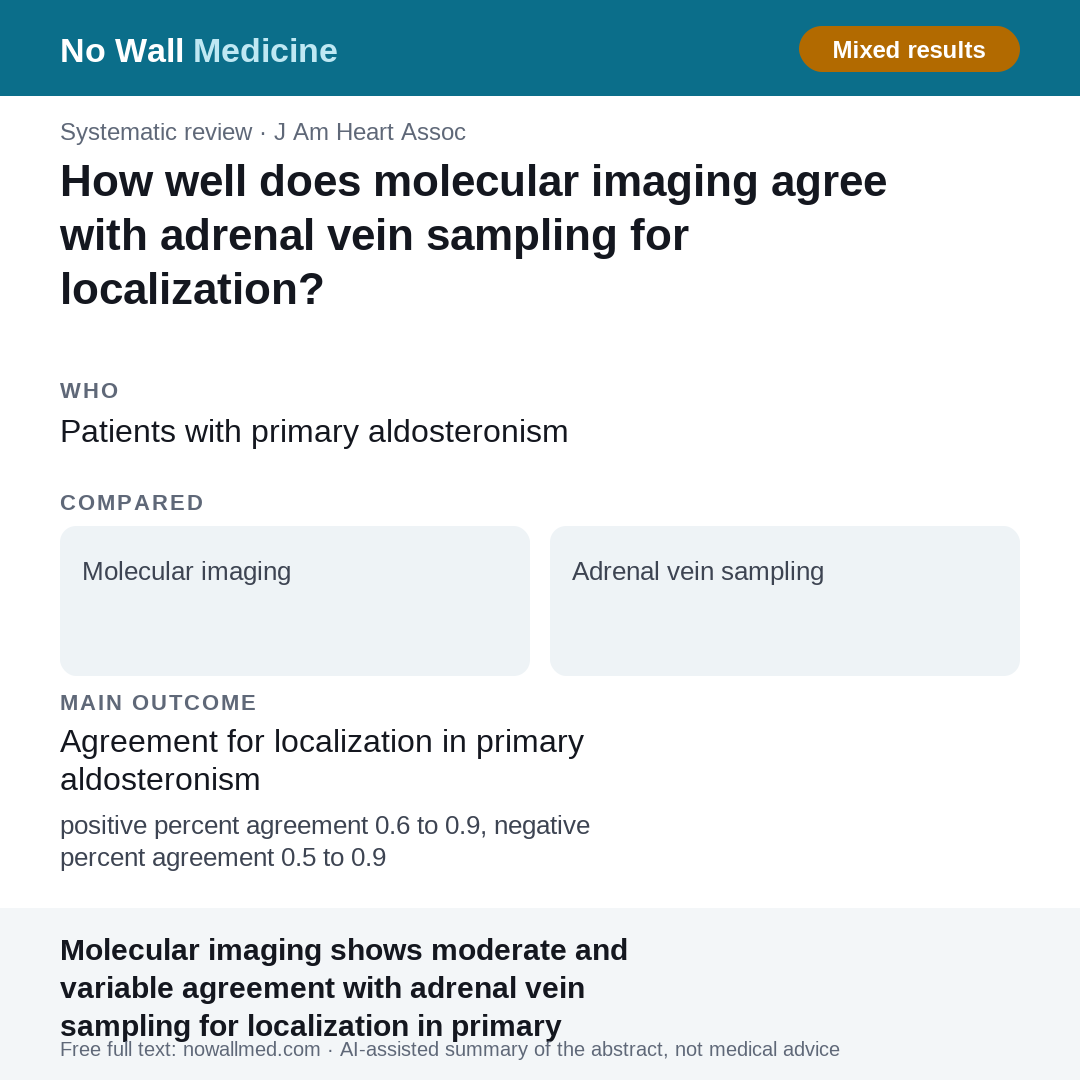
Clinical question: How well does molecular imaging agree with adrenal vein sampling for localization?
Why it matters: Doctors have had limited noninvasive alternatives to adrenal vein sampling for localization testing
Key points
- Twenty studies compared molecular imaging with adrenal vein sampling in primary aldosteronism patients.
- Agreement between modalities was moderate, with positive percent agreement values ranging from 0.6 to 0.9.
- Cohen's κ values indicated moderate-to-strong agreement beyond chance, ranging from 0.33 to 0.93.
Limitation the authors note: Patient outcome-based studies are still needed to define the clinical utility of molecular imaging
Headline and key points written with AI from the paper’s abstract, with every number checked against it. Read the paper before relying on them.
Abstract
Background
Primary aldosteronism is a common cause of hypertension that is curable via surgery when localized to a single adrenal gland. Localization testing has traditionally relied upon adrenal vein sampling (AVS); however, molecular imaging has emerged as a promising noninvasive alternative.Methods
We performed a systematic synthesis of studies comparing molecular imaging with AVS for localization in primary aldosteronism. Studies directly comparing both modalities with prespecified AVS localization criteria were eligible. Agreement was evaluated using positive percent agreement, negative percent agreement, and, where available, Cohen's κ. Because molecular imaging tracers differ in biological targets and interpretation criteria, agreement metrics were examined by tracer rather than pooled. Sensitivity analyses repeated positive percent agreement and negative percent agreement calculations using molecular imaging as the reference.Results
Twenty studies were included. Across tracers, agreement between molecular imaging and AVS was moderate, with positive percent agreement values ranging from 0.6 to 0.9 and negative percent agreement from 0.5 to 0.9. Cohen's κ values ranged from 0.33 to 0.93, indicating moderate-to-strong agreement beyond chance. Each tracer was assessed separately; direct comparisons between tracers were not performed, and quantitative pooling was not undertaken because of heterogeneity in tracer protocols, patient preparation, and test interpretation. Reciprocal analyses yielded similar positive percent agreement and negative percent agreement distributions, with no consistent directional bias between modalities.Conclusions
Molecular imaging shows moderate and variable agreement with AVS for localization testing in primary aldosteronism, suggesting complementary rather than competing roles. Molecular imaging may serve as an adjunct or alternative within diagnostic algorithms; however, patient outcome-based studies are still needed to define its clinical utility.
Abstract reproduced under the article’s CC BY-NC-ND licence.
Topics
Spotted a mistake? Suggest a correction
More in Cardiology
Clonal hematopoiesis mutations linked to higher atrial fibrillation risk in cancer populations
Association of Clonal Hematopoiesis Mutations With Incident Atrial Fibrillation: A Systematic Review and Meta-Analysis
Deep learning model detects aortic stenosis from finger-cuff pressure waveforms accurately
Aortic Valve Stenosis Screening Using Deep Learning on Noninvasive Arterial Pressure Waveforms
Spontaneous coronary artery dissection affects younger women more often than expected
Spontaneous coronary artery dissection: implications for women's health, clinical care, and future research
Early lipid-lowering strategies may reduce atherosclerotic cardiovascular disease risk
Lipid-Lowering Strategies in the Era of Early Atherosclerosis Detection: 2026 ACC Scientific Statement: A Report of the American College of Cardiology