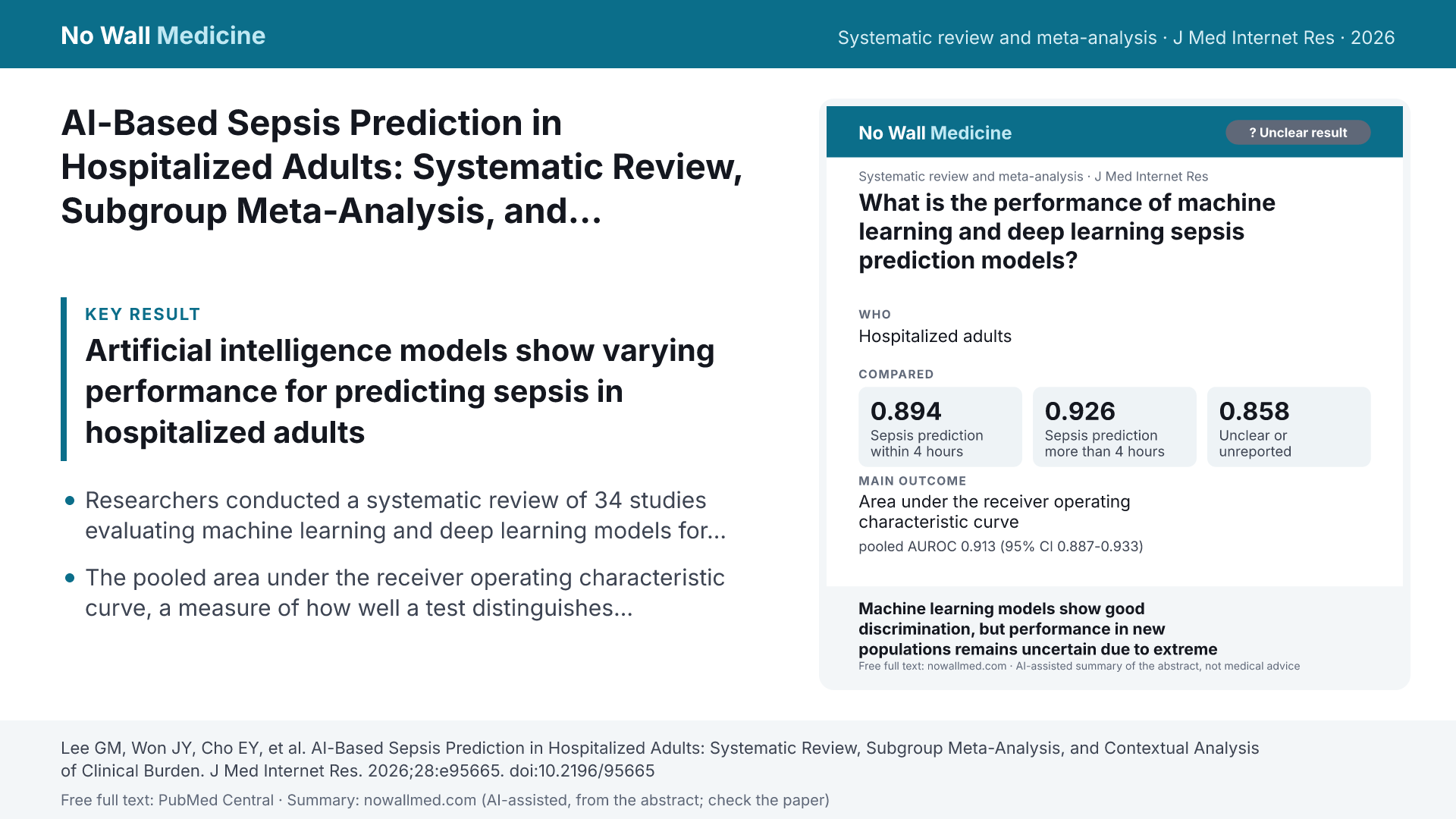
Artificial intelligence models show varying performance for predicting sepsis in hospitalized adults
AI-Based Sepsis Prediction in Hospitalized Adults: Systematic Review, Subgroup Meta-Analysis, and Contextual Analysis of Clinical Burden
Systematic review and meta-analysisUnclear result
What is the performance of machine learning and deep learning sepsis prediction models?
Who
Hospitalized adults
Compared
0.894Sepsis prediction within 4 hours (95% CI 0.829-0.936)
0.926Sepsis prediction more than 4 hours before onset (95% CI 0.897-0.948)
0.858Unclear or unreported prediction windows (95% CI 0.581-0.964)
Main outcome
Area under the receiver operating characteristic curve
Result: pooled AUROC 0.913 (95% CI 0.887-0.933)
Bottom line: Machine learning models show good discrimination, but performance in new populations remains uncertain due to extreme heterogeneity and limited prospective evaluation.
Limitation: Extreme heterogeneity, overlapping public data, inconsistent reporting, and limited prospective evaluation.
J Med Internet Res · 2026-09-17 · Save PNG
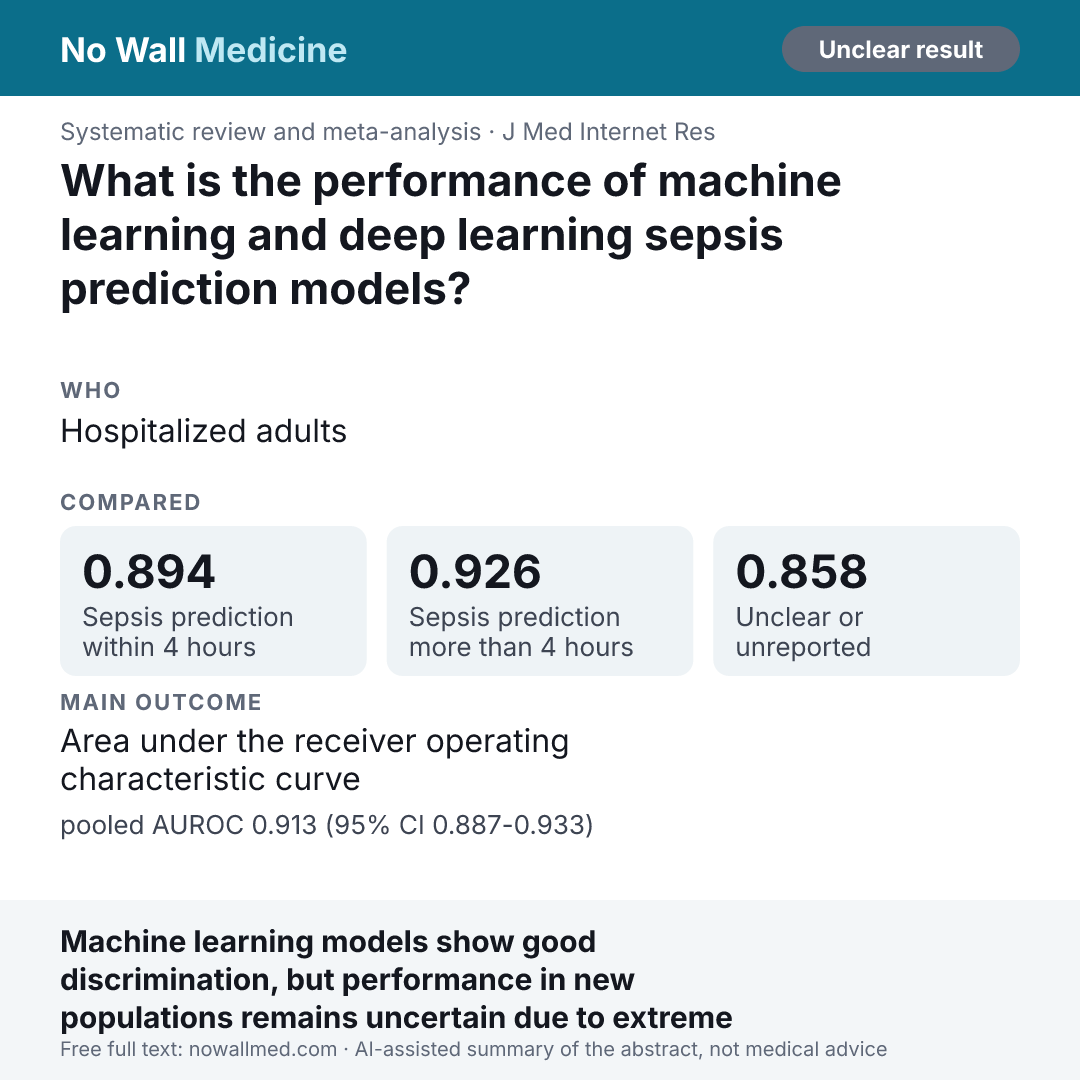
Clinical question: What is the performance of machine learning and deep learning sepsis prediction models?
Why it matters: Reported performance for sepsis prediction models varies across different datasets, prediction windows, and care settings, making a single performance estimate uncertain.
Key points
- Researchers conducted a systematic review of 34 studies evaluating machine learning and deep learning models for sepsis prediction in hospitalized adults.
- The pooled area under the receiver operating characteristic curve, a measure of how well a test distinguishes between groups, was 0.913.
- Subgroup analyses showed pooled scores of 0.894 for predictions within 4 hours and 0.926 for predictions more than 4 hours before onset.
Limitation the authors note: The studies included many retrospective designs and reused several public datasets, meaning the reports did not represent 34 fully independent patient populations.
Headline and key points written with AI from the paper’s abstract, with every number checked against it. Read the paper before relying on them.
Was this summary helpful?
Subject terms
Headline, design, result, key points, caveat and citation as plain text.
Cite this article
Lee GM, Won JY, Cho EY, et al. AI-Based Sepsis Prediction in Hospitalized Adults: Systematic Review, Subgroup Meta-Analysis, and Contextual Analysis of Clinical Burden. J Med Internet Res. 2026;28:e95665. doi:10.2196/95665
Spotted a mistake? Suggest a correction