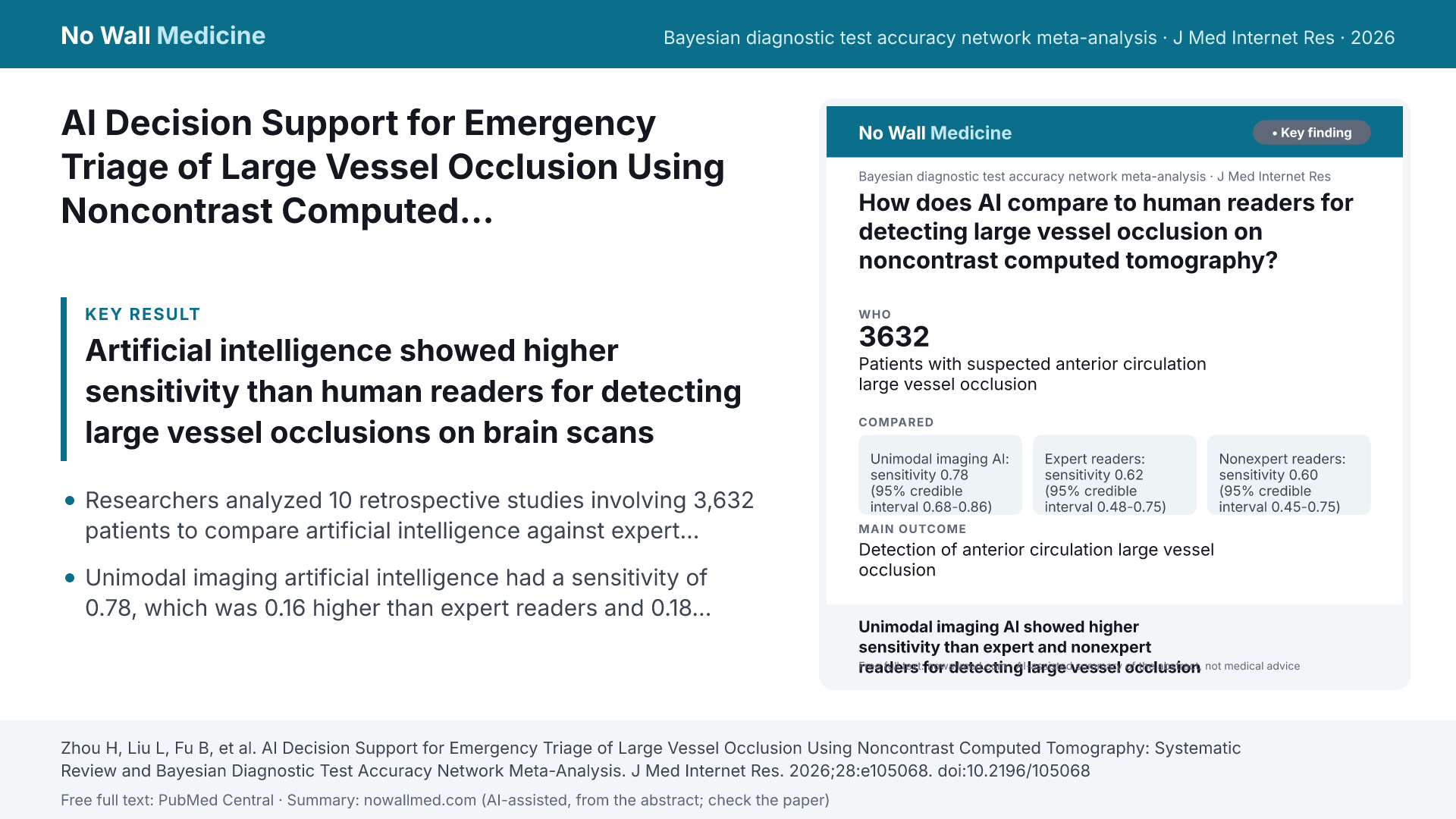
Artificial intelligence showed higher sensitivity than human readers for detecting large vessel occlusions on brain scans
AI Decision Support for Emergency Triage of Large Vessel Occlusion Using Noncontrast Computed Tomography: Systematic Review and Bayesian Diagnostic Test Accuracy Network Meta-Analysis
Bayesian diagnostic test accuracy network meta-analysisKey finding
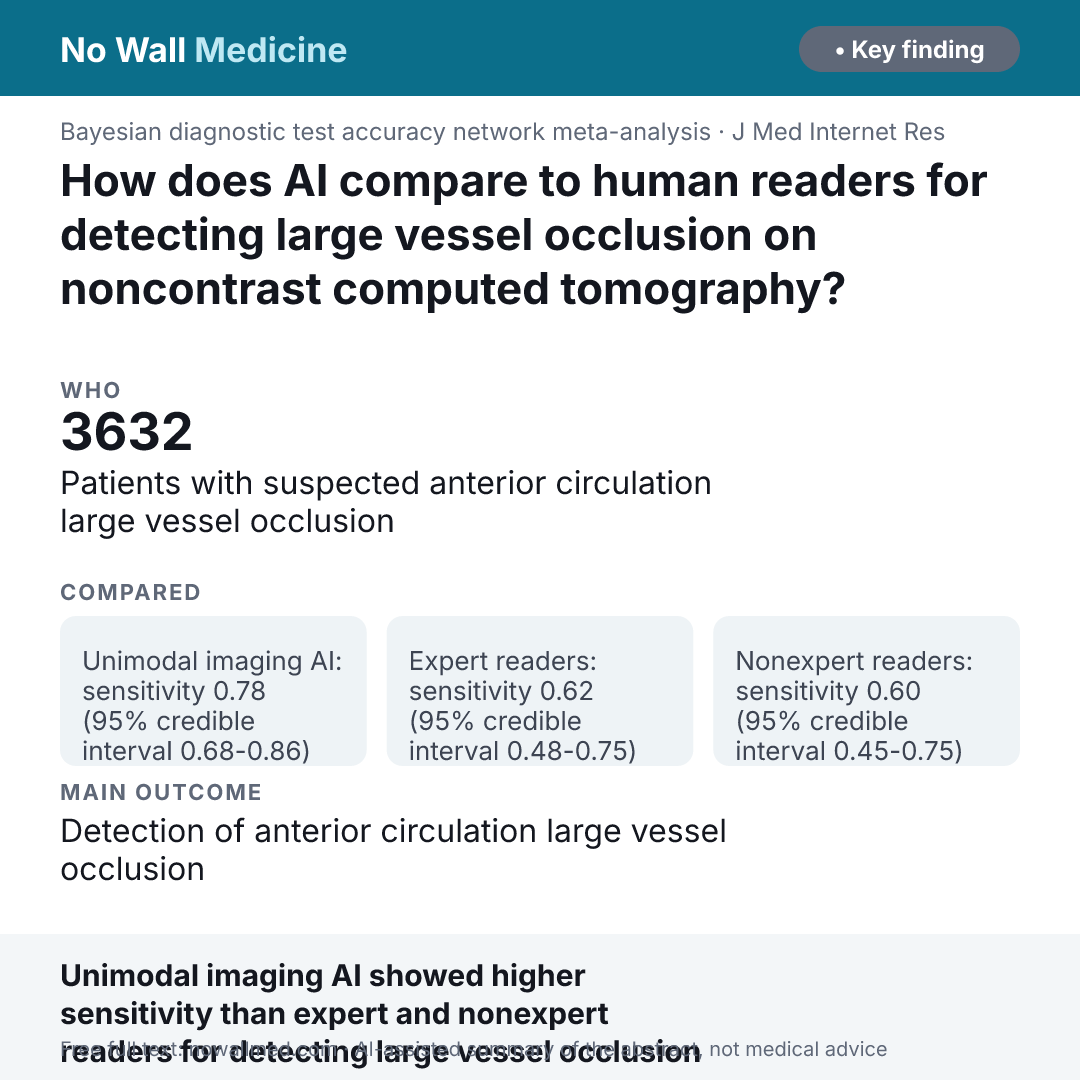
How does AI compare to human readers for detecting large vessel occlusion on noncontrast computed tomography?
Who
3632
Patients with suspected anterior circulation large vessel occlusion
Compared
Unimodal imaging AI: sensitivity 0.78 (95% credible interval 0.68-0.86)
Expert readers: sensitivity 0.62 (95% credible interval 0.48-0.75)
Nonexpert readers: sensitivity 0.60 (95% credible interval 0.45-0.75)
Main outcome
Detection of anterior circulation large vessel occlusion
Result: sensitivity difference 0.16 (95% credible interval 0.03-0.29) vs experts
Bottom line: Unimodal imaging AI showed higher sensitivity than expert and nonexpert readers for detecting large vessel occlusion in retrospective studies.
Limitation: Evidence is accuracy based and does not establish workflow effectiveness or functional outcome benefit.
J Med Internet Res · 2026-09-24 · PROSPERO CRD420261362111
Why it matters: Detecting large vessel occlusions on initial brain scans is difficult outside of specialist settings and is often delayed by vascular imaging and specialist interpretation.
Headline and visual abstract written with AI from the paper’s abstract, with every number checked against it. Read the paper before relying on them.
Was this summary helpful?
Subject terms
Cite this article
Zhou H, Liu L, Fu B, et al. AI Decision Support for Emergency Triage of Large Vessel Occlusion Using Noncontrast Computed Tomography: Systematic Review and Bayesian Diagnostic Test Accuracy Network Meta-Analysis. J Med Internet Res. 2026;28:e105068. doi:10.2196/105068
Spotted a mistake? Suggest a correction